

Running maintenance across multiple facilities is like conducting an orchestra where half the musicians can't read the same sheet music. Each site develops its own shortcuts, interprets policies differently, and before long, your corporate maintenance standards exist only in PowerPoint decks that nobody opens.
I watched this unfold at a retail chain with 47 locations. Their maintenance governance framework was a 200-page manual that regional managers ignored and site technicians had never seen. Critical equipment failed at three locations in one month because preventive maintenance schedules weren't standardized. One site was doing monthly filter changes, another quarterly, and a third only when equipment actually broke. Corporate had no real visibility into any of it.
The problem wasn't the manual or even the technicians. It was the complete absence of any systematic approach to rolling out and enforcing standards across sites. Without clear roles, regular check-ins, and actual enforcement, each location ends up operating as its own maintenance island.
Why maintenance standards fragment across locations
Most multi-site operations start with good intentions. Corporate develops maintenance policies, sends them out via email, maybe runs a training session, then assumes implementation will follow. It rarely does.
What unfolds is more complicated. Site managers face immediate pressures that corporate doesn't see. A location running short-staffed will skip preventive maintenance to handle emergency repairs. A site with an experienced maintenance supervisor might develop better processes than corporate ever put in writing, but those improvements never spread anywhere else. Meanwhile, new hires at various sites get different training depending on whoever happens to be available that week.
The fragmentation accelerates when sites use different contractors. One location's HVAC vendor recommends monthly coil cleaning, another says quarterly is fine. Without central governance, each site just follows whatever their local vendor suggests, creating a patchwork of practices that makes benchmarking performance or controlling costs almost impossible.
Regional managers, who should be enforcing standards, often lack maintenance expertise. They focus on sales metrics and customer complaints, not equipment reliability. When a chiller fails, they call corporate for emergency funding. Nobody connects the dots between inconsistent maintenance and those expensive failures.
The hidden costs of governance gaps
Poor maintenance governance creates cascading problems that most organizations never track properly. Equipment lifecycle varies wildly between locations running identical assets. A properly maintained rooftop unit might last 18 years at one site while an identical unit fails after 12 years at another location following different practices.
Eliminate downtime with proactive maintenance.
Openfixit helps you plan, track, and complete maintenance efficiently—maximizing asset reliability.
- Centralized asset management
- Automated maintenance scheduling
- Inventory and parts tracking
No credit card required
These variations make capital planning nearly impossible. Corporate budgets for equipment replacement based on manufacturer specs, but actual replacement needs depend entirely on how well maintenance is being done locally. Sites with poor practices need replacements 30-40% sooner, blowing holes in capital budgets and forcing reactive spending.
Labor efficiency takes a hit too. When technicians transfer between sites, they waste time learning local variations of what should be standard procedures. A technician might know three different ways to document the same repair depending on which site they're at. That confusion leads to incomplete work orders, missed PM steps, and eventually more equipment failures.
Vendor management becomes expensive chaos. Without standardized requirements and oversight, each site negotiates separate contracts with local vendors. The same company might charge one location $180/hour for emergency HVAC work while billing another site $140/hour for identical services. Across a 50-site operation, those pricing variations alone can add $200k-$300k annually.
Insurance and compliance create another layer of risk. Inconsistent maintenance documentation makes it hard to prove proper care during insurance claims. One healthcare facility network lost a $450k insurance claim because three sites couldn't produce consistent maintenance records for failed chillers. The insurance company argued negligent maintenance, and the scattered documentation across sites made it impossible to prove otherwise.
Building your maintenance governance framework
A functional maintenance governance framework needs four core components working together: role definitions, meeting rhythms, enforcement mechanisms, and migration planning. Miss any one of them and the whole system breaks down.
Start with role clarity at three levels. Site-level roles handle daily execution and local compliance. Regional roles monitor performance patterns and enforce standards across their territories. Corporate roles set policy, manage exceptions, and drive continuous improvement. Each level needs specific responsibilities, not vague mandates about "ensuring quality maintenance."
-
Site-level roles handle daily execution and local compliance.
-
Regional roles monitor performance patterns and enforce standards across their territories.
-
Corporate roles set policy, manage exceptions, and drive continuous improvement.
Site-level maintenance roles
Your site maintenance lead becomes the linchpin of local execution. This person owns daily work order management, ensures preventive maintenance completion, and serves as the first escalation point for technician questions. They need real authority to make decisions about work prioritization within defined parameters.
Create a site maintenance coordinator role, even if it's a partial responsibility for someone with other duties. This person handles vendor coordination, parts ordering, and documentation. They maintain the local maintenance log and make sure work orders get closed properly with required documentation.
Designate a compliance checker—often a senior technician who reviews completed work against standards. They spot-check PM tasks, verify documentation quality, and flag deviations before they become patterns.
Regional oversight structure
Regional maintenance managers need different skills than site supervisors. They analyze patterns across sites, identify systemic issues, and coach site teams on standard implementation. Give them specific metrics to monitor: preventive maintenance completion rates, emergency work order ratios, documentation compliance scores.
These regional managers should spend 60-70% of their time in the field, not behind desks. They need to observe actual maintenance practices, not just review reports. During site visits, they audit random work orders, watch technician procedures, and verify that documented work matches what's actually happening.
Create regional vendor managers who standardize contractor relationships across sites. They negotiate master service agreements, establish uniform pricing, and monitor vendor performance across locations. This role alone can reduce maintenance contractor costs by 15-25% within the first year.
Corporate governance team
Your corporate maintenance governance team sets policy but must stay connected to field reality. Include a standards manager who owns policy documentation and updates. This person translates field feedback into policy improvements and keeps standards grounded in operational reality, not theoretical best practices.
Add a training coordinator who develops standardized training modules and certification requirements. They create role-specific training paths and track completion across all sites. When new equipment or procedures roll out, consistent training delivery is their responsibility.
Include a systems analyst who monitors maintenance data across the portfolio. They identify outliers, benchmark site performance, and provide data-driven recommendations for standard updates. This role bridges the gap between field operations and corporate decision-making.
Meeting cadences that actually work
Governance fails without regular, structured communication. But drowning people in meetings kills productivity. You need the right rhythm at each level.
Weekly site huddles
Site teams need brief weekly maintenance huddles—15 minutes maximum. Review last week's emergency work orders, preview upcoming preventive maintenance, and flag any resource constraints. Keep these tactical and action-focused.
Keep meeting agendas time-boxed and shared in advance.
Document decisions in a simple template: issues raised, decisions made, actions assigned. This creates an audit trail without excessive administrative burden. When problems escalate, you have documentation showing when issues first appeared and what site teams did about them.
Biweekly regional reviews
Regional managers should review site performance biweekly with their site leads. Focus on metrics trends, not individual work orders. Are emergency rates climbing? Is preventive maintenance completion dropping? What obstacles are sites running into?
These reviews identify patterns that need corporate attention. When three sites report similar contractor issues, that's a regional problem needing a standardized solution. When one site consistently outperforms others, their practices might improve the entire region.
Use a standard agenda: safety issues first, then critical equipment status, preventive maintenance adherence, contractor performance, and resource needs. Limit each topic to five minutes unless escalation is needed.
Monthly governance boards
Monthly governance boards bring together regional managers and corporate teams. Review portfolio-wide metrics, discuss policy exceptions, and make decisions about standard updates. These meetings drive strategic improvements, not tactical firefighting.
Structure sessions around decision points, not status updates. Present data in advance so meeting time focuses on discussion and decisions. Common agenda items: policy exception requests, vendor performance issues requiring corporate intervention, training needs analysis, and capital planning adjustments based on maintenance trends.
Track decisions and follow up relentlessly. Nothing undermines governance faster than decisions that never get implemented. Assign every decision an owner and deadline, then review progress at the next meeting.
Quarterly site assessments
Every quarter, regional managers should conduct detailed site assessments. These go beyond routine visits—they're comprehensive reviews of maintenance practices, documentation, and compliance. Use a standardized scoring system that evaluates preventive maintenance execution, work order documentation quality, safety compliance, vendor management, and inventory control.
Share results transparently. Sites need to see how they compare to peers and understand specific improvement areas. Create improvement plans for underperforming sites with specific milestones and real support resources behind them.
Enforcement without becoming the maintenance police
Standards without enforcement are just suggestions. But heavy-handed enforcement creates resentment and workarounds. You need balanced approaches that drive compliance while keeping site teams actually engaged.
Start with positive reinforcement. Publicly recognize sites that hit high compliance scores. Share their best practices across the portfolio. When a site develops an innovative solution, incorporate it into standards and credit the source. This creates ownership instead of resistance.
Build escalating interventions for non-compliance. First occurrence triggers coaching and support. Second occurrence requires a documented improvement plan. Third occurrence involves regional manager intervention and possible resource reallocation. Make consequences predictable and consistent.
Create financial incentives tied to maintenance governance metrics. Link site manager bonuses partially to preventive maintenance completion rates and documentation compliance. Even small percentages—5-10% of variable compensation—drive real behavior change.
Use technology for passive enforcement. Modern maintenance platforms can lock out work order closure until required fields are complete. They automatically escalate overdue preventive maintenance tasks. They flag when sites deviate from standard procedures. This removes personal conflict from enforcement while still maintaining standards.
The audit and feedback loop
Regular audits reveal what's really happening versus what's being reported. But audits shouldn't feel like gotcha exercises. Frame them as health checks that help sites improve.
Rotate audit responsibility between regional managers. This prevents sites from gaming the system around one specific person's preferences. Use standardized checklists covering work order documentation, preventive maintenance execution, safety compliance, vendor management practices, and inventory accuracy.
Share audit results within 48 hours while details are still fresh. Include specific examples of both good and poor practices. Provide clear correction requirements with deadlines. Then follow up to verify corrections actually happened.
Create an appeals process for audit findings. Sometimes sites have legitimate reasons for deviations—local regulations requiring different procedures, or site-specific equipment needing modified maintenance schedules. Document approved exceptions to prevent future audit conflicts.
Ready-to-deploy policy templates
Generic maintenance policies fail because they don't account for operational realities. You need templates that sites can actually implement.
Work order standardization template
Create work order templates for common tasks that enforce documentation standards while staying practical. Required fields should include equipment ID, problem description, work performed, parts used, and time spent. Add outcome fields too: did the repair resolve the issue? Are follow-up actions needed? That information helps identify recurring problems before they become expensive patterns.
Build approval workflows into templates. Emergency work orders above $2,500 need regional approval. Preventive maintenance deferrals require documented justification and rescheduling within 14 days. Capital replacements trigger automatic corporate notification.
Include quality checkpoints. Before closing critical equipment work orders, require supervisor review. For safety-related repairs, mandate test documentation. These checkpoints catch errors before they cause failures.
Preventive maintenance standardization framework
Develop PM templates by equipment type, not by site preference. All rooftop units get the same monthly, quarterly, and annual task lists. All generators follow identical testing protocols. This standardization enables meaningful performance comparison across sites.
Include clear acceptance criteria for each PM task. "Check belt tension" is vague. "Verify belt deflection between 0.5-0.75 inches at center point using 10 pounds of pressure" is auditable. Specific criteria eliminate ambiguity and improve consistency.
Build in flexibility for site-specific conditions. Coastal locations might need monthly coil cleaning due to salt air, while inland sites can stay on quarterly schedules. Document these variations as official exceptions, not informal workarounds.
Vendor governance requirements
Standardize vendor requirements across sites while allowing local relationships. All HVAC contractors must carry $2M liability insurance, provide 24-hour emergency response, and submit monthly performance reports. These non-negotiables ensure minimum service levels everywhere.
| Requirement |
|---|
| All HVAC contractors must carry $2M liability insurance, provide 24-hour emergency response, and submit monthly performance reports. |
| Create standard contract templates with pre-negotiated terms covering specific response times, hourly rates by service tier, and documentation requirements. |
| Implement vendor scorecards that sites update monthly. Track response time, first-time fix rate, documentation quality, and cost performance. When scores drop below thresholds, trigger automatic regional review and potential vendor replacement. |
Create standard contract templates with pre-negotiated terms covering specific response times, hourly rates by service tier, and documentation requirements. Allow sites to select from approved vendors but require use of standard contracts.
Implement vendor scorecards that sites update monthly. Track response time, first-time fix rate, documentation quality, and cost performance. When scores drop below thresholds, trigger automatic regional review and potential vendor replacement.
Phased migration that doesn't break operations
Rolling out a maintenance governance framework across active sites requires careful sequencing. You can't flip a switch and expect immediate compliance.
Phase 1: Foundation setting (Days 1-30)
Start with role definitions and basic reporting structures. Identify your maintenance leads at each site. Establish regional managers if they don't already exist. Create simple reporting templates that capture current practices without requiring massive changes.
Focus on documentation during this phase. What are sites actually doing today? What systems do they use? What vendor relationships exist? This baseline assessment reveals the size of the standardization gap and helps prioritize what to tackle first.
Introduce weekly site huddles using a standard agenda. Don't require extensive reporting yet—just get the communication rhythm established. These early meetings surface immediate issues while building habits for future governance.
Phase 2: Standardization rollout (Days 31-90)
Begin implementing standardized work order processes and preventive maintenance schedules. Start with critical equipment that exists across all sites—HVAC systems, generators, or other common assets. This focused approach proves the framework works before expanding scope.
Launch monthly governance boards with a limited agenda. Focus initially on safety issues and critical equipment status. As comfort grows, expand to cover vendor management and training needs.
Provide intensive support during this phase. Regional managers should increase site visit frequency. Corporate teams should host weekly office hours for questions. Address confusion quickly before it hardens into resistance.
Phase 3: Enforcement activation (Days 91-180)
Activate audit processes and compliance tracking once sites understand expectations. Begin with self-audits where sites score their own compliance. This reduces defensiveness while surfacing gaps.
Introduce financial incentives tied to governance metrics. Start with small percentages and positive rewards rather than penalties. Celebrate early wins publicly to build momentum.
Begin vendor standardization by region rather than forcing enterprise-wide changes all at once. Let each region optimize their vendor portfolio, then share what's working across regions.
Phase 4: Continuous improvement (Day 180+)
Shift focus from compliance to optimization. Sites consistently meeting standards can pilot new approaches. Their successes become tomorrow's standards.
Establish a formal feedback process for standard updates. Site teams who follow procedures daily often spot improvement opportunities that corporate teams miss. Create clear channels for suggestions and commit to quarterly standard reviews.
By month six, you should see measurable improvements: preventive maintenance completion rates above 90%, emergency work orders dropping 20-30%, and documentation compliance above 85%. More importantly, sites start viewing governance as support rather than overhead.
A visual workflow helps stakeholders see the phased rollout at a glance.
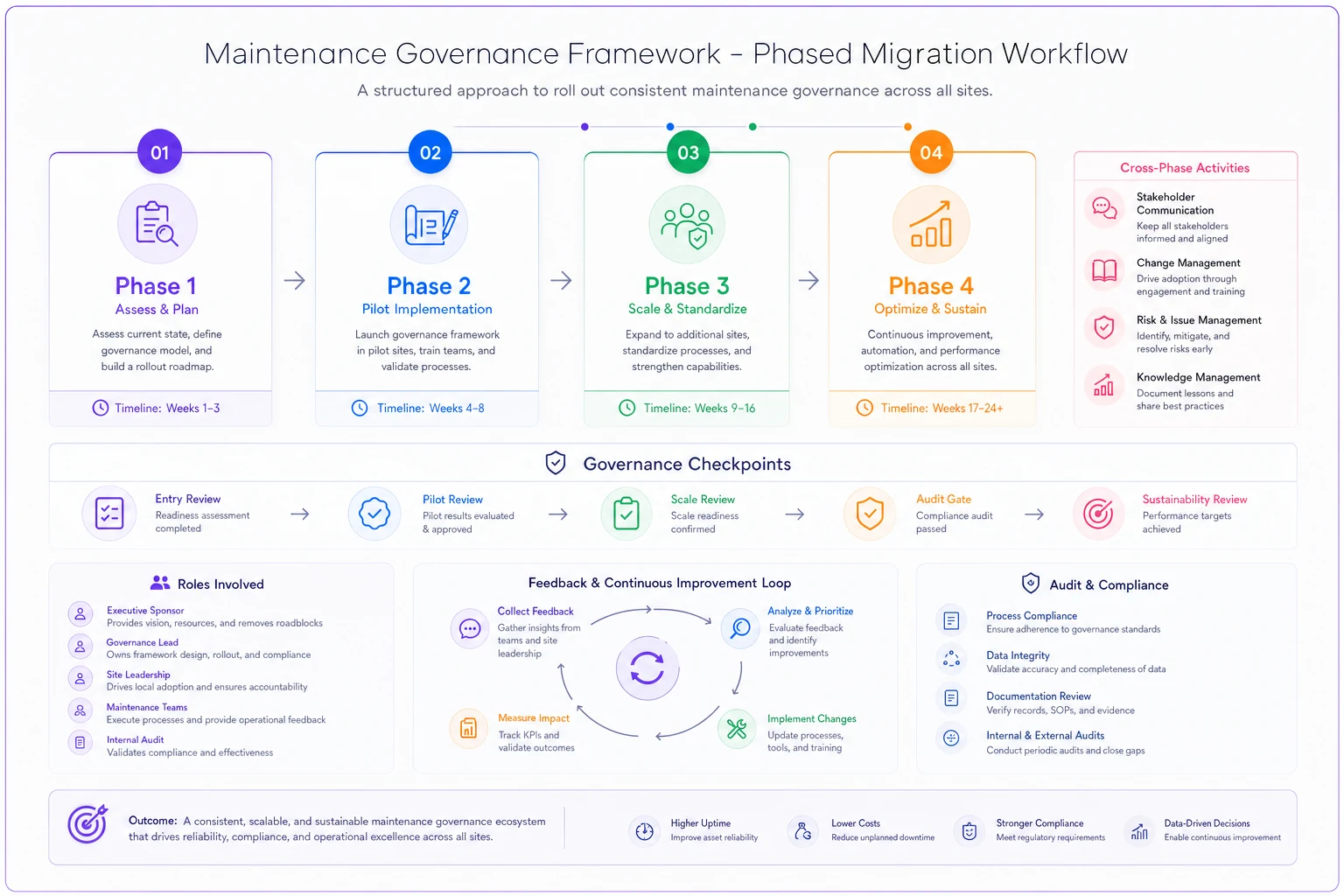
Shift focus from compliance to optimization. Sites consistently meeting standards can pilot new approaches. Their successes become tomorrow's standards.
Technology enablement and the role of AI automation
You can run a maintenance governance framework with spreadsheets and manual processes. It's just exhausting and error-prone. Modern maintenance platforms transform governance from a constant battle into something that mostly runs itself.
AI-powered operational software changes the enforcement dynamic significantly. Instead of regional managers manually checking compliance, automated systems flag deviations instantly. Work orders missing required documentation get flagged before closure. Preventive maintenance approaching due dates triggers automatic notifications. Sites can't claim ignorance when the system has been sending daily reminders.
These platforms also eliminate the data collection burden that kills many governance initiatives. Rather than sites submitting weekly reports manually, the system aggregates performance metrics automatically. Regional managers see real-time dashboards showing compliance scores, emergency ratios, and cost trends. Corporate teams access portfolio-wide analytics without chasing spreadsheets from 50 locations.
The biggest practical improvement is in standardization deployment. When you update a preventive maintenance template in an AI-assisted platform, it propagates instantly to all sites. No more email chains, confusion about which version is current, or training sessions just to communicate a minor update. The system maintains a single source of truth for all standards, procedures, and policies.
AI automation also helps with vendor governance specifically. The system tracks every vendor interaction from initial call to invoice payment, compares response times against SLAs, flags pricing variations between sites, and scores vendor performance automatically. This kind of visibility makes it very hard for underperforming vendors to hide behind a good relationship with a specific site manager.
For organizations managing maintenance across multiple sites, these platforms can reduce governance overhead by a meaningful margin while improving compliance rates. Regional managers spend less time collecting data and more time coaching sites. Corporate teams focus on strategic improvements rather than administrative tasks.
Measuring governance effectiveness
You need metrics that reflect true governance health, not just activity levels. Track both compliance metrics and outcome metrics to understand whether your framework is driving real improvement.
Compliance metrics include preventive maintenance completion rate, documentation compliance score, audit pass rate, and training completion percentage. These show whether sites follow standards but don't indicate whether the standards themselves are working.
Outcome metrics reveal actual governance impact: emergency work order ratio, mean time between failures, maintenance cost per square foot, and equipment lifecycle achievement. When governance is working, emergency ratios drop, equipment lasts longer, and costs stabilize.
Create balanced scorecards combining both metric types. A site with perfect compliance but rising emergency rates has a problem—either the standards are wrong or the compliance reporting is inaccurate. Similarly, a site with great outcomes but poor compliance might have developed better practices worth understanding and spreading.
Review metrics in context. Seasonal variations, local conditions, and equipment age all affect performance. A coastal site might have higher maintenance costs due to corrosion, but their emergency rates should still track with inland sites if governance is functioning.
Use metrics for improvement, not punishment. When sites underperform, investigate root causes. Maybe they need different resources, additional training, or modified standards for local conditions. Governance succeeds when it helps sites improve, not when it catches them failing.
Making governance sustainable long-term
Maintenance governance frameworks fail when they become bureaucratic exercises disconnected from operational reality. Sustainability requires constant refinement based on field feedback.
Keep documentation lean and practical. If sites ignore 200-page manuals, create 20-page guides focused on critical procedures. Use videos for complex tasks rather than written instructions. Make standards accessible on mobile devices so technicians can reference them during work.
Rotate corporate team members through field assignments periodically. Nothing keeps governance relevant like corporate staff actually experiencing site-level challenges. These rotations reveal which standards genuinely help and which just create unnecessary burden.
Build succession planning into your governance structure. Document role responsibilities clearly enough that replacements can step in quickly. Cross-train regional managers so coverage exists during vacations or turnover. Governance frameworks collapse when key people leave without knowledge transfer.
Celebrate the framework's wins visibly. When standardized preventive maintenance prevents a critical failure, share that story. When vendor consolidation generates savings, publicize them. Success stories build buy-in better than any mandate.
And accept that perfect compliance is probably both impossible and unnecessary. Focus on critical standards that directly impact safety, reliability, and cost. Allow flexibility in non-critical areas where site variation doesn't hurt outcomes. The goal is operational excellence, not administrative perfection.
A well-designed maintenance governance framework transforms multi-site maintenance from chaos to coordination. It takes roughly six months to implement and another six to optimize, but the payoff compounds for years. Sites operate more efficiently, equipment lasts longer, and the endless firefighting that exhausts maintenance teams finally starts to slow down.
The framework here is a starting point. Your organization's specific needs will require adjustments. Start with the basics—roles, meetings, enforcement—then build sophistication as maturity grows. The key is starting somewhere rather than waiting for a perfect plan that never arrives.
Ready to optimize your maintenance operations?
Join 2,000+ facilities using Openfixit to reduce unplanned outages, extend asset life, and improve operational efficiency.