
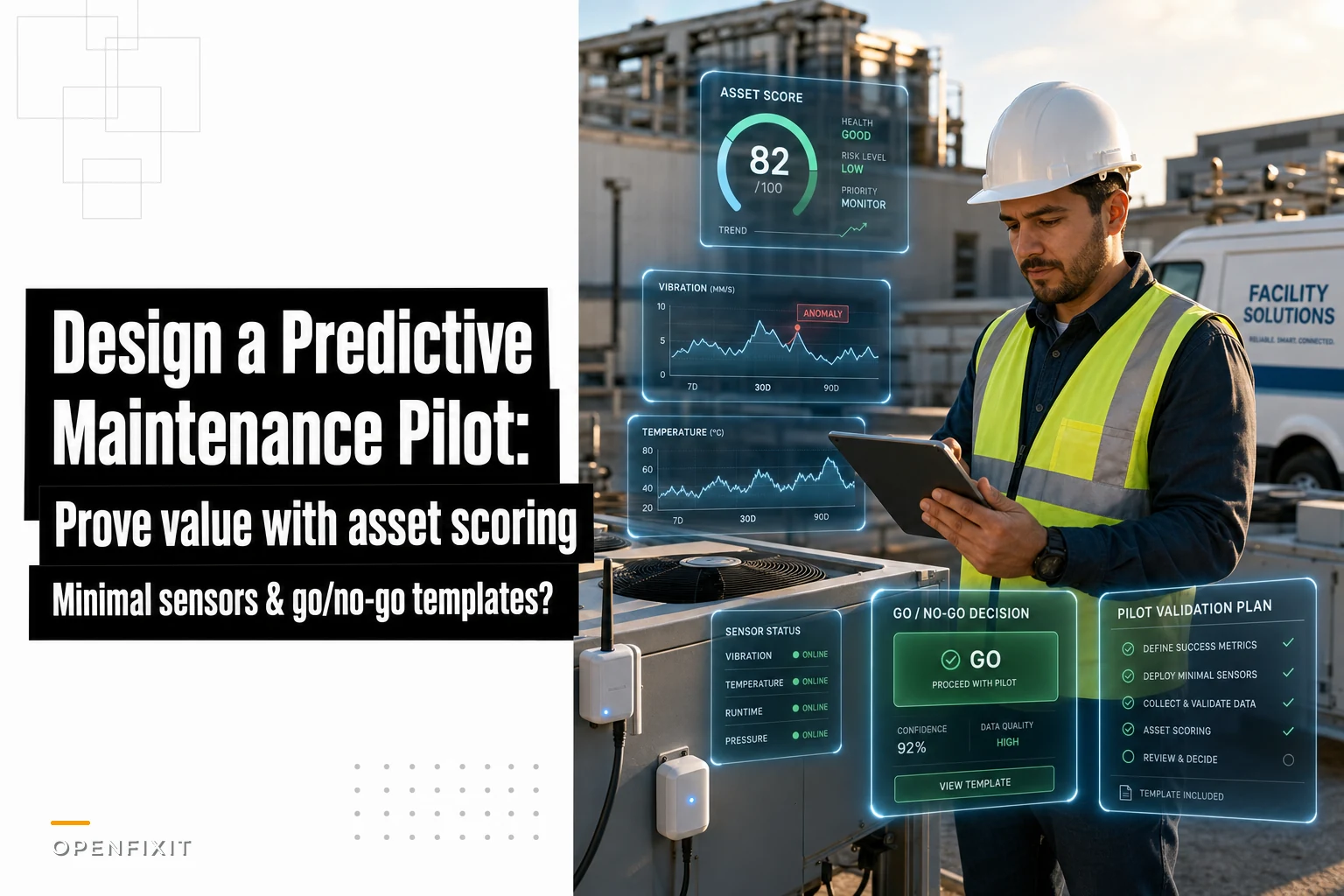

Most predictive maintenance pilots die in month three. Not because the technology fails, but because facilities teams pick the wrong assets, install too many sensors, and have no clear way to measure whether the pilot actually worked.
The pattern is pretty predictable. A vendor shows up with a slick demo. The facility manager gets excited about catching failures before they happen. Six months and $80k later, you've got vibration sensors on every pump in the building generating alerts nobody trusts, and your technicians are back to their paper rounds.
The teams that succeed start small, pick assets that actually matter, and have clear criteria for expanding or killing the pilot before they spend serious money.
The Asset Scoring Framework That Actually Works
Critical Business Impact (0-5 points) Rate how much this asset failing would hurt operations. A chiller serving your data center gets 5 points. The exhaust fan in the rarely-used storage room gets 1.
Failure Frequency (0-5 points) How often does this thing break? Check your maintenance logs from the last two years. If you're calling in repairs every few months, that's 4-5 points. Annual PM-only equipment gets 1-2.
Repair Cost & Time (0-5 points) Add up parts cost plus labor hours multiplied by your loaded rate. Include overtime or contractor callouts. Over $10k per incident? That's 5 points. Under $2k? That's 1-2 points.
Data Accessibility (0-5 points) Can you actually get useful data from this asset without major modifications? A motor with an accessible junction box scores high. Equipment buried behind other machinery or requiring shutdowns to install sensors scores low.
Predictability Potential (0-5 points) Some failures give warning signs through data. Bearing wear shows up in vibration patterns weeks before failure. Capacitor degradation appears in power quality readings. Sudden mechanical breaks from external damage, though? Not so predictable. Score based on whether the typical failure modes can actually be caught early.
Add up your scores. Anything at 18 or above becomes a pilot candidate. Below 15, skip it for now.
A pharmaceutical facility used this framework and narrowed from 47 "critical" assets down to four pilot candidates: their main air handler serving the clean rooms (scored 22), the primary chilled water pump (scored 20), the backup generator (scored 19), and a small but frequently failing dosing pump in their water treatment system (scored 18 due to high failure frequency despite low individual repair cost).
Minimum Viable Sensor Requirements
Vendors will push the "full monitoring suite" - vibration, temperature, current, ultrasonic, oil analysis ports, the works. For a pilot, you need way less than that.
Eliminate downtime with proactive maintenance.
Openfixit helps you plan, track, and complete maintenance efficiently—maximizing asset reliability.
- Centralized asset management
- Automated maintenance scheduling
- Inventory and parts tracking
No credit card required
Start with one primary indicator per asset based on its most common failure mode:
Motors and Rotating Equipment
-
Primary
Vibration sensor (triaxial accelerometer)
-
Secondary (only if budget allows)
Current monitoring
Heat Exchangers and Cooling Systems
-
Primary
Temperature differential (supply and return)
-
Secondary
Flow rate or pressure differential
Electrical Distribution
-
Primary
Current and voltage monitoring
-
Secondary
Power quality analyzer
Compressed Air Systems
-
Primary
Pressure at multiple points
-
Secondary
Flow rate
Hydraulic Systems
-
Primary
Pressure sensors
-
Secondary
Temperature (if overheating is common)
Data collection frequency matters more than having every possible sensor. For pilot assets, you want:
-
Vibration
Every 10-30 minutes for critical rotating equipment
-
Temperature
Every 1-5 minutes for HVAC systems
-
Electrical
Continuous for power quality, every minute for basic monitoring
-
Pressure
Every 1-5 minutes depending on system dynamics
A building management team in Denver ran a successful pilot monitoring just bearing temperature on their two main air handlers - nothing else. Cost them under $3k in sensors and wireless gateways. They caught impending bearing failure twice in the first year, avoiding roughly $25k in emergency repairs and downtime.
Validation Milestones That Prove Progress
Your pilot needs clear checkpoints, or it'll drift into expensive perpetual testing. Here's the milestone framework that keeps things focused:
Month 1: Baseline Establishment
-
All sensors installed and transmitting
-
Minimum two weeks of continuous data
-
Baseline patterns identified for each asset
-
Alert thresholds set (start conservative - you'll tune later)
Month 2-3: Pattern Recognition
-
Documented normal operating patterns for different conditions (weekday/weekend, seasonal, production levels)
-
First round of threshold adjustments based on false positives
-
Correlation between sensor readings and known events like PM activities
Month 4-5: First Catch Validation
-
At least one meaningful anomaly detected
-
Anomaly investigated and documented (whether true or false positive)
-
If true positive
repair performed and cost avoidance calculated
-
If false positive
threshold adjustments made
Month 6: Pilot Decision Point
Success criteria must include:
-
At least one prevented failure OR significant degradation caught early
-
False positive rate below 30%
-
Documented time savings of at least 10 hours per month
-
Clear cost avoidance of at least 2x pilot investment
If you haven't hit these markers by month six, either your asset selection was wrong or your thresholds need major adjustment. Don't extend indefinitely - make the call to pivot or proceed.
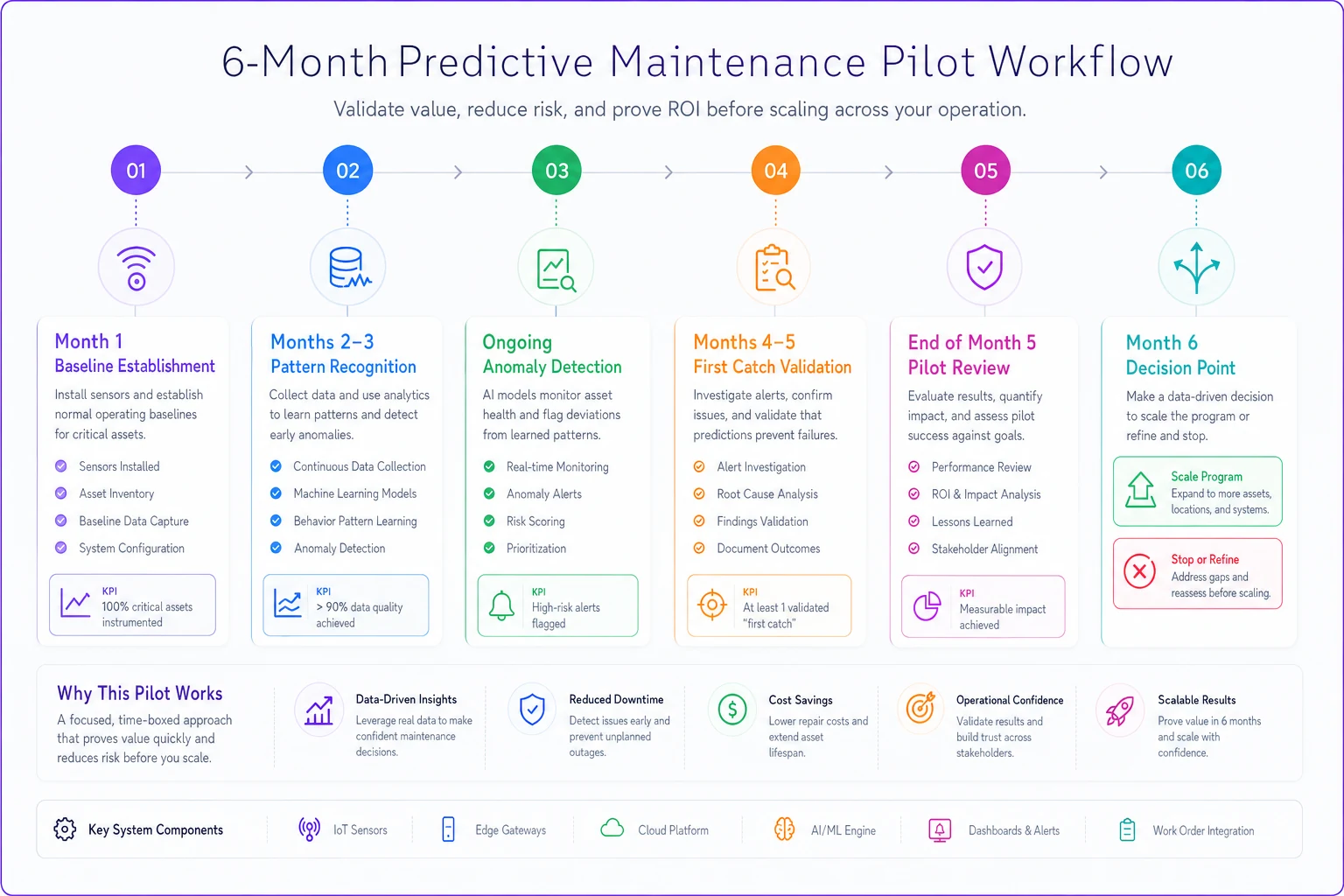
A simple visual can help stakeholders see the decision points and what success looks like at each milestone.
The Go/No-Go Decision Templates
Most pilots fail because nobody defined success upfront. Use these templates before you start.
Go Criteria (must hit 3 of 4):
-
Prevented at least one failure that would have cost >$15k
-
Reduced emergency maintenance calls by 25% on pilot assets
-
Achieved <20% false positive rate after threshold tuning
-
Maintenance team actively uses the data for planning, not just reacting to alerts
No-Go Criteria (any one triggers stop):
-
Six months without catching a real issue
-
False positive rate remains >50% after three rounds of tuning
-
Less than $5k in documented cost avoidance
-
Maintenance team ignoring alerts for over 30 days
Pivot Criteria (try different approach):
-
Good detection but wrong assets selected
-
Detection working but integration with work order system failing
-
Cost avoidance proven but ROI timeline too long
Document these criteria in writing before the pilot starts. Share them with your team, your boss, and the vendor if you're using one. It prevents the "just a few more months" trap that eats pilot budgets alive.
Real Implementation Scenario
A 500,000 square foot distribution center in Ohio is a solid example of this framework in action. Their maintenance team had been pitched predictive maintenance solutions for three years but never pulled the trigger due to cost concerns and previous failed technology implementations.
Out of 200+ pieces of equipment, they identified four pilot candidates:
-
Main cooling tower fan motor (scored 21)
-
Primary conveyor drive motor (scored 20)
-
Loading dock hydraulic lift pump (scored 19)
-
Backup generator (scored 18)
They chose the cooling tower fan and conveyor drive motor for the pilot, installing basic vibration sensors and temperature probes. Total sensor cost came to roughly $4,500 including wireless gateways.
Month one revealed the cooling tower fan had slight imbalance but nothing critical. Month three, vibration patterns on the conveyor motor started trending upward. The maintenance manager scheduled an inspection during the next planned downtime and found early-stage bearing wear. Replacement during scheduled maintenance cost $3,200. Emergency replacement would have run around $18k including overtime and expedited parts.
By month six, they'd prevented two likely failures and reduced emergency calls on those assets to zero. The pilot expanded to eight more assets in year two.
Common Pitfall Patterns
The same mistakes show up repeatedly.
Vendor oversell drives teams to monitor everything at once. Twenty sensors across fifteen assets means you're troubleshooting sensor problems instead of preventing equipment failures. Pick three assets, get them working well, then expand.
Analysis paralysis kills more pilots than technical problems. Teams spend months debating which sensors, which software platform, which communication protocol. Meanwhile, equipment keeps failing. Set a two-week decision deadline, pick something reasonable, and start collecting data. You can upgrade later if the pilot proves value.
Alert fatigue usually starts around week three. Too many false positives, technicians start ignoring alerts, real problems get missed, trust erodes, pilot fails. Start with conservative thresholds. Missing some minor issues early is better than overwhelming your team with noise.
Integration obsession is another one. Teams want predictive data flowing into their CMMS, automatic work order generation, mobile alerts, executive dashboards - before they've proven the concept works at all. Start simple. Even if you're manually checking a dashboard and creating work orders by hand, prove the value first. Integration comes after validation.
When Predictive Maintenance Makes No Sense
Some situations aren't worth the complexity.
Single-shift operations with plenty of maintenance windows often don't need it. The urgency that drives predictive value doesn't really exist when you have time to do traditional PM properly.
Facilities with mostly redundant systems - three identical pumps with two running and one backup - often don't need predictive monitoring on everything. Good PM practices matter more.
Equipment nearing end-of-life shouldn't be pilot candidates. If you're replacing that 25-year-old chiller next year anyway, don't waste pilot resources on it.
Simple, reliable equipment with established PM intervals rarely benefits from continuous monitoring. The exhaust fan that runs five years between bearing replacements? Just keep replacing bearings on schedule.
Making the Data Actually Useful
Raw sensor data means nothing if your technicians can't act on it. The most successful pilots translate complex patterns into simple action triggers.
Instead of showing vibration frequency spectrums, create straightforward threshold bands:
| Band | Status | Action Required |
|---|---|---|
| Green | Normal operation | No action |
| Yellow | Elevated reading | Schedule inspection within two weeks |
| Red | Abnormal reading | Investigate within 48 hours |
Track trends, not just absolute values. A bearing temperature rising 2 degrees per week tells you more than a snapshot reading of 140°F.
Connect findings to existing PM schedules. If vibration trending suggests bearing wear, flag it for the next PM rather than creating emergency work. This builds trust that predictive maintenance adds to good PM practices rather than replacing them. That distinction matters more than people realize when you're trying to get technician buy-in.
The Budget Reality Check
A minimal viable pilot for three assets costs roughly:
-
Sensors and gateways
$3k-8k
-
Basic software platform
$200-500/month
-
Installation labor
$2k-4k
-
Training and setup
$2k-3k
Total first-year investment: $15k-25k
If you can't document at least $30k in cost avoidance by month six, something's wrong with your asset selection or execution.
Avoid the enterprise platform trap. You don't need a $100k annual license for a pilot. Start with basic sensor manufacturers' platforms or simple data logging solutions. Fancy analytics come after you prove the concept works in your facility.
Building Team Buy-In Without Overselling
Your technicians have heard the "this will make your job easier" pitch before. Usually it means more complexity and the same amount of work. Frame predictive maintenance as information that helps them catch problems early and look good doing it - not magic that replaces their expertise.
Start with volunteers. Find the technician who's naturally curious about why things fail and make them the pilot champion. Their enthusiasm spreads better than any management mandate.
Start with a volunteer technician as the pilot champion and publicize their wins to build grassroots support.
Share wins properly. When predictive maintenance catches something, make sure everyone knows it was the technician's response that prevented the failure, not just the sensor. "Jim noticed the alert, investigated, and prevented a $15k failure" beats "the system caught a problem."
Keep scorecards simple and visible. Post a basic chart showing alerts generated, real issues caught, false positives, and money saved. Update it monthly. Let the numbers tell the story.
Scaling Decision Framework
After six months, you face the scale-or-stop decision. If you're scaling, don't just add assets randomly.
Group similar assets for batch deployment. If bearing temperature monitoring worked on air handler #1, deploy to air handlers #2-5 next. Same sensors, same thresholds, faster deployment.
Build internal capability before adding complexity. Make sure your team can handle current pilot assets smoothly before expanding. Monitoring five assets well beats monitoring twenty poorly.
At some point it also makes sense to consider operational software that centralizes your predictive maintenance data alongside other facility management workflows. Platforms with built-in AI automation can correlate sensor data with maintenance history, work orders, and equipment lifecycle patterns - which helps identify which alerts actually matter versus normal variation. That reduces the false positive problem that plagues standalone sensor systems.
The integration should feel natural: sensor alerts automatically creating draft work orders, trending data appearing alongside PM schedules, anomaly patterns linked to historical repair records. That transition from isolated pilot to integrated operations is what determines whether predictive maintenance becomes standard practice or stays a perpetual experiment.
The Honest Assessment
Predictive maintenance isn't magical. It's pattern recognition applied to equipment behavior. Some patterns are obvious and valuable to catch. Others are noise that waste everyone's time.
Successful pilots share common traits: small scope, clear success metrics, appropriate asset selection, and realistic expectations. They don't try to revolutionize maintenance overnight. They prove value on a few critical assets, build confidence, then expand carefully.
Your pilot will face problems. Sensors will fail. False positives will annoy technicians. You'll miss some failures the system should have caught. That's normal. The question isn't whether problems occur, but whether the value exceeds the hassle.
Predictive maintenance doesn't replace good maintenance practices - it enhances them. A poorly maintained facility with predictive sensors just fails with more warning. A well-maintained facility with predictive sensors prevents those failures from happening at all.
The framework in this predictive maintenance pilot checklist gives you structure without locking you in. Adapt it to your facility's reality. Start small, prove value, scale carefully. If it doesn't work, kill it cleanly and try something else. Not every facility needs predictive maintenance, but you won't know until you test it properly.
Ready to optimize your maintenance operations?
Join 2,000+ facilities using Openfixit to reduce unplanned outages, extend asset life, and improve operational efficiency.