
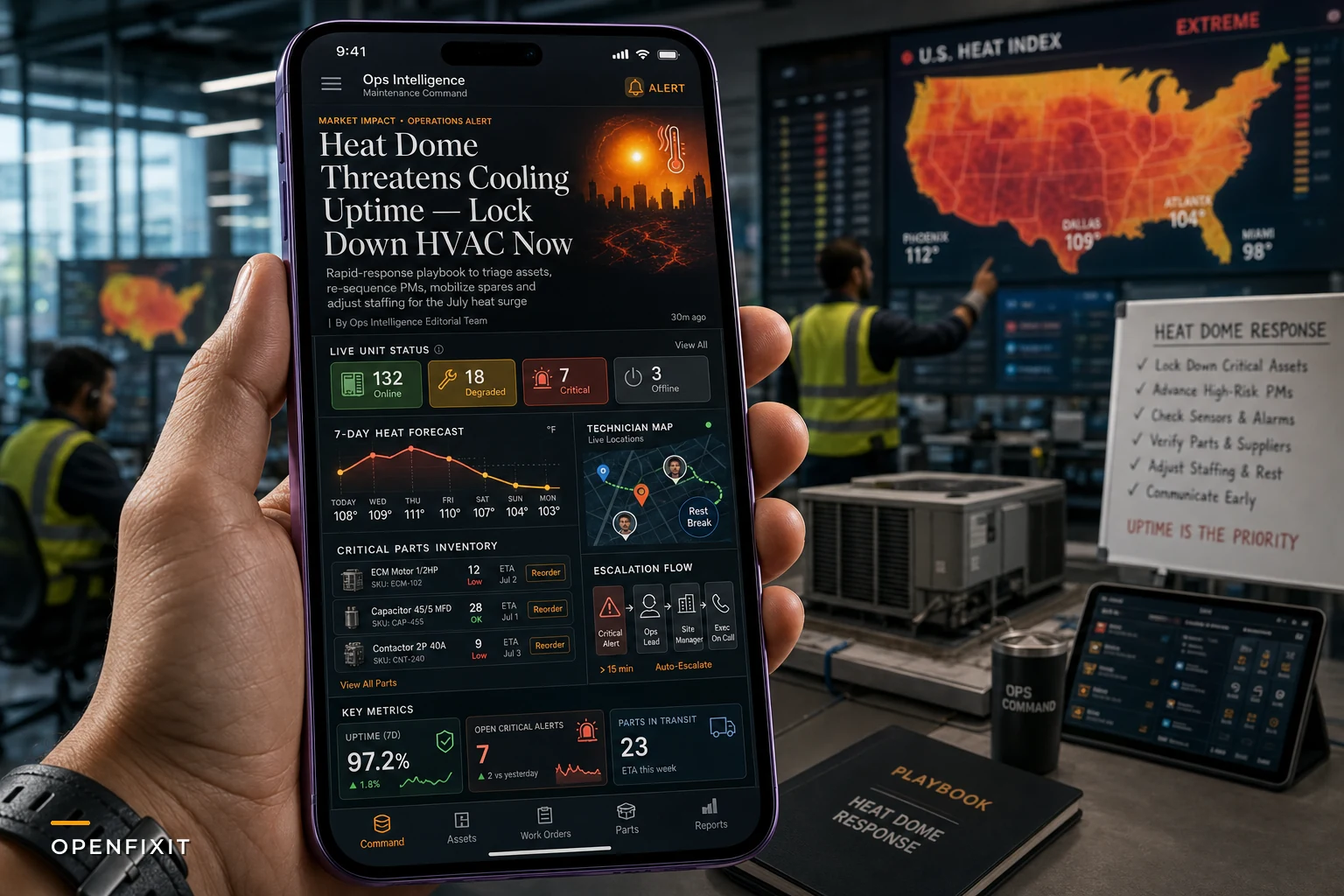

The weather maps look brutal. NPR reports that a massive heat dome is settling over the central and eastern United States, with temperatures pushing into triple digits from Ohio down through the Carolinas. Sustained extreme heat through the July 4th weekend — the kind where overnight lows barely dip below 80°F and your rooftop units never actually get a break.
For facility managers, this isn't just another hot week. This is when HVAC systems that have been coasting along suddenly hit their breaking point. Compressors that were marginal in May fail completely when they're running 20+ hours straight. Capacitors that tested fine during spring PM rounds blow out after three consecutive days of extreme load. And that's before you factor in a parts market where a simple contactor can have a two-week lead time.
The math gets ugly fast. A 50,000 sq ft distribution center running at 95°F internal temperature loses roughly $8,000 per day in productivity drops and potential product damage. A senior living facility faces immediate health code violations and resident evacuations if cooling fails for more than four hours. Even a standard office building going 48 hours without proper cooling can turn tenant complaints into lease violations and permanent vacancy problems.
The parts inventory problem nobody talks about until it's too late
Most facilities stock parts based on normal failure rates — maybe one spare capacitor per ten units, a couple contactors, basic refrigerant. But extreme heat events don't follow normal failure curves. When ambient temps stay above 95°F for multiple days, component failure rates spike in ways standard inventory models simply don't capture.
Take capacitors. Under normal summer conditions you might see one fail every 60-90 days across a portfolio of 20 rooftop units. During a heat dome? Facilities burn through their entire six-month capacitor stock in four days. Fan motors follow the same pattern — constant runtime combined with elevated temperatures means bearings that would normally last another season fail within hours of each other.
The real problem is that everyone else is scrambling for the same parts at the same time. Your regular supplier who normally keeps 50 capacitors in stock is sold out by Tuesday morning of a heat wave. The backup supplier wants a 300% markup for overnight shipping — assuming they even have inventory. During the 2023 heat events across the Southwest, basic components like 40/5 MFD dual capacitors were simply unavailable for weeks in some markets.
Smart facilities have already done their heat wave math. They know which components fail first under extreme load — usually starting capacitors, then fan motor capacitors, then contactors. They've identified their most critical units and pre-positioned spares specifically for those systems. And they've already placed orders on high-failure items, knowing lead times extend dramatically once the heat actually hits.
Your PM schedule needs a complete overhaul — right now
Standard quarterly PM schedules assume relatively even wear throughout the cooling season. A five-day heat dome can put more stress on equipment than two months of normal operation. The facilities that hold uptime during extreme heat aren't following their regular PM calendar — they've completely shifted their maintenance strategy in the weeks before extreme weather arrives.
Eliminate downtime with proactive maintenance.
Openfixit helps you plan, track, and complete maintenance efficiently—maximizing asset reliability.
- Centralized asset management
- Automated maintenance scheduling
- Inventory and parts tracking
No credit card required
What works: pulling forward every PM task that could prevent a heat-related failure. Coil cleaning scheduled for August? Do it now. Belt tensions checked quarterly? This week. Refrigerant charge verification that happens annually? Every unit needs to be looked at before the dome settles in.
Prioritize torque checks and condensate drains first during your PM blitz to prevent common heat-related failures.
The real differentiator is targeting the components that fail specifically under extreme heat stress. Electrical connections expand and contract more dramatically when equipment cycles hard under load — every terminal needs to be checked and torqued. Condensate drains that function fine under normal conditions can overflow when units run continuously, creating water damage and safety hazards. Even confirming proper fan rotation becomes critical when you need every CFM of airflow you can get.
Facilities that sail through heat events have usually spent around 120% of their monthly PM budget in the two weeks prior. They bring in contractors for tasks the in-house team doesn't have bandwidth to complete. They authorize overtime for weekend PM blitzes. It seems expensive until you compare it to emergency repairs at 2x-3x normal rates — assuming you can even find a contractor willing to work on a roof at 115°F.
Staffing math that keeps your team functional when everyone else burns out
Nobody wants to work on a roof when the surface temperature hits 140°F. Your best technician isn't much use if they're dealing with heat exhaustion. And every other facility in your area is also calling around for emergency HVAC support, which drives up rates and makes contractors nearly impossible to find.
Technician productivity during extreme heat is genuinely sobering. A tech who normally completes six rooftop PM tasks in a day might manage two or three once you factor in mandatory cooling breaks, slower movement to prevent heat injury, and the physical reality of working in those conditions. OSHA requires rest breaks every 15 minutes when the heat index exceeds certain thresholds — so your eight-hour shift might yield three hours of actual wrench time.
Facilities that maintain operations during heat events start their staffing adjustments weeks in advance. They shift to early morning and late evening work windows — crews starting at 4 AM to get roof work done before temperatures become dangerous. They pre-negotiate overtime rates and pull in temporary support before the heat arrives and every available tech is already booked.
Most critically, they run strict rotation schedules: nobody works more than 90 minutes on a hot roof before rotating to indoor tasks or a rest period. This isn't optional — it's the only way to keep your crew functional across a multi-day event.
The coordination nightmare that breaks most facilities
When your building automation system shows 14 high-temperature alarms at 2 PM on a Tuesday, normal dispatch falls apart instantly. Facilities that survive heat domes without major failures don't rely on their standard work order process — they've built specific heat wave response protocols that assume everything will happen at once.
Real heat wave coordination looks like a command center. One person tracking which units are alarming and prioritizing by criticality (the server room outranks the break room). Another managing technician locations and rest rotations. Someone else coordinating with parts suppliers and authorizing emergency purchases. All while fielding calls from tenants and updating senior management.
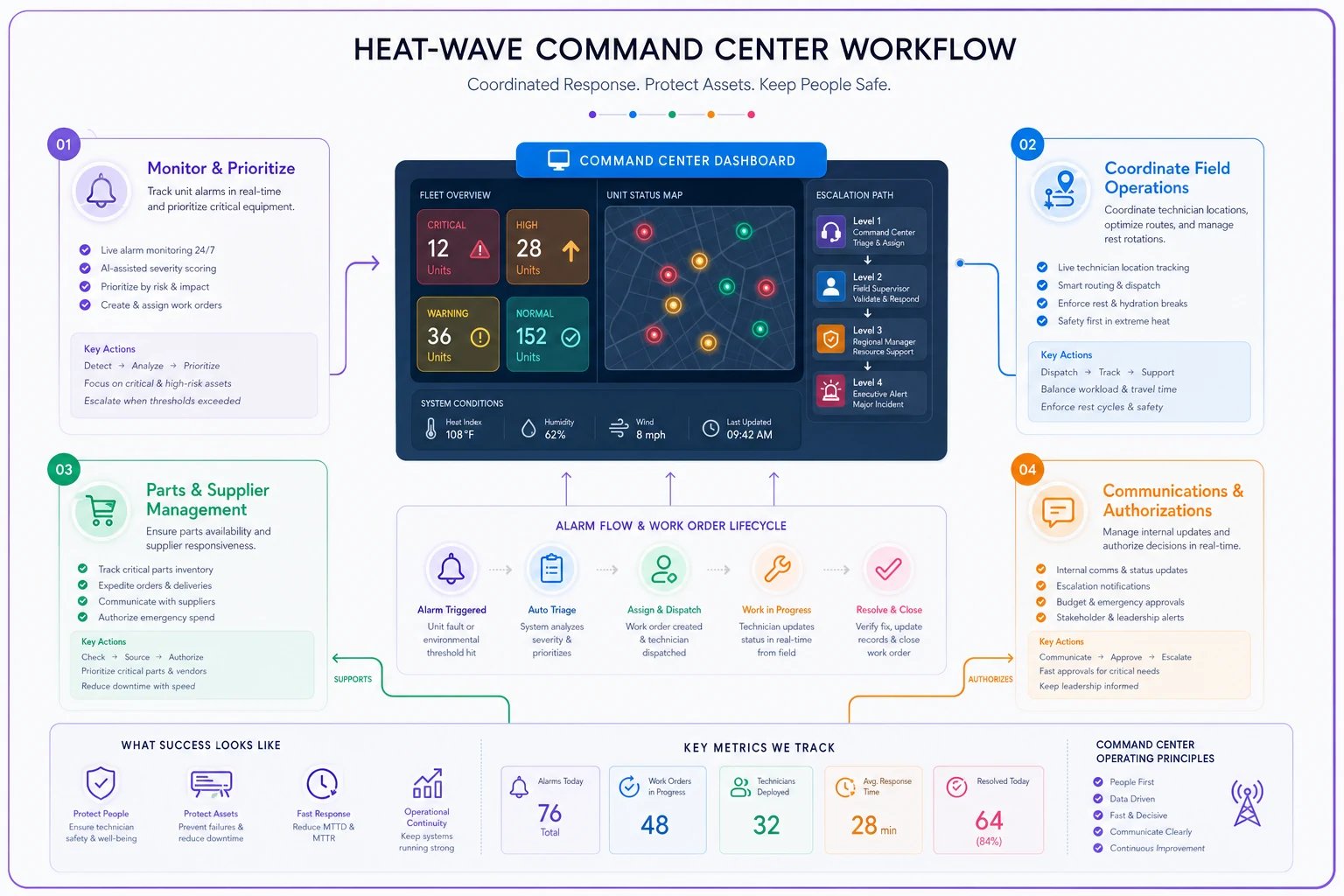
A quick visual of a command-center workflow helps clarify roles during a heat dome.
What to do literally today (assuming the heat dome is T-minus 5 days)
If you're reading this with a heat dome bearing down, here's your emergency action checklist:
Today and tomorrow:
-
Order these parts NOW
dual run capacitors (all common sizes), contactors (30 and 40 amp), fan motor capacitors, belts for every unit
-
Call your preferred contractors and pre-book emergency support hours
-
Pull forward every PM task that can be done in the next 72 hours
-
Check refrigerant levels on your most critical units
By Thursday:
-
Test every piece of backup equipment — portable units, fans, spot coolers
-
Verify all electrical connections on rooftop units are properly torqued
-
Clean every condenser coil — dirty coils will cause failures in extreme heat
-
Identify and physically tag your critical units
Before the heat hits:
-
Stage parts on the roof in weatherproof containers near critical units
-
Set up hydration stations and cooling areas for technicians
-
Adjust BAS setpoints to pre-cool buildings during overnight hours
-
Brief your entire team on heat wave protocols and emergency contacts
The difference between facilities that hold operations and those that fail during extreme heat isn't luck. It's preparation that starts before the heat arrives.
The rental equipment reality check
Portable cooling units disappear faster than toilet paper in March 2020 once a heat dome forecast goes public. By the time your primary chiller fails, every rental unit within 200 miles is already deployed. The facilities still operating during peak heat made their reservations before the weather maps turned red.
Rental contracts during heat emergencies are brutal. Daily rates triple, delivery fees quadruple, and vendors demand payment upfront. That 30-ton portable chiller that normally runs $800/day? Try $2,400/day with a two-week minimum and a $5,000 delivery charge — if you can even find one. During heat events, rental companies prioritize existing contract customers and long-term relationships.
There's another thing most facilities learn the hard way: rental equipment isn't plug-and-play. A portable unit needs three-phase power, which means knowing where your electrical panels are and whether they have spare breakers. It needs water for the condenser loop if it's water-cooled. It needs ductwork connections if it's going inside. Facilities that successfully deploy emergency cooling have already mapped connection points, confirmed electrical capacity, and sometimes pre-installed connection hardware before the event.
The building automation adjustments that buy you time
Your BAS can either be your best friend or worst enemy during extreme heat. Most systems are programmed for efficiency under normal conditions — which makes them completely wrong for survival mode. Facilities that maintain reasonable conditions during heat domes reprogram their entire control strategy before the heat arrives.
Start with setpoint schedules. That normal 76°F daytime setpoint? Raise it to 78°F or even 80°F to reduce load on struggling equipment. More importantly, implement aggressive pre-cooling overnight when temperatures drop and equipment can actually reject heat effectively. Running buildings down to 70°F at 4 AM gives you thermal mass to coast through the afternoon peak.
Load shedding is where you can really buy yourself margin. Instead of trying to maintain 76°F everywhere while equipment fails, identify which zones can tolerate higher temperatures. Unoccupied conference rooms? Let them float to 85°F. Storage areas? Even higher. Selective cooling can reduce total load by 30-40%, which might be the difference between equipment surviving or not.
Humidity control becomes a luxury you can't afford. Those reheat coils that normally maintain 45-50% RH? Turn them off. Let humidity float to 60% if it means your cooling equipment survives. Occupant complaints about humidity are manageable — complete cooling failure is not.
Why your utility company should be on speed dial
During extreme heat events, electrical demand spikes beyond grid capacity. Rolling blackouts become real possibilities. Facilities that maintain operations have already engaged with their utility providers about demand response programs, backup power requirements, and potential curtailment schedules.
Some utilities offer priority restoration for critical facilities, but you need to be registered before the event. Others provide advance warning of potential curtailment, giving you time to adjust operations or start backup generators. The conversation you have with your utility rep on Tuesday might determine whether you have power on Thursday afternoon.
Demand charges matter too. Running all equipment at maximum capacity during peak rate periods can trigger demand charges that show up on your utility bills for the next 12 months. Smart facilities implement demand limiting strategies — cycling equipment, adjusting setpoints during peak periods, using thermal storage if available. A demand charge spike in the $40,000-60,000 range is avoidable with some planning.
The after-action work that prevents next time from being worse
Once you survive a heat dome event, the immediate instinct is to get back to normal and forget it happened. The facilities that handle the next one better do a proper post-event analysis while the pain is fresh.
Document everything. Which components failed first? Which vendors came through and which didn't? What did emergency repairs actually cost versus what preventive measures would have cost? This data becomes your business case for proper heat wave preparation funding.
Calculate the real cost of your near-misses too. That unit that almost failed but didn't — what would the impact have been? The portable cooling unit you couldn't find — what if you'd actually needed it? These scenarios help justify the investment in spare parts, redundant capacity, or upgraded equipment.
Smart facility managers use heat dome events as leverage for capital improvements. The aging chiller that barely survived? Now's the time to get replacement funding approved. The BAS that couldn't provide adequate monitoring? Perfect justification for an upgrade. Crisis creates opportunity for those positioned to make the case.
Making the business case for proactive heat preparedness
Here's the conversation every facility manager needs to have with executives before the next heat dome: reactive emergency response during extreme heat costs roughly 5-10x more than proactive preparation. When you factor in emergency labor rates, expedited parts shipping, rental equipment, and potential business interruption — that's the actual math.
| Scenario | Typical Cost Range |
|---|---|
| Comprehensive heat dome preparation (100,000 sq ft facility) | $15,000 – $20,000 |
| Emergency response after multiple equipment failures | $100,000 – $150,000 |
| Productivity losses and tenant impacts (not included above) | Varies significantly |
The insurance angle matters too. Many policies have specific language about preventable failures due to inadequate maintenance. Document your heat dome preparations thoroughly — it could be the difference between a covered claim and a denial if something major fails despite your best efforts.
The bottom line on heat dome survival
Extreme heat events are becoming more frequent and more severe. CNN's analysis shows these heat domes are lasting longer and covering larger geographic areas than historical patterns. For facility managers, this isn't a one-time emergency — it's the new operational reality that requires fundamental changes to how we maintain and operate HVAC systems.
Facilities that maintain uptime during these events share common characteristics: they prepare weeks in advance, invest in redundancy and spare parts, modify their operational procedures for extreme conditions, and use each event to build resilience for the next one. Most importantly, they recognize that HVAC reliability during extreme heat isn't just about comfort — it's about business continuity, safety, and the basic ability to keep operating.
The heat dome heading toward the eastern US right now is a test. The facilities that have already ordered parts, scheduled contractors, and adjusted their PM calendars will come through it. Those treating it as just another hot week are about to learn expensive lessons.
Even with a few days of lead time, you can dramatically improve your odds. The parts you order today, the PMs you complete tomorrow, the procedures you put in place this week — that's the difference between a controlled response and a full crisis. Your chillers don't care that it's 105°F outside, but with the right preparation, they don't have to.
Ready to optimize your maintenance operations?
Join 2,000+ facilities using Openfixit to reduce unplanned outages, extend asset life, and improve operational efficiency.