

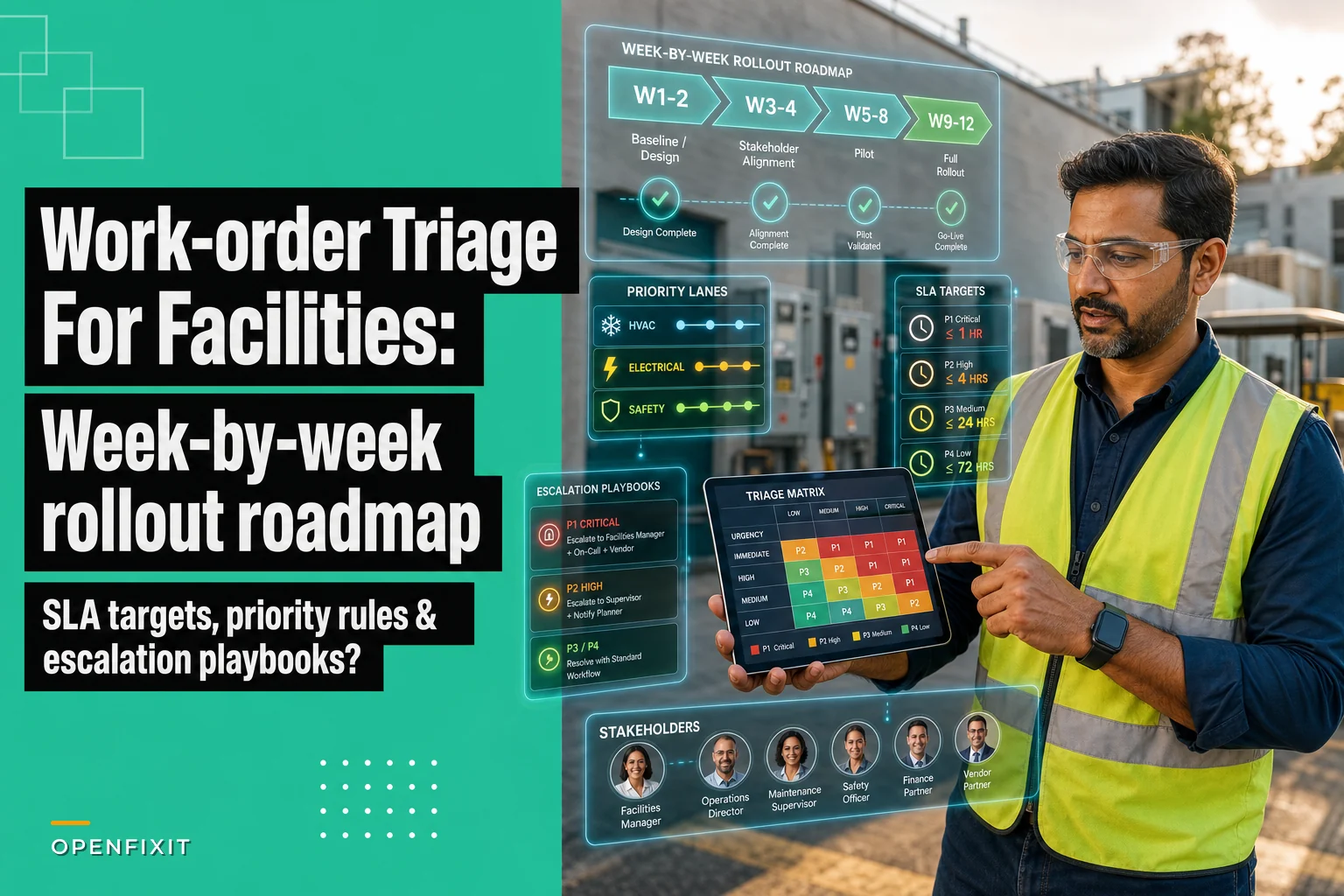

Your maintenance supervisor just texted you at 11 PM. The pharmaceutical building's cold storage compressor failed, putting $2 million in temperature-sensitive inventory at risk. Meanwhile, three other work orders sit unassigned: a flickering light in the admin building, a sticky door in the warehouse, and a leaking coolant line in the data center.
Which one should've been flagged as critical eight hours ago? The coolant line. But nobody caught it because your team treats all work orders like they're equal priority until something breaks badly enough to cause a crisis.
This isn't rare. Most facilities run without a proper maintenance work order triage matrix, relying on whoever screams loudest or whoever happens to check their phone first.
The hidden cost of poor triage goes beyond equipment failure
Without structured triage, facilities averaging around 400 work orders monthly typically see:
-
15-20% of critical issues buried under routine requests
-
Response times stretching 3-5x longer than necessary for true emergencies
-
Technicians burning overtime fixing problems that should've been caught during regular hours
-
Regulatory violations from missed safety-critical repairs
The pharmaceutical facility mentioned above ended up moving inventory to backup storage at 2 AM, costing $18,000 in emergency logistics. The data center coolant line that nobody prioritized correctly? It failed 14 hours later and triggered a server shutdown that ran $42,000 in downtime.
Both completely preventable with proper triage.
Why generic priority systems fail in real facilities
Most CMMS platforms ship with basic priority levels: Low, Medium, High, Emergency. Sounds logical until you realize "High" means vastly different things depending on the system involved.
Eliminate downtime with proactive maintenance.
Openfixit helps you plan, track, and complete maintenance efficiently—maximizing asset reliability.
- Centralized asset management
- Automated maintenance scheduling
- Inventory and parts tracking
No credit card required
A "High" priority HVAC issue in a server room needs response within 2 hours. The same label on an HVAC issue in a storage warehouse might mean it can wait 24 hours. Using identical labels for both guarantees confusion.
-
Asset criticality differences
-
Regulatory requirements
-
Business impact variations
-
Seasonal factors
-
Resource availability
Your maintenance team ends up guessing what "urgent" actually means on any given day.
Building a maintenance work order triage matrix that actually works
A functional triage matrix maps three dimensions: issue type, asset criticality, and business impact. Not just one.
Asset Criticality Tiers
Tier 1 - Mission Critical
-
Direct production impact
-
Life safety systems
-
Regulatory compliance equipment
-
Single points of failure
Tier 2 - Business Critical
-
Indirect production impact
-
Customer-facing systems
-
Redundant systems (one backup available)
-
High-cost downtime areas
Tier 3 - Standard Operations
-
Administrative areas
-
Non-essential comfort systems
-
Multiple redundancies available
-
Minimal business impact
Tier 4 - Convenience
-
Aesthetic issues
-
Employee comfort (non-safety)
-
Deferred maintenance acceptable
Response Time Matrix
| Asset Tier | Safety Issue | Operational Failure | Performance Degradation | Preventive |
|---|---|---|---|---|
| Tier 1 | 30 min | 2 hours | 8 hours | Scheduled |
| Tier 2 | 2 hours | 4 hours | 24 hours | Scheduled |
| Tier 3 | 4 hours | 24 hours | 72 hours | Scheduled |
| Tier 4 | 24 hours | 72 hours | 1 week | Scheduled |
This isn't theoretical. A 200,000 sq ft manufacturing facility that adopted this matrix cut emergency callouts by roughly 68% over six months — not by fixing things faster, but by catching critical issues during regular hours instead of after hours.
HVAC triage rules that prevent shutdowns
HVAC failures follow predictable patterns, which means your triage rules can too.
Critical HVAC Scenarios (Tier 1 Response)
Complete cooling loss in:
-
Server rooms (2-hour response max)
-
Clean rooms (30-minute response)
-
Pharmaceutical storage (immediate response)
-
Operating rooms (immediate response)
Heating loss when outside temp drops below 35°F in:
-
Wet pipe sprinkler zones
-
Process water systems
-
Occupied patient areas
Any scenario involving:
-
Refrigerant leaks in occupied spaces
-
Carbon monoxide detection
-
Smoke in air handlers
-
Complete ventilation failure in confined spaces
Standard HVAC Issues (Tier 2-3 Response)
Performance degradation:
-
Temperature variance ±5°F from setpoint
-
Unusual noises without performance impact
-
Minor refrigerant loss in outdoor units
-
Single zone issues with alternate spaces available
One medical facility tracked HVAC work orders for a full year. Before implementing these rules, they averaged 12 emergency HVAC calls monthly. After implementation it dropped to 3 — mostly genuine emergencies like compressor failures during heat waves.
The key difference was straightforward: issues like "strange noise from rooftop unit #4" stopped triggering 2 AM callouts when the system was still maintaining temperature.
Electrical triage that balances safety and operations
Electrical issues carry unique risks. Your matrix needs to clearly separate inconvenience from genuine hazard.
Immediate Response Electrical Triggers
Any report of:
-
Burning smell from panels or equipment
-
Visible arcing or sparking
-
Circuit breakers that won't stay reset
-
Water intrusion in electrical rooms
-
Exposed energized conductors
-
Emergency lighting failures
-
Fire alarm system faults
Power loss affecting:
-
Life safety systems
-
Data centers without UPS backup
-
Medical equipment
-
Security systems
-
Refrigeration for pharmaceuticals or food
Scheduled Response Electrical Issues
Non-critical scenarios:
-
Single outlet failures where alternatives are available
-
Lighting issues in non-egress paths
-
Cosmetic damage to covers or plates
-
GFCI nuisance tripping in dry locations
-
Under-voltage conditions without equipment impact
A distribution center that implemented these electrical triage rules saw maintenance overtime drop from 140 hours monthly to around 45 hours — just from correctly categorizing which issues could wait until the next shift.
Safety system triage without regulatory violations
Safety systems require special handling. OSHA, fire codes, and insurance requirements override convenience every time.
Mandatory Immediate Response
Fire Protection Systems:
-
Sprinkler system impairments
-
Fire pump failures
-
Standpipe pressure loss
-
Fire alarm communication failures
-
Kitchen suppression system faults
-
Exit sign or emergency light failures exceeding 10% in any area
Environmental Safety:
-
Eyewash station failures
-
Safety shower malfunctions
-
Fume hood face velocity drops
-
Chemical detection alarm activation
-
Confined space ventilation loss
Physical Safety:
-
Guard removal or damage on operating equipment
-
Lockout/tagout mechanism failures
-
Emergency stop malfunctions
-
Fall protection anchor concerns
-
Pressure relief valve lifting
Documentation Requirements
Every safety-related work order needs:
-
Time of discovery
-
Interim control measures implemented
-
Notification log (who was informed, when)
-
Regulatory reporting if required
-
Return-to-service verification
A chemical processing facility avoided $45,000 in OSHA fines by having clear documentation showing they responded to eyewash station failures within their triage matrix timeframes — even though repairs took longer due to parts availability.
SLA definitions that technicians and management both understand
Vague SLAs create conflict. "Respond quickly" means nothing. "On-site within 2 hours" means everything.
Response vs Resolution
Response Time: Qualified technician arrives and assesses
Resolution Time: Problem fixed or controlled with a documented plan
Your SLAs should specify both:
| Priority Level | Response Time | Resolution Target | Update Frequency |
|---|---|---|---|
| P1 - Emergency | 30 minutes | 4 hours or documented workaround | Hourly |
| P2 - Urgent | 2 hours | 8 hours or escalation | Every 2 hours |
| P3 - Normal | 8 hours | 48 hours | Daily |
| P4 - Scheduled | Per agreement | Per agreement | Weekly |
Escape Clauses That Prevent Impossible Situations
-
Parts availability delays
-
Specialist contractor requirements
-
Weather-related access issues
-
Concurrent higher-priority emergencies
-
Customer-caused delays
Document these upfront. A facilities team serving multiple buildings avoided three contract penalties by having clear force majeure clauses covering scenarios where multiple P1 emergencies hit simultaneously.
Escalation playbooks that prevent 3 AM confusion
When a cooling tower fails at midnight, your technician shouldn't be figuring out who to call. They should be following a checklist.
P1 Emergency Escalation (Critical Systems)
0-30 minutes:
-
On-call technician notified via automated system
-
Acknowledge receipt within 10 minutes
-
Provide ETA within 15 minutes
-
If no response, system auto-dials backup technician
30-60 minutes:
-
Technician on-site or valid delay documented
-
Initial assessment communicated to supervisor
-
If parts needed, emergency vendor contacts activated
-
Affected stakeholders notified via template message
60+ minutes:
-
Facilities manager looped in
-
External contractor called if needed
-
Business continuity plan activated if resolution exceeds 4 hours
-
Executive notification if business impact exceeds $50K
P2 Urgent Escalation (Business Impact)
0-2 hours:
-
Work order assigned to next available qualified tech
-
If no availability, scheduler notified
-
Overtime authorization requested if needed
2-4 hours:
-
Supervisor reviews resource allocation
-
Lower priority work reassigned if needed
-
Contractor option evaluated
4+ hours:
-
Facilities manager decides on contractor vs. overtime
-
Affected departments notified of timeline
-
Temporary workarounds implemented
Ensure the playbook is accessible and that all on-call staff know the automated notification and acknowledgement steps.
When your triage matrix needs adjustment
Triage rules aren't permanent. Facilities evolve, equipment ages, and business priorities shift.
Review triggers:
-
Seasonal transitions (heating/cooling season swap)
-
New equipment installations
-
Business model changes
-
Repeated SLA failures in specific categories
-
Post-incident reviews revealing gaps
Monthly metrics to track:
-
False emergency percentage (P1 calls that weren't true emergencies)
-
SLA achievement by category
-
Overtime hours by priority level
-
Average time from submission to correct triage
-
Re-categorization frequency
One data center adjusted their triage matrix after installing redundant cooling. What was previously P1 dropped to P2 because backup capacity existed. That single change reduced emergency callouts by roughly 40% without any increase in risk.
Implementing triage without disrupting operations
Rolling out a new maintenance work order triage matrix while keeping operations running requires actual planning.
Week 1-2: Baseline and Design
-
Document current state
-
Analyze last 90 days of work orders
-
Identify patterns and problems
-
Draft initial matrix
Week 3-4: Stakeholder Alignment
-
Review with technicians for a reality check
-
Get operations input on business impact
-
Align with safety and compliance teams
-
Finalize matrix and escalation paths
Week 5-8: Pilot Program
-
Run parallel with old system
-
Track discrepancies
-
Gather feedback daily
-
Adjust rules based on real outcomes
Week 9-12: Full Implementation
-
Switch to new matrix
-
Daily reviews first week
-
Weekly reviews first month
-
Monthly optimization ongoing
A visual workflow can help stakeholders understand the rollout phases.
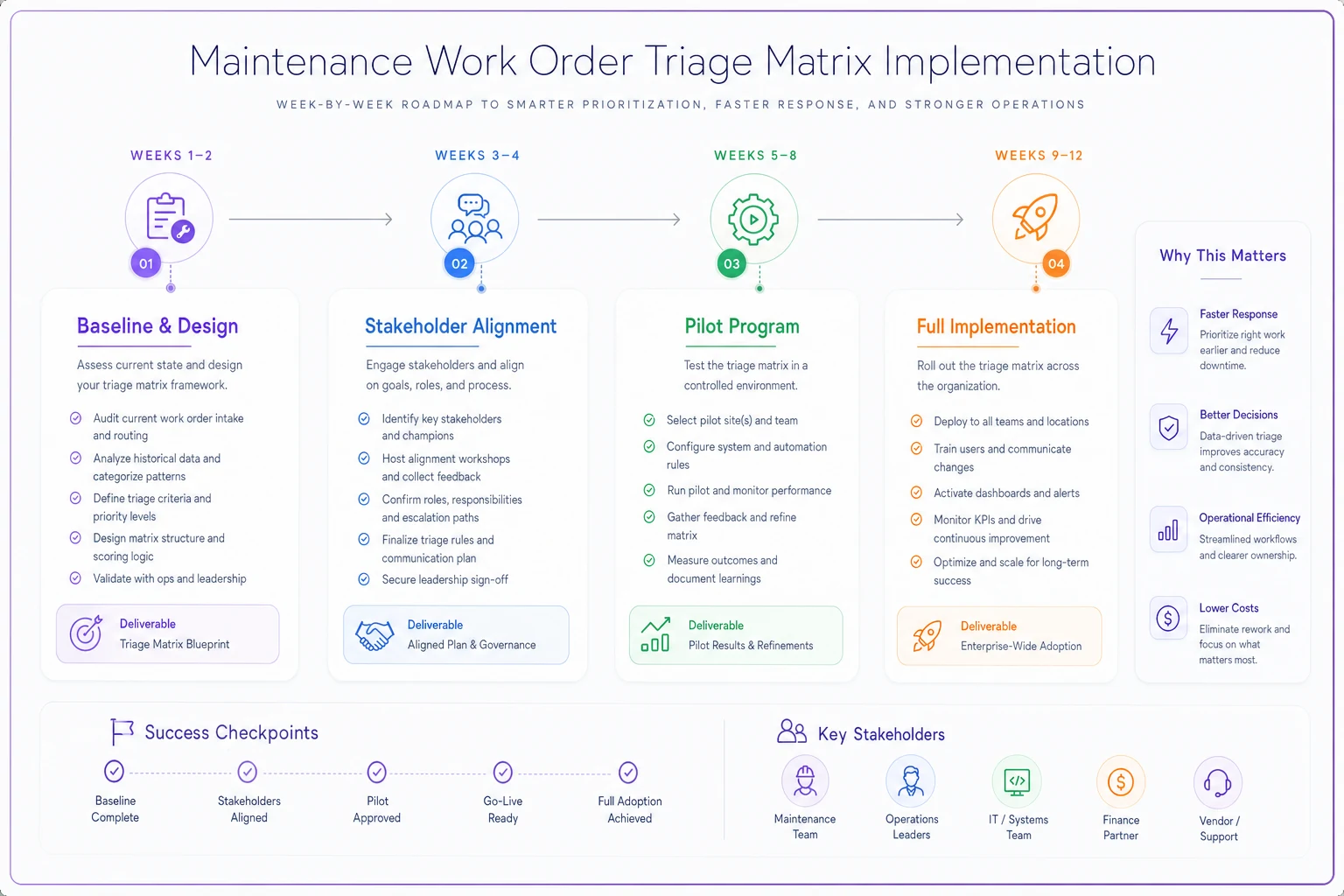
Use the visual during alignment meetings so technicians and managers share the same timeline expectations.
Technology and process alignment
Your triage matrix only works if your CMMS can actually support it. Manual triage at 2 AM rarely follows the rules regardless of how well they're written.
AI-powered operational software can automatically categorize incoming work orders against your matrix rules — checking asset criticality, scanning for safety-related keywords, and pulling from historical patterns. Instead of a technician making judgment calls while half-awake, the system routes work orders correctly from the moment they're submitted.
That kind of automation handles:
-
Keyword scanning for safety triggers
-
Asset database lookups for criticality tiers
-
Automatic escalation when SLAs approach breach
-
Notification routing based on priority
-
Performance tracking against targets
Align CMMS fields with your triage matrix so automation doesn't misclassify assets.
It takes human error out of the triage decision while keeping human judgment where it belongs — on the actual repairs. A hospital system that moved to automated triage saw average critical issue response time drop from 47 minutes to 31 minutes, entirely through faster and more accurate initial routing.
Common triage mistakes that create more problems
Over-prioritizing based on requester rank The VP's squeaky door isn't more important than the server room temperature alarm, regardless of who's complaining louder.
-
Under-prioritizing preventive maintenance PMs prevent emergencies. Constantly bumping them for "urgent" repairs creates a death spiral of reactive maintenance.
-
Ignoring seasonal patterns A static triage matrix will cause problems when conditions change. How you weight HVAC issues in July should look different than how you handle them in January.
Missing the cascade effect A small water leak above the electrical room needs different priority than the same leak above the storage closet. Location context matters as much as issue type.
Measuring triage effectiveness
Track these monthly:
-
Emergency work orders that could have been prevented
-
True emergency response time
-
False positive emergency rate
-
Work order aging by priority level
-
Technician overtime correlation with triage accuracy
If your P1 emergency rate consistently exceeds 5% of total work orders, your triage rules need adjustment. Real emergencies are rare when maintenance runs the way it should.
Beyond basic triage
Advanced facilities layer predictive elements into their triage matrix. When the building automation system shows rising bearing temperatures on AHU-7, that work order gets elevated before failure happens. Proactive triage prevents the emergency entirely instead of just responding faster to it.
The best triage systems evolve continuously — learning from near-misses, adjusting for seasonal patterns, improving after each incident review. What starts as a simple priority grid becomes real institutional knowledge about what actually matters in your specific facility.
Your overnight emergency calls should be genuine surprises, not predictable failures that nobody prioritized correctly eight hours earlier. With the right triage matrix, properly implemented and continuously refined, those 11 PM texts become rare exceptions instead of weekly occurrences.
The difference between a facility that runs smoothly and one in constant crisis often comes down to how quickly and accurately the team identifies what matters most — not everything can be P1, but when something truly is, your team needs to know immediately and respond accordingly.
Ready to optimize your maintenance operations?
Join 2,000+ facilities using Openfixit to reduce unplanned outages, extend asset life, and improve operational efficiency.