

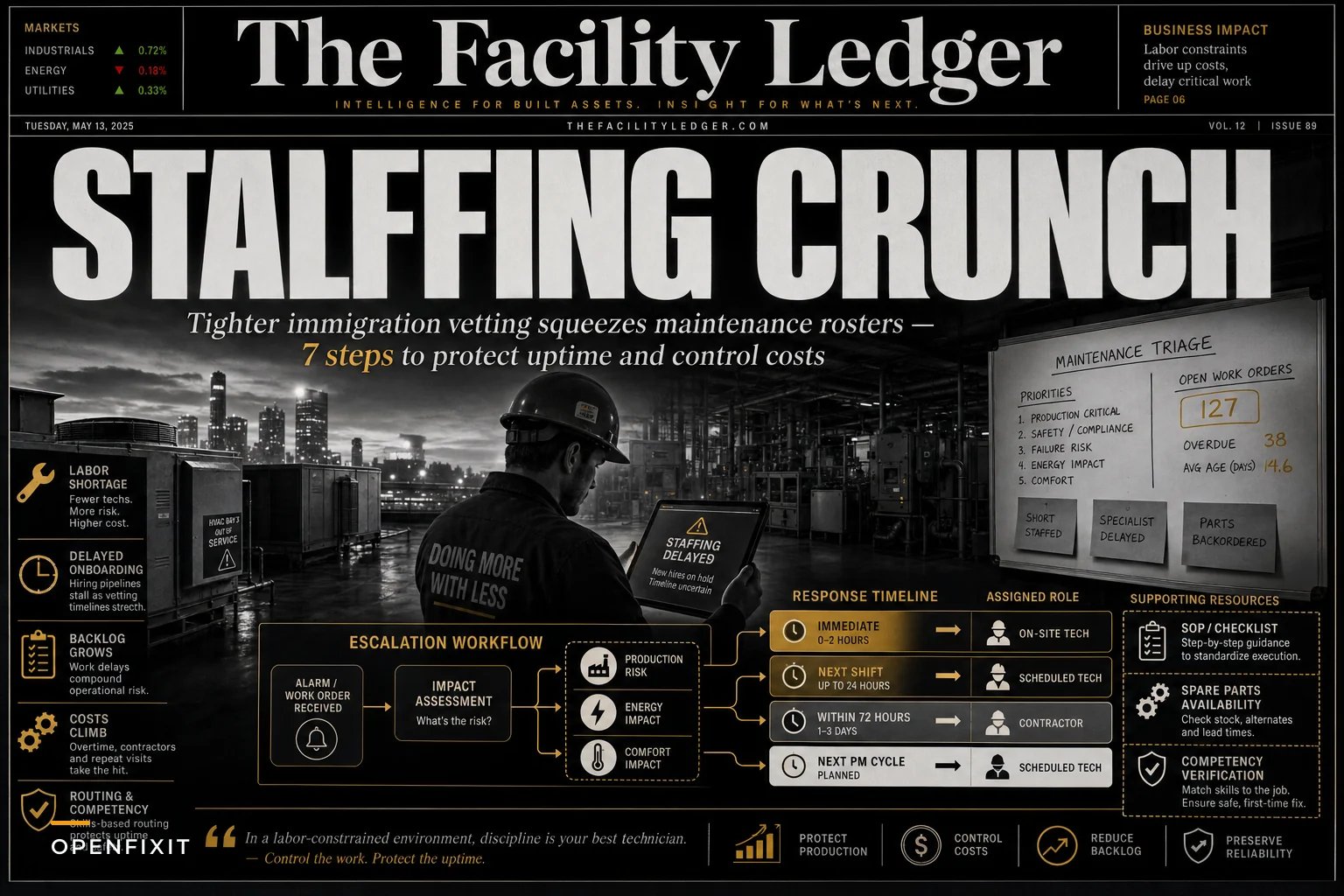

Your maintenance supervisor just called. The two H-2B technicians you were counting on for the summer cooling season won't arrive until September—if at all. That specialized controls tech from Canada? His TN visa processing got pushed back another 45 days.
Recent changes to immigration vetting and form requirements reported by Reuters are creating serious bottlenecks across multiple visa categories. What used to take around 60 days now stretches to 120 or more. For facility teams who've relied on seasonal workers and specialized foreign technicians, this isn't just an HR headache—it's an operational problem that builds quietly in the background until it isn't quiet anymore.
The math gets ugly fast. Each missing technician doesn't just leave a gap—overtime for your existing crew jumps 30-40%, contractor callouts can triple your labor costs, and deferred maintenance starts stacking. One pharmaceutical facility put their cost per missing tech at roughly $4,800 per week when you factor in overtime, emergency contractors, and equipment downtime risk. That number adds up faster than most managers realize until they're already deep in it.
What most facility managers miss: the solution isn't just "hire more contractors" or "pay more overtime." Those are band-aids that make the underlying problem worse by burning out whoever's left. The facilities handling this best aren't patching their hiring—they're restructuring how maintenance actually gets done.
Step 1: Immediately audit your critical equipment dependencies
Most facilities find out they're one technician away from disaster only after that technician doesn't show up. Pull your work order history for the last 90 days and identify which equipment actually requires specialized skills. Not the manufacturer's recommendation—your real repair history.
A distribution center in Ohio thought they needed four HVAC specialists on staff. When they mapped actual work orders, only their ammonia refrigeration system truly required certified techs. Everything else their general maintenance team could handle with proper documentation. That one realization let them focus limited specialized labor where it genuinely mattered.
-
Equipment that absolutely requires certified or specialized technicians
-
Equipment where specialized knowledge speeds repairs but isn't strictly mandatory
-
Equipment your general team can maintain with better documentation
The third category will probably surprise you. It's usually 40-50% of your so-called "specialized" work. Most of what gets labeled specialized is just stuff nobody bothered to document.
Step 2: Build skill bridges, not skill silos
Your remaining technicians probably know more than their job titles suggest. The problem is that knowledge stays locked in their heads because nobody's ever asked them to share it.
Eliminate downtime with proactive maintenance.
Openfixit helps you plan, track, and complete maintenance efficiently—maximizing asset reliability.
- Centralized asset management
- Automated maintenance scheduling
- Inventory and parts tracking
No credit card required
Set up 30-minute "skill swaps" a few times a week. Not formal training—just one tech showing another how they troubleshoot that finicky chiller or reset that one elevator controller. Record these on phones. Nothing fancy. Just get the tribal knowledge out of people's heads before it walks out the door with them.
Record these on phones.
A hotel chain started doing this after losing three senior techs to retirement. Within about six weeks, their junior staff could handle 70% of what previously required senior technicians. Not perfectly, not as fast, but enough to keep operations running.
One thing that actually matters here: keep it informal. The moment you turn it into a formal "training program," it dies under paperwork and scheduling conflicts.
Step 3: Restructure PMs to match your actual capacity
Traditional PM schedules assume full staffing. When you're down 30% on technicians, following the manufacturer's PM schedule becomes difficult to sustain. But skipping PMs entirely guarantees failures at the worst possible time.
Risk-based PM restructuring is the practical middle ground. Divide your PM schedule into three tiers based on failure consequence, not manufacturer recommendations:
Tier 1: Catastrophic if failed (main electrical panels, fire suppression, critical HVAC)
-
Keep these at full schedule compliance
-
Assign your most experienced remaining techs
-
Document everything for regulatory compliance
Tier 2: Expensive but manageable failures (secondary chillers, non-critical pumps)
-
Extend intervals by around 25%
-
Use predictive indicators where available—oil analysis, vibration trends
-
Schedule during lowest operational impact windows
Tier 3: Convenience issues if failed (lighting, doors, cosmetic items)
-
Move to run-to-failure or extend by 50%
-
Batch similar work to cut setup time
-
Consider contractor packages for volume work
A logistics facility using this approach cut PM hours by about 35% while maintaining 98% uptime on critical systems. The key is being honest about which tier things actually belong in—not where you wish they belonged.
Step 4: Create contractor relationships, not contractor dependencies
Every facility manager is calling the same contractors right now. The ones answering are either overpriced or overbooked. Instead of competing on rate, compete on structure.
Offer contractors predictable work packages rather than emergency scrambles. Bundle your Tier 3 maintenance into monthly contracts. Give them read-only access to your CMMS so they can see upcoming work before showing up. Pay within 15 days, not 45.
One facility started creating "contractor prep sheets" for each system—photos, manuals, common issues, where to park, access codes. Their contractor efficiency jumped around 40% because techs stopped wandering around trying to find basics. That efficiency translated directly into better rates and better availability when it counted.
Assign contractor coordination to one person. When everyone can call contractors, you get duplicate work, chaos, and costs that spiral fast.
Step 5: Implement graduated response protocols
Not every equipment alarm needs immediate response. But without clear protocols, everything becomes an emergency when you're already short-staffed.
Build response matrices based on operational impact:
Use a simple escalation workflow to decide who responds and when.
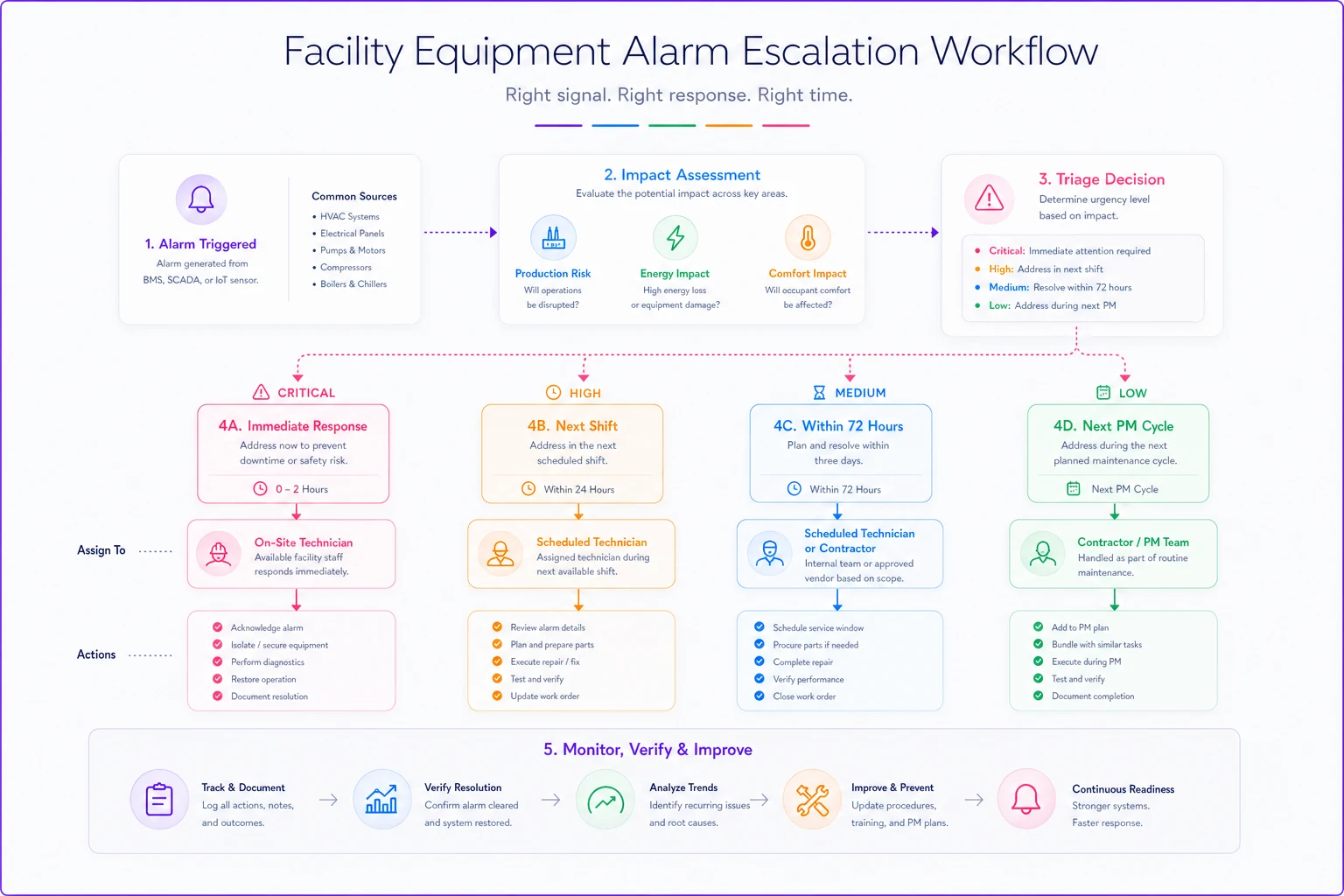
| Equipment Type | Failure Mode | Current Impact | Response Time | Who Responds |
|---|---|---|---|---|
| Primary Chiller | High temp alarm | Production at risk | 15 minutes | On-site tech |
| Primary Chiller | Efficiency warning | Higher energy cost | Next shift | Scheduled tech |
| Secondary Pump | Vibration alert | Backup available | Within 72 hours | Contractor |
| Office HVAC | Temp complaint | Comfort issue | Next PM cycle | Batched work |
Facilities that build these matrices typically see emergency callouts drop by more than half. Techs stop running between fires and start preventing them. That shift alone can change how your whole team operates under pressure.
Step 6: Build a skilled labor pipeline for next year
The immigration bottlenecks aren't clearing quickly. Start building alternative talent sources now rather than waiting to see how processing times shake out.
Technical schools: Offer part-time positions to students in their final year. They get hands-on experience, you get motivated help. One facility hired four HVAC students part-time—within a year, two became full-time techs who already understood their systems cold.
Cross-training from operations: Your operators often understand equipment better than you'd expect. Identify the mechanically inclined ones and offer maintenance training. Start with basic PMs, lubrication routes, filter changes. A food processing plant converted three operators to maintenance techs this way—took about six months but permanently solved their staffing gap.
Veteran programs: Veterans with military technical backgrounds often struggle to translate their experience into civilian certifications, but the technical aptitude is real. Partner with veteran transition programs. The skills are there; they just need facility-specific context.
Retired technician pools: Recently retired techs usually don't want to come back full time, but many will consult or train others for 15-20 hours a week. That arrangement tends to work well for both sides.
These pipelines take time to build, which is exactly why you start now and not after the next shortage hits.
Step 7: Document everything like your next tech starts tomorrow
Because they might. When staffing shortages force rapid hiring, the difference between a smooth onboarding and a disaster is documentation.
Not 200-page manuals nobody reads. One-page quick cards for each critical piece of equipment:
-
Common failures and fixes, with photos
-
Where to find parts
-
Who to call for what
-
Safety lockout points
-
The weird quirks ("tap here twice if the display freezes")
Store these in clear sleeves attached to the actual equipment. Physically attached. Cloud documentation is great until your new tech spends 20 minutes searching for the right file while the equipment sits broken.
A hospital that implemented this cut new technician ramp-up time from six weeks to two. Their quick cards became so useful that experienced techs started referencing them regularly. That's how you know the documentation is actually good.
The operational reality check
These delays aren't resolving on a short timeline. The vetting changes affect multiple visa categories, and processing times keep extending. But the facilities adjusting their operational approach—rather than just scrambling for bodies—are finding something unexpected.
They're building more resilient maintenance operations. When you can't import skills, you develop them. When you can't throw headcount at problems, you prevent them. When every technician matters, you stop treating them as interchangeable.
Moving from reactive scrambling to systematic solutions
The best time to implement these changes was before the shortage hit. The second best time is now, while the pressure is creating organizational buy-in for changes that normally face resistance.
Stop treating this as a temporary staffing problem. Start treating it as a chance to rebuild maintenance operations that don't collapse when hiring gets difficult—because whether it's immigration delays, retiring boomers, or the next disruption nobody sees coming, staffing crunches aren't going away.
For teams dealing with accumulated work from these shortages, our previous guide on clearing maintenance backlogs without burning out technicians walks through how to manage the workload surge while protecting whoever's still on your roster.
The facilities succeeding right now aren't the ones with the biggest budgets or the best contractor connections. They're the ones who looked at their empty tech positions and figured out how to make it work anyway—then built systems that turned a staffing crisis into something closer to an operational upgrade.
Ready to optimize your maintenance operations?
Join 2,000+ facilities using Openfixit to reduce unplanned outages, extend asset life, and improve operational efficiency.