
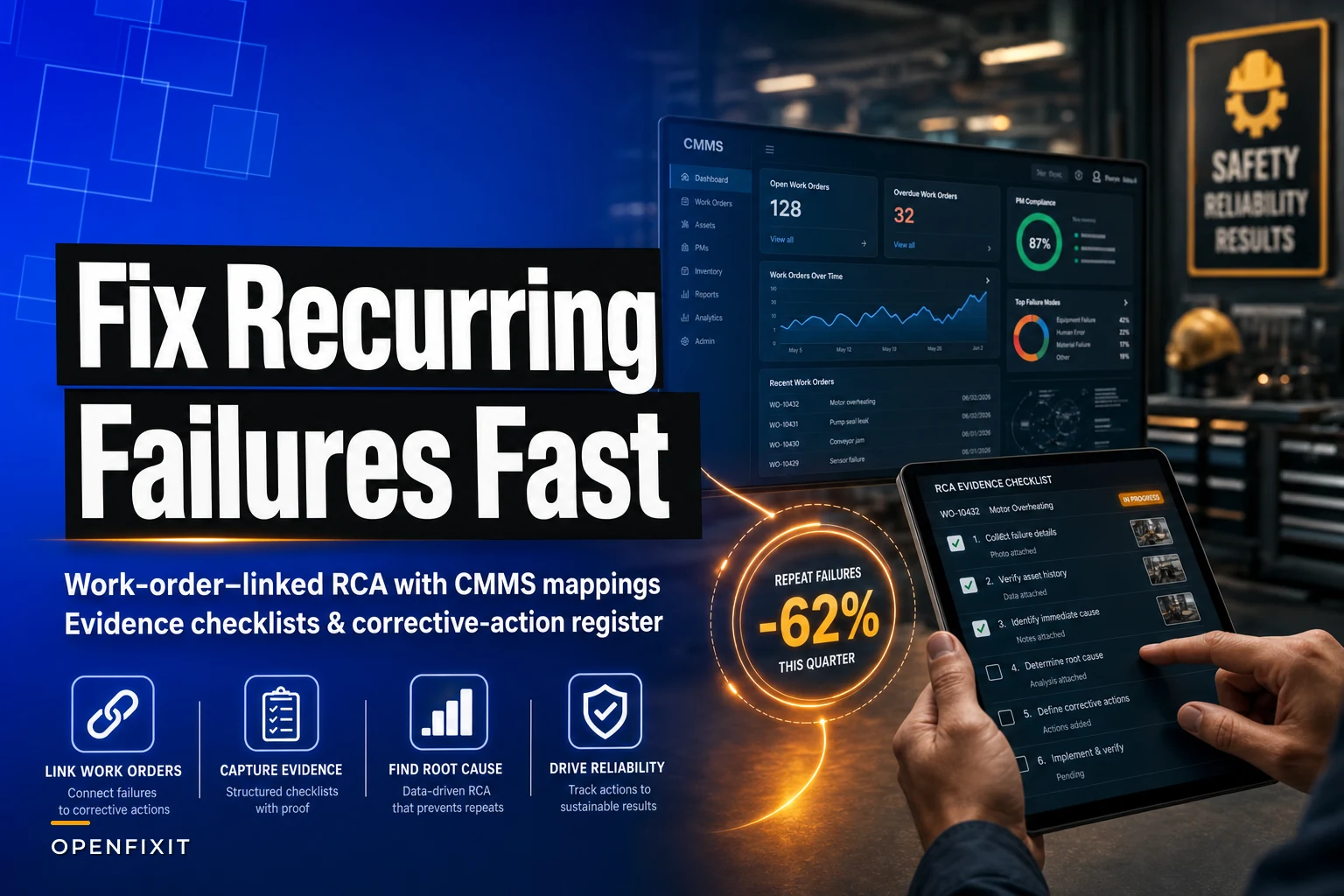

Your maintenance team keeps fixing the same conveyor motor failure every three weeks. Same symptoms, same parts replaced, same temporary fix. The work orders pile up, each one closed out with "motor replaced" and nothing else. Meanwhile, that motor failure is costing you around $4,800 in downtime per occurrence, plus tech hours, plus expedited parts shipping.
Most facilities run into this pattern constantly. A chiller trips offline during peak summer load—techs reset it, log minimal notes, move on. Two weeks later, same trip, same reset. The failure repeats until something catastrophic happens and suddenly you're looking at a $45,000 compressor replacement instead of what could have been a $200 capacitor fix months earlier.
Root cause analysis sounds great in theory. Quality departments have their fishbone diagrams, operations has their 5-whys methodology, but maintenance gets a work order system that barely captures "fixed pump" as the resolution note. No structure for investigation, no prompts for evidence collection, no real link between the failure pattern and the corrective action that would prevent it from happening again.
Why maintenance teams skip root cause analysis (even when they know better)
The disconnect happens at the intersection of urgency and documentation. Your lead tech knows that bearing keeps failing because of misalignment, but when production is screaming about downtime, nobody's filling out lengthy RCA forms. The knowledge stays in that tech's head until they leave for another job.
Traditional RCA frameworks fail in maintenance environments for pretty predictable reasons. They're designed for major incidents—environmental spills, safety near-misses—not the daily grind of equipment failures. A full fishbone diagram for every bearing failure? Your team would spend more time drawing diagrams than turning wrenches.
What tends to happen instead: techs develop informal pattern recognition. They know the south building's HVAC units fail more because of poor ventilation in the mechanical room. They know pump #3 cavitates because operations keeps running it outside spec. But that knowledge never makes it into a system where it can drive preventive action.
The documentation burden kills most RCA attempts. Generic forms asking for "contributing factors" and "systemic issues" get ignored because they don't map to how maintenance actually thinks about failures. Your tech doesn't think in terms of "organizational factors"—they think in terms of runtime hours, operating conditions, and maintenance history.
The cascading cost of unresolved root causes
A food processing plant had a mixer gearbox that failed every four months. Each repair ran about $3,400 in parts and labor. After the fifth identical failure, someone finally discovered severe overloading during product changeovers—a procedural issue that a $50 load meter and some operator training could have prevented. Total unnecessary cost over eighteen months: $17,000, plus production losses.
Eliminate downtime with proactive maintenance.
Openfixit helps you plan, track, and complete maintenance efficiently—maximizing asset reliability.
- Centralized asset management
- Automated maintenance scheduling
- Inventory and parts tracking
No credit card required
The pattern recognition breaks down across shift changes and personnel turnover. Your night shift might notice that a centrifugal pump always fails after specific batch runs, but if day shift handles the repairs, that correlation disappears into the shift handover void.
Worse, repeated failures train your team into a reactive mindset. Why investigate when you know it'll fail again in three weeks anyway? Just stock extra parts and plan for the breakdown. That resignation becomes embedded in your maintenance culture—the exact opposite of the reliability mindset you're trying to build.
Build your maintenance RCA playbook with automatic triggers
The key to sustainable RCA in maintenance is making it automatic, not optional. Here's a framework that works in practice:
Work Order Trigger Criteria
-
Same asset failure within 30 days
-
Any failure causing >2 hours of production downtime
-
Repair cost exceeding $2,500
-
Safety-critical asset failures (regardless of cost)
-
Any catastrophic failure mode
These triggers need to generate an RCA task automatically in your CMMS. No manual decision-making, no judgment calls—if the criteria are met, the RCA process starts.
Severity Classification Matrix
| Severity | Downtime Impact | Cost Impact | RCA Depth | Team Involvement |
|---|---|---|---|---|
| Critical | >4 hours | >$10,000 | Full investigation | Cross-functional team |
| High | 2-4 hours | $5,000-$10,000 | Structured checklist | Maintenance + Operations |
| Medium | 1-2 hours | $1,000-$5,000 | Quick assessment | Lead tech + supervisor |
| Low | <1 hour | <$1,000 | Standard notes | Executing technician |
This keeps your team from over-analyzing minor issues while making sure critical failures get proper attention.
Quick visual: how an automated trigger creates an RCA, prompts evidence collection, and schedules corrective work orders.
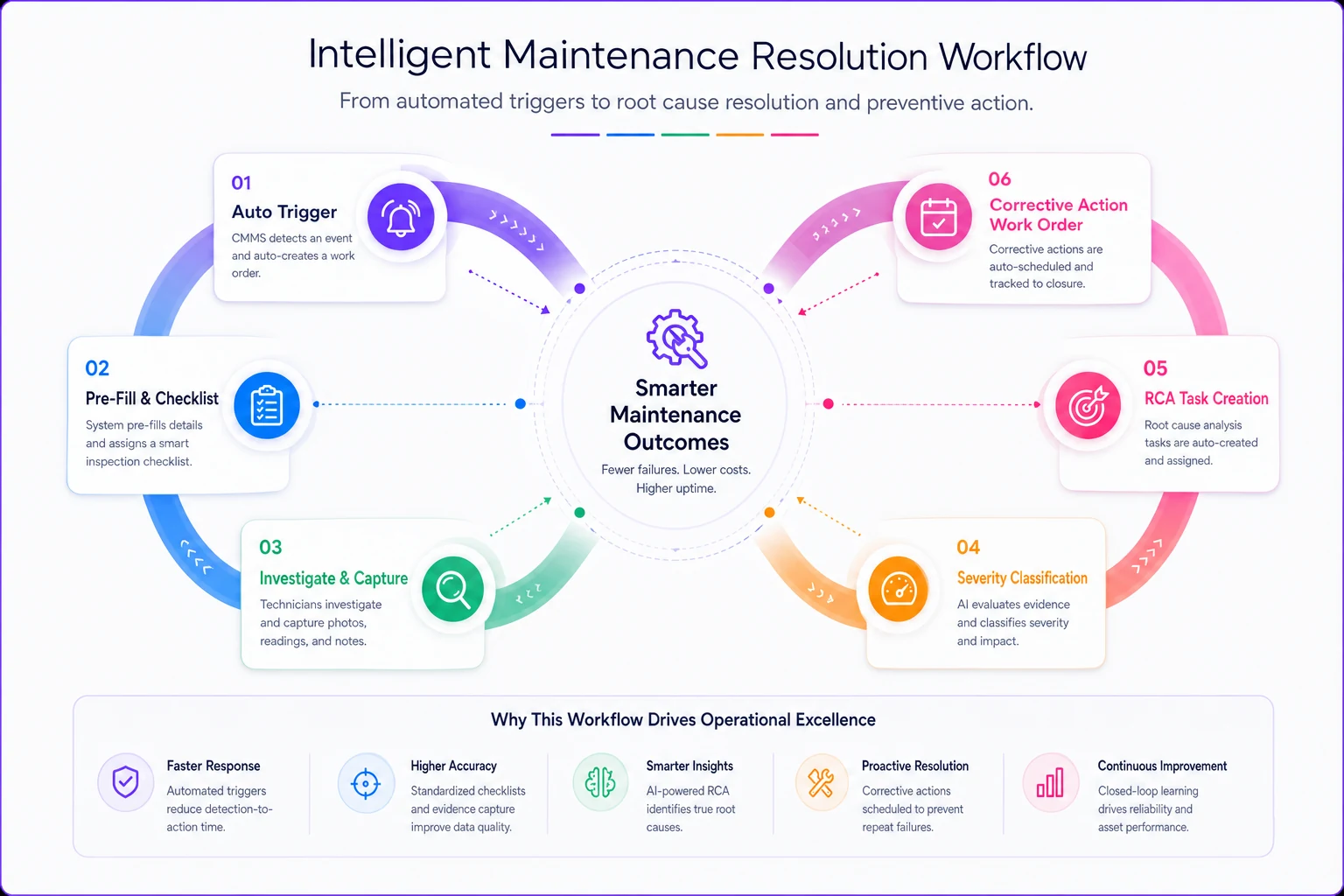
This keeps your team from over-analyzing minor issues while making sure critical failures get proper attention.
Evidence collection that maintenance techs will actually complete
The evidence checklist needs to mirror how techs naturally investigate failures. Forget abstract categories—focus on concrete, observable data points.
Pre-Failure Conditions
-
Runtime hours since last PM
-
Operating parameters at failure (pressure, temp, speed, load)
-
Recent operational changes or abnormal runs
-
Environmental conditions (temperature, humidity, contamination)
-
Last three work orders on this asset
Failure Point Evidence
-
Specific component that failed
-
Failure mode (wear, fracture, contamination, overload)
-
Photo documentation requirements (overall, close-up, comparison to new part)
-
Unusual sounds, smells, or vibrations noted before failure
-
Control system alarms or warnings preceding failure
Post-Failure Verification
-
Measurements taken (clearances, voltages, resistances)
-
Oil/fluid sample results if applicable
-
Coupling alignment readings
-
Vibration signatures
-
Thermal imaging results
Require only the most actionable measurements (e.g., amp draw, alignment readings) on the initial checklist so techs can complete evidence collection in under two minutes.
Structure these as checkbox lists with optional photo attachments, not essay prompts. A tech can check boxes while troubleshooting—they won't write paragraphs.
Map your CMMS fields to support pattern recognition
Your CMMS probably has dozens of fields, most staying empty because they're too generic. Map specific fields for RCA pattern tracking:
Failure Coding Structure
-
Problem (what failed)
Motor | Bearing | Seal | Coupling | Control
-
Cause (why it failed)
Wear | Overload | Contamination | Misalignment | Voltage
-
Detection (how found)
PM inspection | Operations report | Catastrophic | Monitoring alert
-
Action (what fixed it)
Replace | Adjust | Clean | Lubricate | Recalibrate
Operational Context Fields
-
Production status during failure (running, changeover, startup, shutdown)
-
Product type being processed (if applicable)
-
Operator on duty
-
Recent maintenance performed within the last week
-
Weather conditions (for outdoor equipment)
These fields seem minor but reveal patterns. That pump that keeps failing? Turns out it only fails during product changeovers when operators run it dry for thirty seconds.
The corrective action register that drives real prevention
Most corrective action registers become graveyards of good intentions. "Implement better PM program" sits there for months with no owner, no deadline, no specifics. Here's a structure that actually drives action:
Action Classification
-
Immediate fix (completed during repair)
-
Short-term prevention (<30 days)
-
Long-term improvement (>30 days)
-
Design modification (capital project)
Detailed Action Fields
-
Specific action required (not "improve maintenance" but "add monthly vibration check to PM")
-
Asset/system affected
-
Owner assigned
-
Due date
-
Resource requirements (hours, parts, tools)
-
Verification method
-
Link to implementing work order
Copy-Paste Templates by Failure Mode
Bearing Failure - Contamination
-
Immediate
Replace bearing, inspect seals
-
Short-term
Add quarterly seal inspection to PM, install bearing isolators
-
Long-term
Evaluate upgraded seal design, improve area ventilation
Motor Failure - Overload
-
Immediate
Replace motor, verify correct HP rating
-
Short-term
Install load monitoring, add amp draw to operator rounds
-
Long-term
Review process parameters with operations, consider VFD installation
Pump Failure - Cavitation
-
Immediate
Replace impeller, check NPSH
-
Short-term
Add suction pressure gauge, train operators on minimum flow
-
Long-term
Redesign suction piping, install automatic recirculation valve
Having these templates means techs don't start from scratch—they modify proven action sets for their specific situation.
Closing the loop: from investigation to prevention
The hardest part isn't finding root causes—it's making sure corrective actions actually happen. A hospital facilities team had discovered that around 40% of their HVAC failures traced back to skipped filter changes. They knew the root cause, had the corrective action documented, but filters still weren't getting changed.
The breakdown happened between RCA completion and work order generation. Corrective actions lived in a spreadsheet nobody checked. The fix was straightforward: every corrective action had to generate a work order immediately, with automatic scheduling based on the action type.
Track completion rates. If corrective actions aren't hitting 80% completion within their due dates, your RCA process is just expensive theater. Weekly reviews of overdue actions, automatic escalation to maintenance managers, and tying completion rates to performance metrics all help—but the real key is making actions specific enough that techs can execute them without interpretation.
When your maintenance RCA playbook pays off
A manufacturing facility running this structured approach tracked results over six months. They investigated 47 triggered failures, identified 31 addressable root causes, and implemented corrective actions for 26 of them. Their repeat failure rate dropped from 34% to 11%, and emergency work orders decreased by roughly 40%.
The real value comes from pattern visibility across assets. When three different pumps show cavitation damage, you stop treating them as isolated incidents and start looking at systemic issues—maybe operators need training on minimum flow requirements, or your system design has inherent NPSH problems.
Making RCA sustainable with the right operational foundation
The difference between RCA programs that stick and those that fade comes down to integration. Standalone forms and separate corrective action lists create extra work that doesn't get done. When your RCA process lives inside your work order flow—evidence collection happens during troubleshooting, corrective actions automatically become scheduled work orders—the process sustains itself.
This is where modern operational software makes a real difference. Instead of juggling paper forms, spreadsheet registers, and manual follow-ups, AI-powered maintenance platforms can automatically trigger RCA workflows based on your criteria, prompt techs for specific evidence during work order completion, and schedule corrective actions without anyone manually pushing them through. The investigation becomes part of the repair process, not an addition to it.
Pattern recognition that would take hours of spreadsheet analysis can happen in the background—flagging when multiple assets show similar failure modes, surfacing proven corrective actions from your template library. Your lead tech's knowledge about that bearing failure pattern gets captured and shared across shifts, not lost when they move on.
Start with your highest-impact failures
Don't try to implement RCA for every failure at once. Start with your top five problem assets—the ones eating the most downtime or maintenance hours. Build your evidence checklists and corrective action templates around those specific failure modes. Get the process working before expanding.
Focus on making documentation painless. If techs are spending more than two minutes on evidence collection, simplify the checklist. If corrective actions aren't getting completed, make them more specific or break them into smaller tasks. The goal is systematic prevention that happens automatically, not perfect documentation that never gets used.
Your RCA playbook succeeds when techs stop seeing the same failures repeatedly, when tribal knowledge becomes institutional memory, and when "we've always had problems with that pump" turns into "we fixed that pump's root cause six months ago and haven't touched it since."
The path from reactive firefighting to systematic prevention requires structure, but not complexity. With clear triggers, practical evidence collection, and automatic corrective action scheduling, RCA becomes part of maintenance execution rather than overhead. Each investigated failure builds your knowledge base, making the next investigation faster and more effective.
Stop accepting repeat failures as inevitable. With the right maintenance RCA playbook, those recurring problems become one-time fixes. The motor that failed every three weeks? After proper RCA, it runs for two years straight. That's the difference between maintenance that just fixes things and maintenance that actually prevents them.
Ready to optimize your maintenance operations?
Join 2,000+ facilities using Openfixit to reduce unplanned outages, extend asset life, and improve operational efficiency.