



The headlines this month are sending mixed signals, and if you run facilities across retail or logistics sites you've probably already felt it. A recent CNBC report noted that big employers like Amazon and UPS are posting fewer traditional short‑term "seasonal" roles this year while leaning harder into part‑time and warehouse/fulfillment hires. At the same time, Indeed's Hiring Lab shows seasonal postings up roughly 10% year‑over‑year — but that growth is concentrated in loading and fulfillment, not the broad store‑and‑temp hiring we used to see.
For most people reading the business press, that's a labor-market story. For maintenance leads, it's an asset-runtime story wearing a labor-market costume. The shift tells you two things at once: your buildings are going to run harder in specific places, and the usual flood of temporary hands won't show up the same way. That combination quietly rewrites your PM schedule, your parts reorder points, and your overtime budget — and most teams won't notice until week three of December when the conveyor drive at the busiest DC starts throwing faults.
The real signal buried in the hiring data
Strip away the labor-market framing and the operational read is this: demand is getting concentrated. Fewer scattered seasonal retail roles and more fulfillment hires means volume is funneling into high-throughput warehouse and sortation environments. That's where the parcels move, that's where equipment runs 18–20 hours a day during peak, and that's where mechanical wear accelerates non-linearly.
A store might go from normal to busy. A fulfillment center goes from busy to redlined.
That matters because maintenance planning usually treats a portfolio evenly — same PM cadence across sites, same parts buffers, same technician coverage model. When demand concentrates, even coverage becomes the wrong strategy. You end up over-maintaining quiet retail sites and under-protecting the two or three facilities actually carrying the peak.
The second signal is subtler. The decline in short-term temps doesn't just affect the warehouse floor — it drains the informal labor pool maintenance teams have historically borrowed from. In a lot of multi-site operations, peak coverage quietly depended on temporary hands doing low-skill support work: clearing jams, basic housekeeping around assets, staging materials. That freed skilled technicians to focus on actual repairs. Thin that pool out and your licensed techs absorb the overflow. That's where burnout and overtime creep in — not from more breakdowns, but from fewer people handling the small stuff.
Where this bites first: the assets that feel concentration
When fulfillment runtime climbs, failures don't spread evenly. They cluster on a predictable short list.
Eliminate downtime with proactive maintenance.
Openfixit helps you plan, track, and complete maintenance efficiently—maximizing asset reliability.
- Centralized asset management
- Automated maintenance scheduling
- Inventory and parts tracking
No credit card required
| Asset group | What changes at peak | Early failure signal | What usually gets missed |
|---|---|---|---|
| Conveyor drives & motors | Near-continuous runtime, higher start/stop cycles at sortation | Bearing temp drift, belt tracking issues | PM intervals set for "normal" duty, not peak duty |
| High-bay HVAC / ventilation | More bodies, more equipment heat, doors cycling constantly | Rising return-air temps, filter loading faster | Filter change cadence too slow for the dust load |
| Material-handling (lifts, pickers, tuggers) | Double shifts, less idle recovery | Hydraulic temp, battery cycle degradation | Battery rotation plans built for single-shift use |
| Dock equipment (levelers, doors, restraints) | Far more cycles per day | Hydraulic leaks, seal wear | Treated as "set and forget" until one fails mid-shift |
| Compressed air systems | Longer duty cycles feeding pneumatic tools | Pressure drop, moisture in lines | Drain and filter PMs skipped during the rush |
The pattern across all of these is the same: PM intervals calibrated for normal duty quietly become inadequate when runtime jumps 30–50% for six straight weeks. A grease interval that's fine at 10 hours/day of conveyor operation is not fine at 19 hours/day. The asset doesn't care what your calendar says — it wears on operating hours.
If you can't automate runtime triggers, assign a person to log cycle counts twice weekly for peak assets.
That's the first adjustment worth making right now: shift your critical peak assets from calendar-based PM to runtime- or cycle-based triggers for the duration of the season, then revert in January. You don't need to re-engineer your whole program — just a temporary peak profile for maybe 15–25 assets that are actually carrying the load.
The mistake most teams make going into peak
The common error isn't doing too little maintenance. It's doing the same maintenance everywhere while the risk profile has completely shifted.
Here's how it usually plays out. The PM schedule was built months ago, evenly distributed to smooth technician workload across the year. Nobody wants to pile PMs into December, so the system keeps generating the normal mix — the quarterly HVAC check at the slow retail store, the monthly inspection at the DC that's now running flat out. Technicians work the queue in order. Meanwhile the assets actually under stress don't get extra attention because nothing in the schedule flagged that they should.
Then a conveyor goes down on a Tuesday in mid-December. The repair itself takes two hours. But displaced work, overtime to catch up, and an emergency parts order at premium shipping turn a $400 fix into something closer to $2,500–$3,000 all-in once you factor in throughput loss and the scramble.
The deeper problem is that the schedule reflects last quarter's reality, not the next six weeks'. Nobody re-sequenced when the demand picture changed. This is exactly the failure mode a demand-driven approach is built to prevent — matching capacity and work to where demand actually lands instead of where it was originally forecast. We've written about this in the demand-driven maintenance capacity planning model for multi-site teams, and the logic applies directly here.
A six-week re-sequencing plan
You don't have time for a redesign. You need a focused reset.
This sequence works even if you're already into the rush.
-
Rank your sites by actual peak load, not by size. Pull throughput or shift-hour data from operations. The two or three sites carrying real volume get a different maintenance posture than the rest. Don't guess — ask the ops managers what's redlined.
-
Pull critical PMs forward now. Anything due in the next six weeks on a peak-load asset: do it this week if you can. A grease job or belt inspection done early costs you an hour. The same work as an emergency costs you a shift.
-
Convert peak-asset PMs to runtime triggers temporarily. For your 15–25 highest-risk assets, switch the trigger from calendar to operating hours or cycle count. If you can't automate it, assign a named person to check runtime counters twice a week.
-
Defer low-risk PMs at quiet sites — deliberately, with documentation. The quarterly check at the slow store can slip three weeks without real risk. Document the decision so it's a choice, not a miss. This frees the labor you need elsewhere.
-
Tighten reorder points on peak-critical spares. Belts, bearings, drive components, filters, hydraulic seals, dock parts. Raise the reorder threshold and safety stock on the specific SKUs tied to your redlined assets — not the whole catalog. Premium shipping in mid-December eats any savings from running lean.
-
Lock in contractor coverage before everyone else does. Your HVAC and material-handling contractors are getting the same demand surge. Confirm response windows in writing now. Verify arrival with photo and timestamp tied to the work order so you're not paying for visits that didn't fully happen.
-
Build a short daily huddle for peak sites only. Ten minutes. What ran hot yesterday, what's queued, what parts are short. This catches the drift before it becomes a Tuesday breakdown.
Use the steps above as a short checklist you can run through with ops and the CMMS lead to reassign work for the next six weeks.
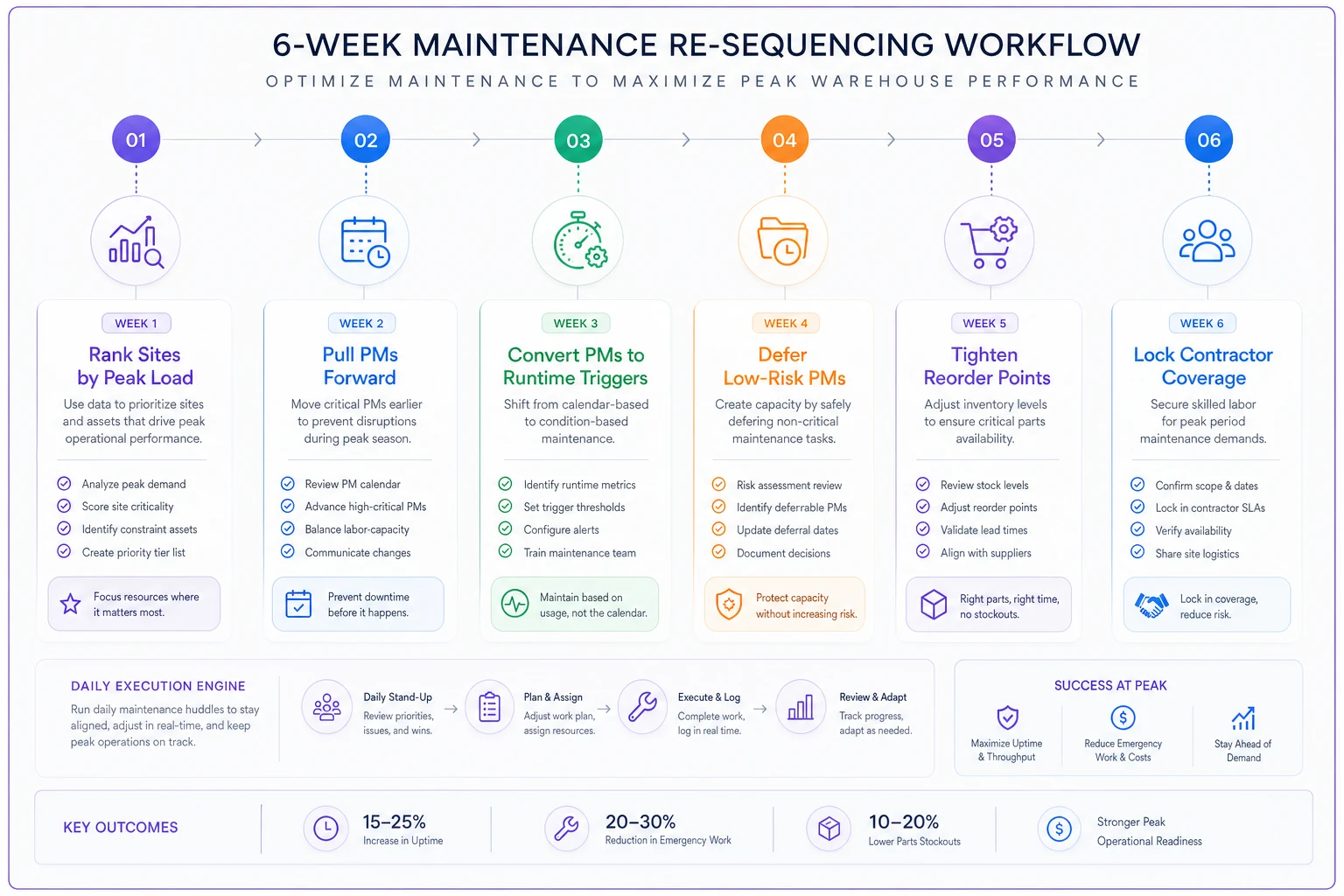
Keep a copy of this flow visible for the team handling peak sites so the sequence becomes operational, not just a plan.
A quick field checklist before the rush fully lands
Run through this per high-load site. If you can't check a box, that's your next task.
-
Peak-load assets identified and tagged separately in the CMMS
-
Runtime/cycle triggers set on those assets for the season
-
Next-six-weeks PMs on critical assets pulled forward or scheduled
-
Spare-parts reorder points raised on peak-critical SKUs only
-
Contractor response windows confirmed in writing
-
Arrival verification (photo/timestamp) tied to contractor work orders
-
Mobile/offline work-order capture tested at the site
-
Overtime budget and technician coverage reviewed against expected load
-
Low-risk PMs at quiet sites formally deferred and documented
This list isn't exhaustive, but if you hit all nine boxes at each high-load site before volume spikes, you've already closed most of the gap where teams get surprised.
Why offline-reliable capture matters more during peak
One thing that catches teams off guard: during peak, the weak points in your data capture become operational weak points. When a tech fixes a jammed sortation line at 11pm in a dead-signal corner of a high-bay and the mobile work order won't save, that repair either doesn't get logged or gets reconstructed from memory later. Multiply that across a hundred small fixes a week and your parts usage, failure history, and audit trail all drift.
That drift isn't just a records problem. It means your January analysis — what failed, how often, which assets need capex — is built on holes. And if you're in a regulated or audited environment, missing documentation from the busiest month of the year is exactly what an auditor circles.
Capture has to work where the work happens, not just where the Wi-Fi is strong. That sounds obvious, but it's the kind of thing that gets skipped during procurement because it's not visible until 11pm in December.
When the "even coverage" approach still makes sense
Not every portfolio should scramble to re-sequence. If your sites are genuinely uniform in load — a chain of similar retail footprints with no concentrated fulfillment — even coverage is reasonable and adding a peak profile just creates confusion. The concentration play matters specifically when volume funnels unevenly, which is exactly what this year's hiring shift signals for warehouse-heavy operators.
If your peak demand is modest — a 10–15% bump rather than a 40% surge — pulling PMs forward and tightening a handful of reorder points is probably enough. You don't need runtime triggers and daily huddles for a gentle rise. Match the response to the actual load.
Single-site operations with predictable demand and a stable technician bench probably shouldn't bother with aggressive re-sequencing at all. The overhead outweighs the benefit. This whole approach earns its keep when you're juggling multiple sites with uneven load and a labor pool that just got thinner.
A realistic scenario
A regional 3PL running four distribution sites went into last peak with a flat PM schedule and the usual assumption that extra seasonal hands would cover the floor. The temp pool came in lighter than planned. By the second week of December, two of the four sites were running near-continuous, and skilled techs were spending hours a day on jam clearing and housekeeping that temps normally handled.
The outcome was predictable in hindsight: a conveyor gearbox at the busiest site failed after missed grease intervals, three emergency parts orders at premium freight, and overtime that ran roughly 20–25% over plan for the month. Nothing catastrophic, but a genuinely avoidable drain — somewhere in the low thousands per incident once throughput loss was factored in.
The reset the following year wasn't complicated. They tagged about 18 peak-critical assets, switched those to runtime-based PMs for the season, pulled critical grease and inspection work forward into early November, and raised reorder points on maybe a dozen SKUs. Overtime came back closer to plan, and emergency freight orders mostly disappeared because the parts were already on the shelf. The fix wasn't more maintenance. It was maintenance pointed at the right assets at the right time.
The underlying lesson for this peak
The hiring shift this year is a reminder that your maintenance plan is only as good as its most recent assumptions about demand. Volume is concentrating into fulfillment, the informal labor buffer is thinner, and the assets carrying peak are going to run harder than your calendar-based schedule accounts for.
None of that requires a dramatic overhaul. It requires looking honestly at where load is actually landing, moving your attention and your parts to those few assets, and documenting the trade-offs so deferrals are decisions rather than accidents. Teams that do this quietly sail through peak. Teams that run the same schedule everywhere find out the hard way — usually on a Tuesday in mid-December — which assets they should have been watching all along.
Teams that do this quietly sail through peak. Teams that run the same schedule everywhere find out the hard way — usually on a Tuesday in mid-December — which assets they should have been watching all along.
Ready to optimize your maintenance operations?
Join 2,000+ facilities using Openfixit to reduce unplanned outages, extend asset life, and improve operational efficiency.