

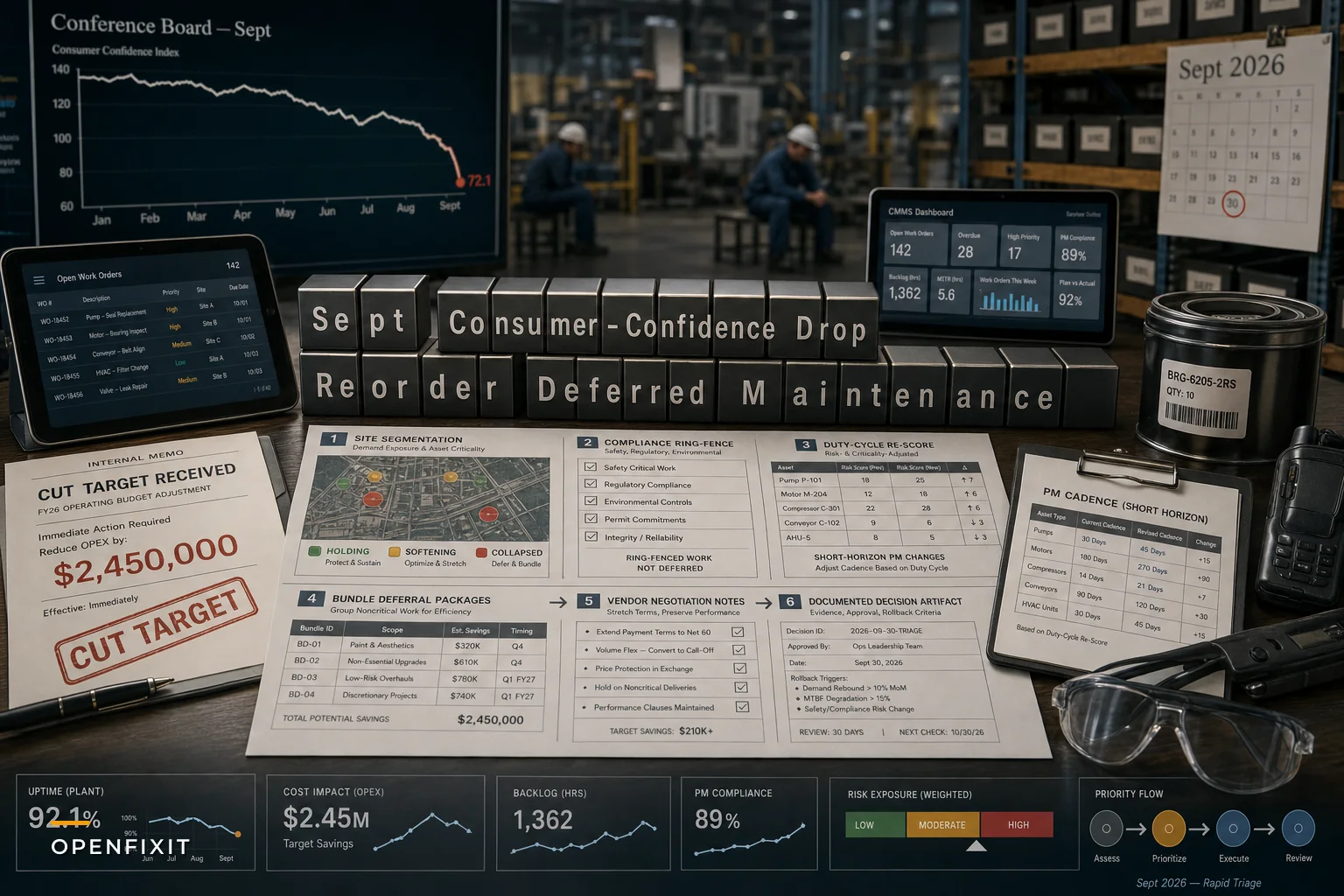

The Conference Board's September 2026 reading landed hard. Consumer confidence slid to 81.9, a 6.7-point drop and the lowest level since 2014. CNBC put it plainly — optimism cratering as households brace for higher prices and shakier jobs. For most people that's a macro headline and nothing more. For anyone running maintenance across a multi-site portfolio, it's a signal that your deferred-maintenance list is about to get re-litigated by finance — whether you're ready or not.
What doesn't show up in the press release: a confidence drop this size doesn't translate into one clean budget cut. It translates into a slow, uneven squeeze that hits different sites at different times. The maintenance leaders who get caught flat-footed are the ones treating their backlog like a static list instead of a living risk register.
What a confidence drop actually does to your sites
Consumer confidence feeds foot traffic, and foot traffic feeds the revenue that justifies your maintenance spend. But the transmission isn't uniform. A sharp drop like September's tends to show up first as reduced discretionary visits — the second coffee run, the weekend browse, the impulse retail stop. Essential-traffic sites barely move. Discretionary-traffic sites feel it within weeks.
That matters because most portfolios carry both, and finance tends to apply a single blended cut across the board. That's the first mistake. When a 10% opex reduction lands equally on your highest-traffic grocery-anchored site and your softest mall location, you've mispriced risk in both directions — over-protecting the site that's already struggling and under-protecting the one still carrying real revenue.
The pattern that shows up when confidence drops fast: budget cuts arrive before demand actually falls at the asset level. Finance reacts to the macro signal. Your buildings respond on their own lag. For maybe six to ten weeks, you're being asked to cut spend on equipment that's still running at full duty cycle. That gap is where deferred maintenance gets dangerous — deferring a PM on an asset that's still working hard is a very different bet than deferring one on an asset that just went quiet.
The real exposure: your backlog was never prioritized for a downturn
Most deferred-maintenance lists are organized around capital planning calendars — this quarter, next fiscal year, the five-year plan. That organizing logic falls apart the moment the assumptions underneath it shift: occupancy, hours, revenue per site.
Eliminate downtime with proactive maintenance.
Openfixit helps you plan, track, and complete maintenance efficiently—maximizing asset reliability.
- Centralized asset management
- Automated maintenance scheduling
- Inventory and parts tracking
No credit card required
In practice, the backlog gets frozen in the shape it had when times were good. A chiller overhaul that made sense when the site ran 14-hour days might be completely deferrable now that hours are getting trimmed — but nobody revisits it, so it sits there competing for scarce dollars against work that genuinely can't wait. Meanwhile a roofing repair that seemed low-urgency gets quietly pushed another cycle, even though a leak into an electrical room doesn't care about consumer sentiment.
The exposure isn't that you have deferred work. Every portfolio does. The exposure is that your current ranking logic assumes stable demand, and that assumption just broke. Three things get mispriced the instant confidence drops:
-
Duty-cycle-sensitive work gets over-prioritized. You're still scheduling PMs at intervals built for peak operating hours that may not return this year.
-
Safety and compliance work gets bundled with "discretionary" and cut together, because the person holding the red pen doesn't see the regulatory distinction on a spreadsheet row.
-
Revenue-protective repairs lose their urgency framing. When the site is quieter, it feels fine to defer the thing that keeps customers comfortable — right up until the equipment fails during the one busy weekend you still have.
The instinct under budget pressure is to cut from the bottom of the list. That's backwards. The right move is to re-score the whole list against the new demand reality, then cut from the new bottom — which will look different from the old one.
Re-scoring, not re-cutting
This is where a structured scoring approach earns its keep. If you already run a project-scoring and bundling matrix for deferred maintenance, a confidence shock is exactly the event that should trigger a re-run with updated occupancy and hours inputs. If you don't have one, this is the forcing function to build it — scoring work by gut feel under budget stress defaults to whoever argues loudest in the room.
A workable re-scoring pass weighs four things, and the relative weights shift in a downturn:
| Factor | Normal weighting | After a confidence drop | Why it changes |
|---|---|---|---|
| Safety / regulatory exposure | High | Non-negotiable floor | Downturn or not, a failed inspection or incident costs more than any PM you deferred |
| Revenue-protection (uptime at active sites) | High | High, but site-specific | Protect uptime where traffic remains; relax where hours are genuinely cut |
| Duty-cycle / wear-driven PM | Medium | Lower | Reduced operating hours legitimately extends some intervals |
| Long-horizon capital renewal | Medium | Deferrable | Easiest honest deferral when cash is tight and asset isn't near failure |
The insight most teams miss: a downturn is one of the few moments where deferring maintenance is defensible rather than negligent — but only for the duty-cycle-driven work, and only if you can prove the duty cycle actually dropped. Deferring compliance work is never defensible. Deferring revenue-protection at a still-busy site just moves the cost from a planned PM to an emergency call plus lost sales.
A practical re-prioritization sequence
When the cut target lands on your desk, run through this before you touch the list:
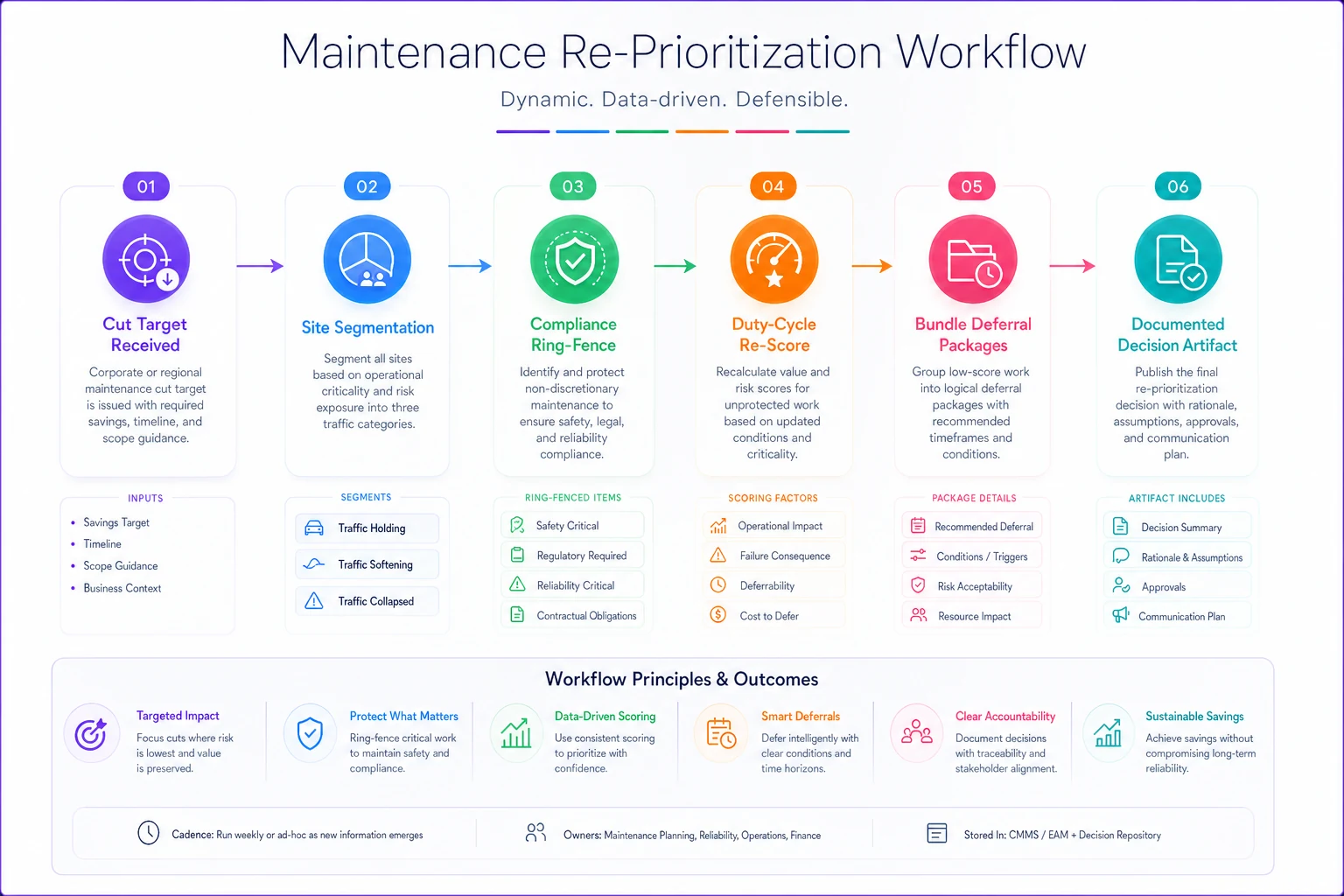
Use this flow as a quick visual checklist for the re-prioritization steps.
-
Pull actual operating hours and occupancy per site for the last 30–60 days, not the annual assumption. You need current duty cycle, not budgeted duty cycle.
-
Segment sites into three buckets
traffic holding, traffic softening, traffic collapsed. Your cut strategy differs for each.
-
Flag every safety and compliance item and remove it from the negotiable pool entirely. Make it visible to finance as a separate, protected line so it doesn't get swept into a blanket percentage cut.
-
Re-score duty-cycle PMs against current hours. Assets now running fewer hours earn interval extensions — document the justification so it survives an audit later.
-
Protect uptime hard at traffic-holding sites. This is where a failure still costs real revenue. Cutting here to hit a blended target is the most expensive kind of savings.
-
Bundle the deferrable work into coherent packages tied to budget cycles, so when money frees up you can release logical groups rather than scrambling to re-scope.
-
Document the re-score itself as an artifact — dates, inputs, decisions. Six months from now, when someone asks why a PM slipped, the answer needs to be a defensible decision, not a lapse.
The step people skip is number one. They re-prioritize against last year's assumptions because pulling real recent hours per site is tedious when the data is scattered across BAS exports, scheduling systems, and spreadsheets. But re-scoring against stale duty-cycle data just reproduces the old ranking with new anxiety attached.
A real scenario
Consider a regional operator running around 40 mixed retail and quick-service sites. When the confidence number dropped, corporate handed maintenance a roughly 12% opex reduction target for the back half of the year, applied flat across the portfolio.
The team's first pass — cutting from the bottom of the existing backlog — would have deferred a fire-suppression inspection at two sites (bundled in as "low activity") while keeping full-interval RTU PMs at four locations that had quietly cut to six-hour days. It would have cut the one thing that could never be cut and preserved spend on equipment that was barely running.
After re-scoring against actual operating hours, the picture inverted. Compliance items came out of the negotiable pool entirely. The low-duty sites earned PM-interval extensions that were defensible on paper, freeing up somewhere in the $18k–$22k range without touching anything safety-related. That freed-up budget got redirected toward uptime protection at the six highest-traffic sites — the ones still carrying the revenue that justified the whole portfolio. They hit the cut target, preserved every compliance obligation, and strengthened coverage where failures still mattered. The savings weren't dramatic, but the risk profile was far cleaner than the flat-cut version would have produced.
When deferring is smart — and when it's quietly reckless
Deferring makes sense when: the asset's duty cycle has genuinely dropped, you can document the reduced load, it's not safety- or compliance-related, and failure wouldn't interrupt revenue at a site still drawing traffic. A chiller running half its normal hours can often absorb a stretched PM interval without meaningful added risk.
Deferring is a bad idea when: the item carries any regulatory weight, when the asset protects a revenue-active site, or when deferral just converts a scheduled cost into a probable emergency cost. The math on emergency HVAC service plus lost customer comfort on a busy day almost never favors the deferral you made to save a few hundred dollars.
Who should be especially careful: operators whose "low-traffic" sites are seasonal rather than structurally soft. Confidence drops and seasonal lulls look identical on a traffic chart for a few weeks — until the season turns and the equipment you deprioritized gets hit with full demand it's no longer maintained for.
Keeping the re-score honest over time
The one-time re-ranking isn't what makes this work across a full downturn. It's keeping the inputs current as conditions keep shifting. Confidence doesn't drop once and stabilize; it drifts, and your site-level demand drifts with it on a lag. A backlog re-scored in September against September's hours is stale by November if traffic kept sliding.
Keep duty-cycle and occupancy data feeding your backlog so re-scoring is fast and defensible.
This is the practical argument for keeping duty-cycle and occupancy data flowing into whatever system holds your backlog, rather than treating re-prioritization as a quarterly fire drill. When current operating hours sit next to each deferred work order, re-scoring becomes something you can run in an afternoon instead of a two-week data-gathering project. That's the difference between adjusting ahead of the squeeze and reacting after finance has already made the decision for you.
The macro signal is just the trigger. The real work is making sure that when budgets tighten, the things that get deferred are the things that can be deferred — and that every protected line, especially safety and compliance, is visible and defensible before anyone reaches for the red pen. A downturn doesn't have to erode your reliability. Handled well, it's one of the cleaner opportunities you'll get to prove your backlog was built on risk, not habit.
Ready to optimize your maintenance operations?
Join 2,000+ facilities using Openfixit to reduce unplanned outages, extend asset life, and improve operational efficiency.