


Every facilities team carries a graveyard of deferred work. Roof patches pushed two winters ago. A pump rebuild that keeps getting bumped. Lighting retrofits that made the list three budget cycles running and never got money. Individually, each deferral felt reasonable. Collectively, they become a liability nobody can explain to finance.
The core problem isn't deferral itself — that's a legitimate financial tool. The problem is that most teams defer inconsistently. A squeaky-wheel manager gets his project funded while a quietly degrading fire damper waits another year. There's no shared logic, so the backlog grows in ways that don't map to actual risk or return. Then something fails, and suddenly everyone wants to know why it wasn't caught.
A prioritization matrix fixes the decision layer, not just the list. It gives you a repeatable way to score hundreds of deferred items, bundle the ones that make sense together, and translate all of it into a one-page ask that survives a budget meeting.
Why deferred backlogs rot in predictable ways
Deferred maintenance doesn't stay flat. It compounds, and it compounds unevenly across categories most teams don't track separately.
Backlogs tend to fail along three axes at once:
-
Safety and compliance items get buried under volume. A life-safety deficiency looks identical to a cosmetic repair when everything's just a line in a spreadsheet. Once you have 400+ open deferred items, the critical ones stop standing out.
-
Lifecycle timing gets ignored. A motor at year 12 of a 15-year life and a motor at year 3 get treated the same because nobody's connecting the work order to the asset's actual condition curve.
-
The cheap-to-bundle work never gets bundled. Five separate small jobs in the same mechanical room, each requiring its own mobilization, its own shutdown, its own contractor visit. Done separately they cost 40% more than if you'd grouped them.
The deeper issue is coordination. Deferral decisions usually happen in isolation — one at a time, whenever someone brings it up — instead of as a portfolio evaluated together. A portfolio view changes everything, because it lets you compare a $2,000 safety fix against a $30,000 efficiency upgrade using the same yardstick.
Build the score before you build the list
Most matrices fail because people jump straight to ranking without agreeing on the dimensions first. You end up with a number that feels precise but means nothing.
Eliminate downtime with proactive maintenance.
Openfixit helps you plan, track, and complete maintenance efficiently—maximizing asset reliability.
- Centralized asset management
- Automated maintenance scheduling
- Inventory and parts tracking
No credit card required
Score every deferred item on four dimensions. Keep the scales short — 1 to 5 — because false precision is worse than useful roughness.
1. Safety and compliance severity. This is the override dimension. A code violation, a life-safety impairment, or anything with regulatory exposure gets scored high regardless of cost. Don't let ROI logic drown out a fire-rated door that no longer closes.
2. Operational impact. If this fails, what stops? Score based on downtime consequence, redundancy, and how many people or processes depend on it. A single chiller with no backup serving a data closet scores very differently than one of four rooftop units on a lobby.
3. Lifecycle position. Where is the asset on its condition curve? Something near end-of-life with rising failure probability scores higher than a young asset. This is where your CMMS history and manufacturer data actually earn their keep.
4. ROI / cost avoidance. Energy savings, avoided emergency-repair premiums, reduced overtime, extended asset life. Some of this is soft, and that's fine — score the direction and magnitude, not a spreadsheet-perfect NPV.
Here's a compact version of how the scoring dimensions play against each other:
| Dimension | What drives a high score | Common scoring mistake |
|---|---|---|
| Safety / compliance | Code violation, life-safety impairment, regulatory deadline | Treating "could be a hazard someday" the same as an active violation |
| Operational impact | No redundancy, high downtime cost, many dependents | Scoring by asset size instead of consequence of failure |
| Lifecycle position | Near end-of-life, rising failure rate, obsolete parts | Using install date instead of actual condition |
| ROI / cost avoidance | Energy savings, avoided emergency premiums, labor reduction | Only counting hard dollars, ignoring avoided downtime |
A simple weighting that works for most facility portfolios: safety carries a hard multiplier or veto, operational impact and lifecycle get roughly equal weight, and ROI acts as the tiebreaker between things that are otherwise close. If two items land at the same composite score, the one with better payback gets the funding.
The safety override rule (don't skip this)
One pattern worth calling out separately: a weighted score can quietly average away a genuine safety problem. If you multiply a 5-on-safety by a 1-on-ROI, the math can drop it below a mediocre efficiency project.
Don't let it. Build a hard rule that any item scoring at the top of the safety/compliance scale jumps to a mandatory-funding tier before the composite ranking runs. These don't compete with ROI projects. They come out of the pool first. Everything else fights over what's left.
This one rule is what keeps the matrix defensible when something goes wrong. You want to be able to show that critical items were categorically protected, not that they happened to rank well that quarter.
Bundling: where the real money hides
Scoring tells you what matters. Bundling tells you how to actually get it funded and done. Most frameworks skip this part entirely, which is a shame because it's where a lot of the savings actually live.
Bundle candidates share at least one of these:
-
Same location — multiple items in one mechanical room, on one roof, on one electrical panel.
-
Same shutdown window — anything that requires the same outage or production stoppage.
-
Same trade / mobilization — five small electrical items that each need the same licensed contractor.
-
Same asset system — components that fail together or should be renewed together.
Set a bundling threshold so you're not over-engineering it. A practical rule: bundle when combined items either (a) cross a capital threshold that makes the project easier to justify as one line, or (b) reduce total mobilization and shutdown cost by more than roughly 15–20%. Below that, the coordination overhead isn't worth it — just schedule them separately.
A worked example. A plant had eight deferred items scattered across one central utility area:
-
Two scored high on safety (a grounding deficiency, a guarding issue)
-
Three were mid-tier lifecycle renewals (valves, a small VFD)
-
Three were low-priority cosmetic items
Done separately, the estimate came to roughly $46k, largely because each job carried its own mobilization and two required overlapping shutdowns booked on different days. Bundled into a single planned outage, the estimate dropped to about $34k — and the two safety items got done in the same window instead of waiting for a separate approval. The bundle turned a scattered set of deferred items into one clean, fundable project.
That's the leverage. Bundling doesn't just save money; it creates a fundable unit out of items that were individually too small to compete for capital.
Turning scores and bundles into budget-cycle timing
A ranked, bundled list is still useless if it doesn't line up with how money actually flows. Deferred maintenance lives in the awkward space between operating budgets and capital budgets, and getting that classification wrong is how good projects die in committee.
The same project framed as capex versus opex can hit completely different approval paths and depreciation treatment. If you haven't nailed that down, working through how to map maintenance budgets to asset lifecycles and finance with defensible capex-vs-opex rules will save a lot of back-and-forth with your controller.
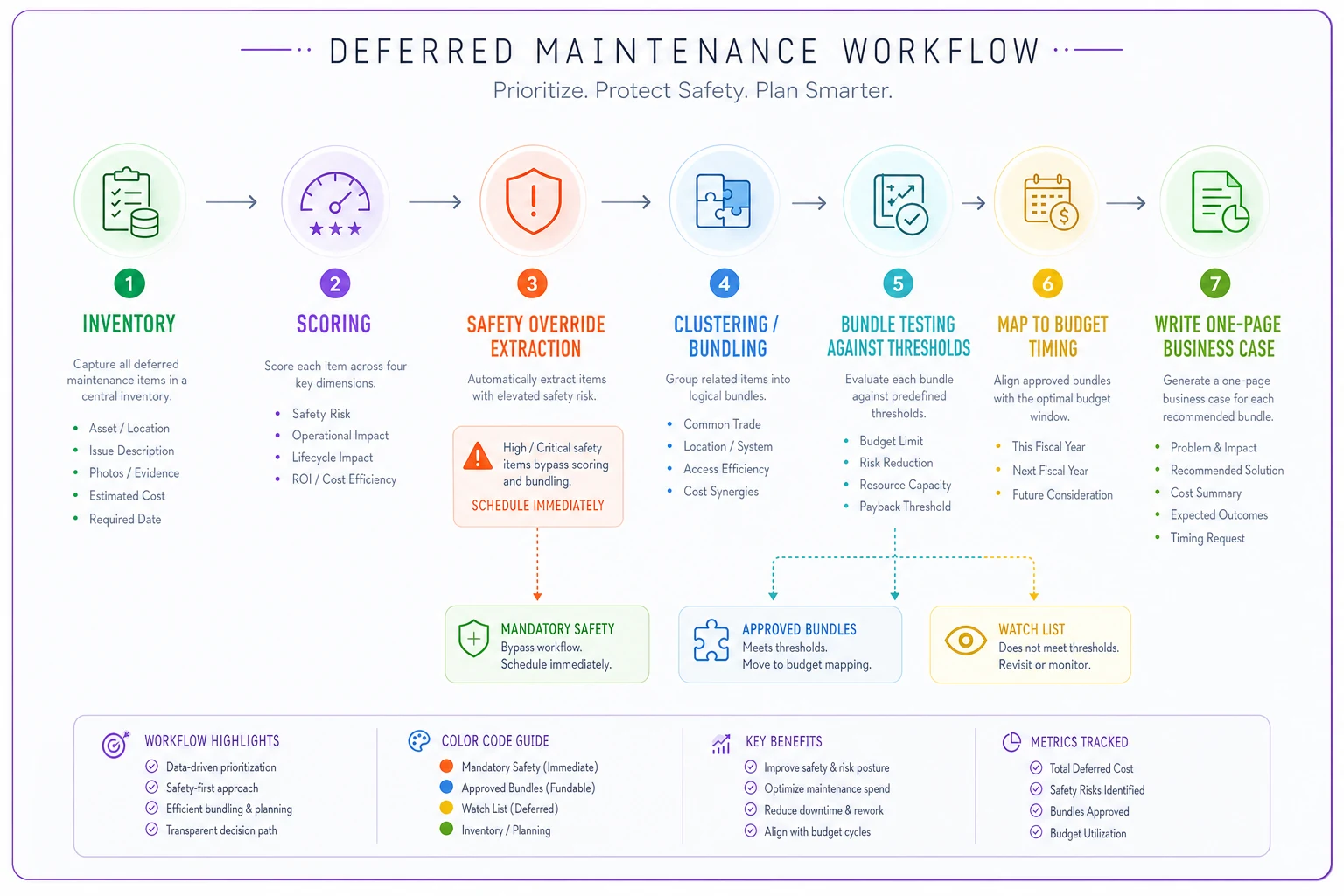
The workflow, end to end:
-
Inventory every deferred item with a rough cost, location, and asset link.
-
Score each on the four dimensions.
-
Pull safety/compliance items into the mandatory tier immediately.
-
Cluster the remainder by location, shutdown window, and trade to find bundle candidates.
-
Test each bundle against your threshold — does it cut cost meaningfully or create a cleaner capital line?
-
Map to budget timing — mandatory items to the nearest cycle, high-ROI bundles to the next capital round, low-scoring items to a watch list with a documented reason.
-
Write the one-pager for anything that needs approval.
Here's a simple visual of that workflow.
The watch list matters more than people expect. Deferring something with a documented rationale and a review date is a defensible decision. Deferring something because nobody looked at it is closer to negligence. The matrix converts the first kind into a paper trail and eliminates the second.
For items where the real question is how often you should be doing the work at all, it's worth separating true deferral from interval optimization — sometimes the right answer isn't to fund the work, it's to change the frequency. The logic in optimizing preventive maintenance intervals to balance labor and parts costs pairs naturally with the scoring approach here.
The one-page business case
If your ask can't fit on one page, it won't get read the way you want. Finance approves things they understand quickly. Here's the structure that consistently gets a yes — or at least a clear no with a reason:
-
Header Project/bundle name, total cost, requested funding cycle, capex or opex.
-
What it is Two sentences. The bundled scope, plainly stated.
-
Why now The composite score, and specifically the safety/compliance and lifecycle drivers. If it's a safety-tier item, say so first.
-
Cost of doing nothing The realistic downside — failure probability, downtime cost, emergency-repair premium, compliance exposure. This is the section that moves money.
-
Bundle savings If bundled, show the separate-vs-combined delta.
-
Payback / cost avoidance Simple numbers. Rough is fine; defensible beats precise.
-
Risk of deferral What changes if this waits one more cycle.
-
The ask One clear number, one clear timing.
The single biggest mistake in these one-pagers is leading with the solution instead of the cost of inaction. Nobody funds a valve replacement. They fund avoiding the shutdown the failed valve causes. Frame the downside first.
When this framework makes sense — and when it doesn't
It makes sense when you have more deferred items than budget, decisions are being made inconsistently, and you need to defend those decisions to finance or auditors. Basically, any portfolio past a few dozen open items.
It's overkill when your deferred list is short and the priorities are obvious. If you've got eight items and three are clearly urgent, don't build a scoring model — just do them. The matrix earns its cost at scale.
One group that should be careful: teams that treat the score as gospel. The number is a decision aid, not a decision. A composite of 3.4 versus 3.6 is not a meaningful difference — those are functionally tied, and judgment breaks the tie. Teams that rank to two decimal places and follow the list blindly end up funding the wrong things with great confidence.
Where the system usually breaks at scale
Once you're running this across multiple sites, a few failure points show up reliably.
Scoring drift is the first one. Different sites score the same condition differently — one facility's "3" is another's "5." Without calibration, your cross-site ranking becomes noise. The fix is a short scoring guide with anchored examples for each dimension, and an occasional joint review where sites score the same sample items and compare results.
Keep a short scoring guide with anchored examples and run an occasional joint calibration to keep cross-site scoring consistent.
The second is stale data. A deferred item scored eighteen months ago on lifecycle position may have crossed into failure territory since. Scores need a refresh cadence tied to your budget cycle, not a one-time exercise. Keeping deferred items live in your CMMS — linked to the actual asset, with condition and history attached — beats a standalone spreadsheet that nobody reopens. When scoring inputs pull from real work-order history and asset records instead of memory, the ranking stays honest and the re-scoring work stops eating a week of someone's time every quarter.
The third is the bundling window closing. You identify a great bundle tied to a shutdown, then miss the shutdown because the approval didn't move fast enough. Bundles are time-sensitive in a way individual items aren't. Flag them with their window and treat that window as a hard deadline in your budget calendar.
A short real scenario
A mid-sized manufacturing site had about 190 open deferred items and a habit of funding whatever the loudest department head pushed. The maintenance manager built a four-dimension score and re-ran the whole backlog over roughly two weeks.
Two things fell out immediately. First, three genuine compliance items had been sitting mid-list for over a year because they were cheap and nobody was pushing for them — they went straight to mandatory funding. Second, the location clustering surfaced two natural bundles tied to a planned annual outage that were previously being requested piecemeal across different quarters.
The bundled approach cut the combined estimate by roughly a quarter versus doing them separately, mostly through shared mobilization and a single shutdown window. More importantly, the next budget meeting ran differently. Instead of a defensive back-and-forth about individual line items, the manager brought seven one-pagers with clear cost-of-inaction framing. Five got funded on the spot. The two that didn't got a documented review date — which meant, for the first time, the deferral was a decision rather than an accident.
The point isn't the score — it's the discipline
A prioritization matrix works less because of the math and more because it forces a consistent conversation. Same dimensions, same thresholds, same one-page format, cycle after cycle. That consistency is what makes deferral defensible and what keeps genuinely dangerous items from hiding in the volume.
Start small. Score your current backlog on four dimensions, pull the safety items out, look for two or three obvious bundles, and write one clean business case. You'll learn more from running it once against your real list than from any amount of framework refinement. The backlog will still be there — but now it's a plan instead of a pile.
Start small. Score your current backlog on four dimensions, pull the safety items out, look for two or three obvious bundles, and write one clean business case. You'll learn more from running it once against your real list than from any amount of framework refinement. The backlog will still be there — but now it's a plan instead of a pile.
Ready to optimize your maintenance operations?
Join 2,000+ facilities using Openfixit to reduce unplanned outages, extend asset life, and improve operational efficiency.