

Most facility teams don't have an alert problem. They have an ownership problem that shows up as an alert problem.
You can tune thresholds all day, but if nobody actually owns a given signal — if it lands in a shared inbox, a group SMS, or three technicians' phones simultaneously — the alert doesn't get resolved faster. It gets diffused. And diffused alerts are the ones that turn into 2 a.m. escalations, missed compressor trips, and the awkward post-incident meeting where everyone swears they thought someone else had it.
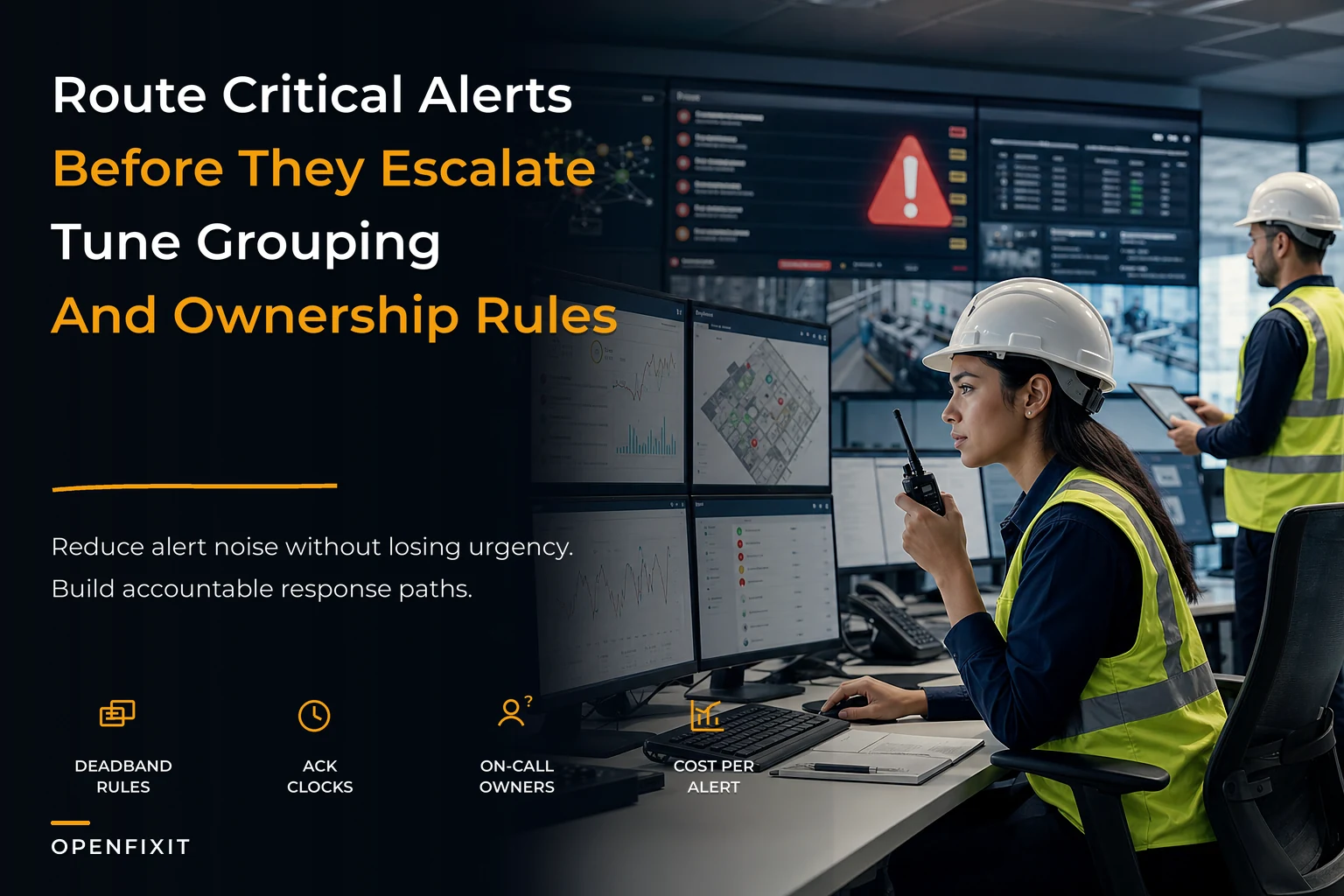
This is about the economics and routing structure underneath alerting: who owns what, how signals get grouped and dampened, what each alert actually costs you, and how to build routing templates that hold up when you go from 4 buildings to 40. Less about which sensor fires, more about what happens in the ninety seconds after it does.
Start with the unit economics, because that's what breaks first
Every alert has a cost, and almost nobody prices it. Once you do, most routing decisions make themselves.
The cost isn't the alert itself — it's the human response chain it triggers. A single "high discharge temp" notification might look free. But trace it: a technician stops what they're doing, opens the CMMS, checks the trend, decides it's noise, dismisses it, and re-contextualizes back into whatever they were doing. That's 6–8 minutes of real time, even for a false one.
Now multiply by volume. A mid-sized portfolio pushing 900–1,200 alerts a month, where 60–70% are nuisance, is quietly burning something like 70–110 technician-hours monthly on alerts that resolve to nothing. At a loaded labor rate, that's easily $4k–$6k a month evaporating on dismissals — before you count the alert fatigue tax, which is the real killer.
The pattern worth internalizing: the cost of a false alert is small individually and catastrophic in aggregate, because it doesn't just waste minutes. It trains your team to ignore the channel. Once technicians learn that 7 out of 10 pages are junk, they start responding slower to all of them — including the real one. That's the moment your alerting system stops being an asset.
So the first governance question isn't "what should we alert on." It's "what is the maximum false-positive rate we'll tolerate per channel before the channel loses credibility?" A useful working number: if a routing channel exceeds roughly 25% nuisance rate, people stop trusting it, and you need to either retune it or split it.
Ownership rules: one signal, one accountable human
The single most expensive mistake in alert routing is the "notify the group" default. It feels safe. It's actually the opposite.
Eliminate downtime with proactive maintenance.
Openfixit helps you plan, track, and complete maintenance efficiently—maximizing asset reliability.
- Centralized asset management
- Automated maintenance scheduling
- Inventory and parts tracking
No credit card required
When five people get the same page, diffusion of responsibility means the expected number who act on it can drop below one. This isn't a personality flaw — it's structural. Everyone reasonably assumes the closest or most relevant person will grab it. If routing doesn't designate that person, the assumption fails silently.
The fix is an ownership model with three tiers, applied per asset or asset class:
-
Primary owner — one named role (not a person, a role) accountable for first response. "Site 12 HVAC on-call," not "Marcus."
-
Escalation owner — where it goes if primary doesn't acknowledge within the SLA window.
-
Governance owner — who's accountable for the rule itself: its threshold, its routing, and whether it's still earning its place. This role almost never exists in facility teams, and its absence is why alert configs rot.
The role-not-person distinction matters more than it sounds. When ownership attaches to individuals, every vacation, shift change, and resignation punches a hole in your routing. When it attaches to roles that people rotate into, the routing survives turnover. A typical failure: a technician who built half the alert rules leaves, and six months later nobody can explain why the chiller alarms go to a phone number that's been disconnected.
Naming roles instead of individuals is one of those things that sounds bureaucratic until you've watched a portfolio lose coverage because the one person who understood the routing went on paternity leave.
Hysteresis and grouping: stop the same problem from paging you eleven times
If you've ever gotten twelve alerts in four minutes for one flapping sensor, you already understand why raw thresholds don't survive contact with reality. Signals that hover near a setpoint oscillate. Without dampening, one marginal condition becomes an alert storm, and alert storms are where real problems hide.
Two mechanisms handle most of this, and they're worth standardizing across the whole portfolio rather than tuning ad hoc:
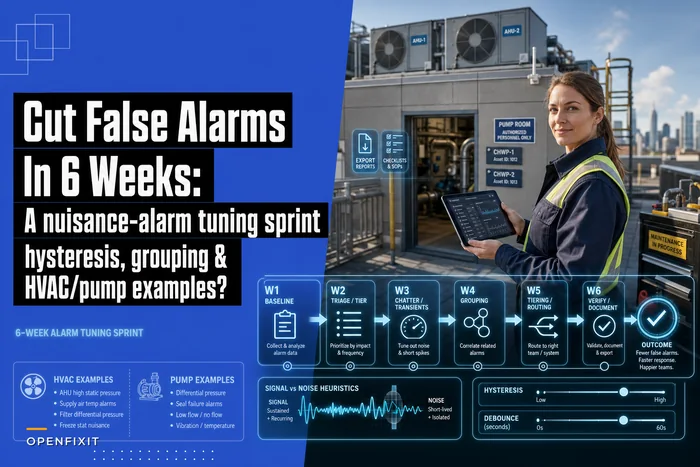
Hysteresis — separate the trigger threshold from the clear threshold so a signal can't rapidly re-fire. If high temp triggers at 82°F, it shouldn't clear until it drops below 78°F. That 4-degree deadband kills the flapping. The mechanics of this are covered in depth in the nuisance-alarm tuning sprint, and the same deadband logic applies whether you're dealing with temperature, pressure, vibration, or runtime.
Grouping and de-duplication — collapse related signals into one incident. If a rooftop unit throws high-head-pressure, high-discharge-temp, and low-airflow within the same window, that's one problem presenting three ways. Routing them as three separate alerts to three response chains is how you end up with two technicians dispatched to the same unit.
A 4-degree deadband is a simple starting point for temperature hysteresis.
A grouping standard worth adopting portfolio-wide:
-
Time window — signals from the same asset within a rolling 5–10 minute window group into one incident.
-
Parent-child suppression — when a parent condition fires (unit offline), suppress the children it obviously causes (all its downstream sensor alarms).
-
Storm caps — if any single asset generates more than N alerts in an hour, cap notifications and flag the asset for investigation rather than paging repeatedly.
-
Correlation across assets — a building-wide power event should generate one facility incident, not forty independent device alarms.
The insight most teams miss: grouping isn't just about volume reduction. It's about diagnostic accuracy. A well-grouped incident tells the technician "here's the whole picture" instead of forcing them to mentally reassemble twelve fragments while driving to site.
Routing by criticality: not every asset deserves the same machinery
Generic alerting fails at scale because it treats a lobby thermostat and a life-safety pump with the same routing weight. Criticality has to drive the entire response chain — the channel, the speed, the escalation aggressiveness, and how much nuisance you'll tolerate.
Here's a routing matrix structure that scales cleanly across a portfolio:
| Asset Criticality | Example Assets | Channel | Ack SLA | Escalation Path | Nuisance Tolerance | After-Hours |
|---|---|---|---|---|---|---|
| Critical (safety/compliance) | Fire pumps, emergency generators, med-gas, egress | Phone call + SMS | 5 min | Primary → Escalation (10 min) → Manager (20 min) | Near-zero — tune aggressively | Full escalation |
| High (operational core) | Main chillers, primary AHUs, critical process | SMS + app push | 15 min | Primary → Escalation (30 min) | Low (<10%) | On-call only |
| Medium (comfort/support) | Zone units, exhaust fans, non-critical pumps | App push + email digest | 4 hours | Primary → daily review | Moderate | Next business day |
| Low (convenience) | Lobby thermostats, minor sensors | Email digest only | Next business day | Ticket queue | High — batch it | Suppressed |
The pattern to notice: as criticality drops, alerts should move from interruptive channels to batched ones. A low-criticality signal has no business firing an SMS. Push it into a once-a-day digest and it stops competing for attention with the alerts that actually matter. Most teams over-route low-criticality signals and under-route the critical ones — which is exactly backwards.
One more field that belongs in this matrix but rarely makes it: who owns the rule's governance. For critical assets, someone should be reviewing the false-positive rate monthly. For low-criticality, a quarterly glance is fine. Governance cadence should scale with criticality, same as everything else.
What breaks when you go from a handful of sites to a portfolio
Alerting that works fine at four buildings tends to collapse somewhere between fifteen and thirty. The failure isn't gradual — it's a set of thresholds you cross.
Template drift. Each site's rules were built by whoever was there, so "high temp" means 80°F at one building and 85°F at another, with different routing and different escalation. When you try to report portfolio-wide, nothing's comparable. The fix is a template library — standard rule sets per asset class that sites inherit and can only override with documented reason. Ownership of the template sits centrally; local exceptions are logged, not silent.
Notification fatigue goes portfolio-wide. At four sites, a noisy sensor annoys one team. At thirty, a bad template replicated across the portfolio generates thousands of junk alerts and torches trust everywhere at once. This is why the cost-per-alert math matters — a 15% nuisance rate is survivable at small scale and financially serious at large scale.
On-call coverage gaps. With a few sites you can informally cover after-hours. Across a portfolio you need explicit on-call rotations mapped to routing, and you need the routing to know who's on-call tonight. Static routing to named people is where 3 a.m. alerts go to someone who left the company.
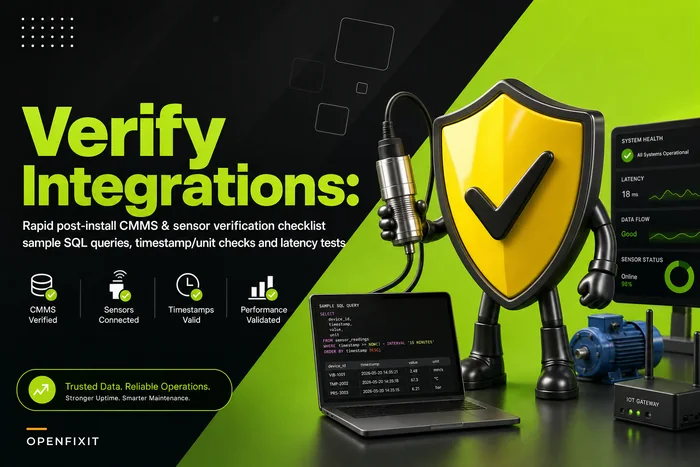
Integration fragility. More sites means more sensor-to-CMMS handoffs, and each one is a place where alerts can silently stop flowing. A rule that no longer fires is far more dangerous than one that fires too much, because nothing tells you it's broken. Verifying these paths after any install or config change is non-negotiable — the kind of latency and data-flow checks covered in the post-install verification checklist become mandatory portfolio hygiene, not a nice-to-have.
What a well-designed alert path actually looks like
Trace a single high-criticality alert through a mature system so the pieces connect:
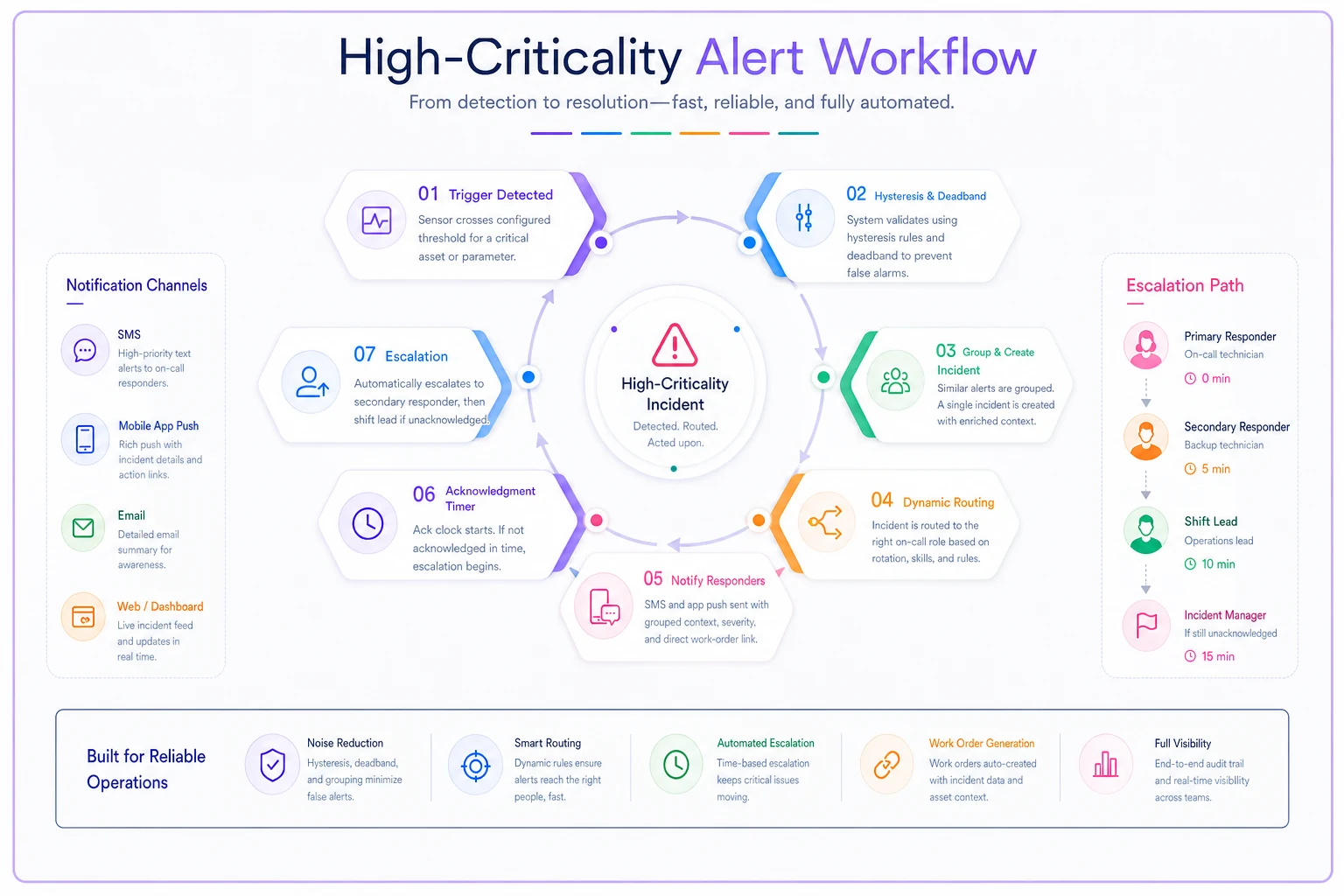
Notice what's not happening: no group blast, no eleven duplicate pages, no signal orphaned in a shared inbox, no scramble to figure out who's on tonight. Each of those absences is a deliberate design choice, and each one is a place a lesser system fails.
The technician arrives at the asset already knowing what triggered, what else fired alongside it, and what the work history looks like. That context matters. Diagnostic time on-site drops significantly when someone isn't starting from scratch.
When to invest in this — and when not to
Building out full ownership matrices, hysteresis standards, and criticality-based routing is real work. It's not always the right first move.
This makes sense when:
-
You're running more than roughly 8–10 sites, or heading there fast.
-
Your nuisance rate is high enough that technicians visibly ignore alerts.
-
After-hours coverage depends on informal "someone will catch it" arrangements.
-
You can't answer, per alert type, who owns first response.
This is premature when:
-
You have a couple of buildings and a tight team who genuinely all see and act on alerts. Formal routing matrices add overhead you don't need yet.
-
Your sensor data quality is still bad. Routing garbage faster just delivers garbage faster — fix the signal before you engineer the response chain.
-
You haven't defined asset criticality at all. Routing is downstream of criticality; without it, you're just guessing at channels.
Teams that get this wrong usually over-engineer routing while their underlying alerts are still untrustworthy. Order matters: clean the signals, define criticality, then build the routing machinery on top.
A real scenario
A regional property group ran maintenance across 22 mixed-use buildings — offices, a couple of light-industrial tenants, retail ground floors. Their alerting was a decade of accumulated rules dumped into a group SMS thread that four supervisors and about nine technicians could all see.
The numbers were rough. Roughly 1,400 alerts a month, and when they audited a sample, close to two-thirds resolved to nothing actionable. Response to genuinely critical alerts had crept up past 40 minutes on average, because real ones were buried in the noise and everyone assumed someone else had eyes on the thread. They'd had two near-misses on after-hours generator issues in a single quarter.
They didn't buy anything new. They restructured. Criticality tiers got assigned across the asset base. Hysteresis deadbands and parent-child suppression cut the flapping. Low-criticality signals moved to a daily digest and out of the interruptive channel entirely. Ownership moved from "the group thread" to named on-call roles with automatic escalation.
Over the next quarter, monthly alert volume dropped to somewhere around 500–600 — not because anything went unmonitored, but because grouping and suppression collapsed the duplicates and the digest absorbed the trivial stuff. Acknowledged response time on critical alerts came down under 12 minutes. The supervisors' biggest tell: the group thread went quiet enough that when it did buzz, people actually looked.
The through-line
Alert management isn't a tuning exercise, and it isn't a tooling purchase. It's an ownership and economics problem that happens to express itself through thresholds and notifications. Get the ownership model right — one accountable role per signal, escalation that survives turnover, governance that keeps rules honest — and price what each alert costs you, and the routing decisions stop being arguments.
The portfolios that scale alerting well aren't the ones with the fanciest thresholds. They're the ones where every alert has exactly one owner, where noise is dampened before it reaches a human, and where the routing machinery matches the criticality of what's being watched. Everything else is just noise with a phone number attached.
The portfolios that scale alerting well aren't the ones with the fanciest thresholds. They're the ones where every alert has exactly one owner, where noise is dampened before it reaches a human, and where the routing machinery matches the criticality of what's being watched. Everything else is just noise with a phone number attached.
Ready to optimize your maintenance operations?
Join 2,000+ facilities using Openfixit to reduce unplanned outages, extend asset life, and improve operational efficiency.