

Most maintenance teams think they have evidence. They have photos on phones, meter readings typed into work orders, calibration certs saved somewhere on a shared drive, and signatures scribbled on paper that eventually gets scanned. It all feels like proof.
Then a real challenge shows up — an insurance denial after a fire, an OSHA citation, a warranty dispute where the manufacturer says the unit was never serviced correctly, or a contractor's lawyer arguing your team caused the damage. And suddenly all that "evidence" stops being evidence. The timestamps don't match. Nobody can prove the photo wasn't edited. The certificate is a PDF with no traceable source. The signature belongs to a tech who left two years ago and can't be reached.
That gap — between capturing something and capturing something that holds up — is what a field evidence policy exists to close. This isn't about buying better cameras or forcing techs to take more pictures. It's about deciding, organization-wide, what counts as defensible evidence, how it gets captured, what metadata rides along with it, who signs off, and how long it lives before it's legally allowed to disappear.
Below is how this actually breaks in real operations, and how to build a policy that survives contact with a lawyer or an auditor.
The moment evidence gets challenged is the moment you realize you never had a system
Here's a pattern that plays out constantly. A facilities team runs clean day to day. PMs get done, work orders close, everyone's happy. The evidence problem stays invisible because nobody ever tests it.
Then something goes wrong that ends up in a conference room with lawyers. A chiller fails and the manufacturer denies the warranty claim, arguing the required annual oil analysis was skipped. Your team did the oil analysis. You have a photo of the sample being pulled and a lab report in an email somewhere.
-
Can you prove this photo was taken on the date you claim, at this specific asset?
-
Can you prove the photo hasn't been altered or reused from a prior year?
-
Can you produce an unbroken record showing who handled the sample, when it went to the lab, and that the report matches that sample?
If the honest answer to any of those is "well, sort of," your evidence is now an argument instead of a fact. And arguments lose warranty claims that run into six figures on large equipment.
What shows up across a lot of facility operations is that the failure isn't laziness. Techs are documenting. The problem is that documentation was designed to remind themselves what happened, not to prove it to a hostile third party. Those are completely different standards.
Why this happens across almost every maintenance organization
Capture happens on personal or shared devices with no standards. A tech takes a photo on a phone, texts it to a supervisor, who saves it into the work order later. By the time it lands anywhere official, the original metadata — the EXIF timestamp, GPS coordinates, device ID — is stripped or overwritten. A texted or screenshotted photo is often forensically worthless because the compression and transfer destroy the very data that would prove authenticity.
Eliminate downtime with proactive maintenance.
Openfixit helps you plan, track, and complete maintenance efficiently—maximizing asset reliability.
- Centralized asset management
- Automated maintenance scheduling
- Inventory and parts tracking
No credit card required
Metadata is treated as optional. Most CMMS setups have a free-text notes field and a photo attachment slot, and that's considered "documentation." Nobody defined which fields are mandatory for evidence to count, so they get filled inconsistently. One tech logs the asset ID; another writes "RTU on roof." Neither realizes only one of those survives an audit.
Chain of custody isn't a concept anyone was trained on. In maintenance, chain of custody usually only comes up around calibration certs or environmental samples. But the same logic applies to any evidence you might have to defend: who captured it, who touched it, who transferred it, and whether it could have been tampered with in between.
Retention is either forever or accidental. Half of organizations keep everything indefinitely because deleting feels risky, which creates its own legal exposure. The other half lose evidence because a phone got wiped or a shared drive got cleaned up. Almost nobody has retention mapped to the actual legal and regulatory clock for each evidence type.
None of this matters until it matters. Then it matters a lot.
What breaks specifically as you scale
A single building with one maintenance lead can sometimes get away with informal evidence, because that one person remembers context and can testify to it. That falls apart fast once you add sites, techs, and time.
Across sites, capture standards drift. Site A's team photographs the nameplate with every job. Site B doesn't. When corporate needs to defend a portfolio-wide compliance position, the evidence quality is wildly uneven and the weakest site drags down the whole case.
Turnover destroys testimony. The person who captured the evidence is often the person who has to authenticate it in a dispute. In an industry with heavy turnover, the tech who did the work two years ago is gone. If the evidence can't stand on its own metadata and chain of custody, it can't stand at all.
Volume makes retrieval impossible. One site generates a few thousand work orders a year. Twenty sites generate tens of thousands. When legal asks for "all inspection evidence on this asset class for the past three years," a system without structured evidence fields turns that into a multi-week manual scavenger hunt — and you'll still miss things.
Contradictory records surface. At scale you inevitably find two versions of the same event — a paper form that says one thing and a CMMS entry that says another. Opposing counsel loves contradictions. Consistency across your evidence chain is itself a form of credibility, and inconsistency at scale is nearly guaranteed without a policy.
This connects directly to the auditability problems that show up during system migrations. If you've dealt with keeping records defensible through a platform change — which is covered in depth in not losing auditability during a CMMS cutover — you already know how quickly evidence integrity degrades when data moves without a chain of custody attached.
The four pillars of admissible field evidence
Before the templates, it helps to be clear on what actually makes evidence hold up. There are four properties, and evidence needs all four — missing any one gives the other side an opening.
| Property | What it means | How it fails in practice |
|---|---|---|
| Authenticity | You can prove it is what you say it is | Photo texted around, original metadata gone |
| Integrity | You can prove it hasn't changed since capture | No hash, no version lock, editable file |
| Provenance | You can trace where it came from and who handled it | No chain of custody, unknown capture device |
| Completeness | The record isn't cherry-picked or missing context | Only "good" photos kept, no timestamps, gaps in the sequence |
Every decision in the policy below maps back to protecting one of these four. If a rule doesn't strengthen authenticity, integrity, provenance, or completeness, it's probably bureaucracy and you can cut it.
Building the capture standard
Capture is where most integrity is won or lost, because you can't fix bad capture after the fact. The standard should specify the how, not just the what.
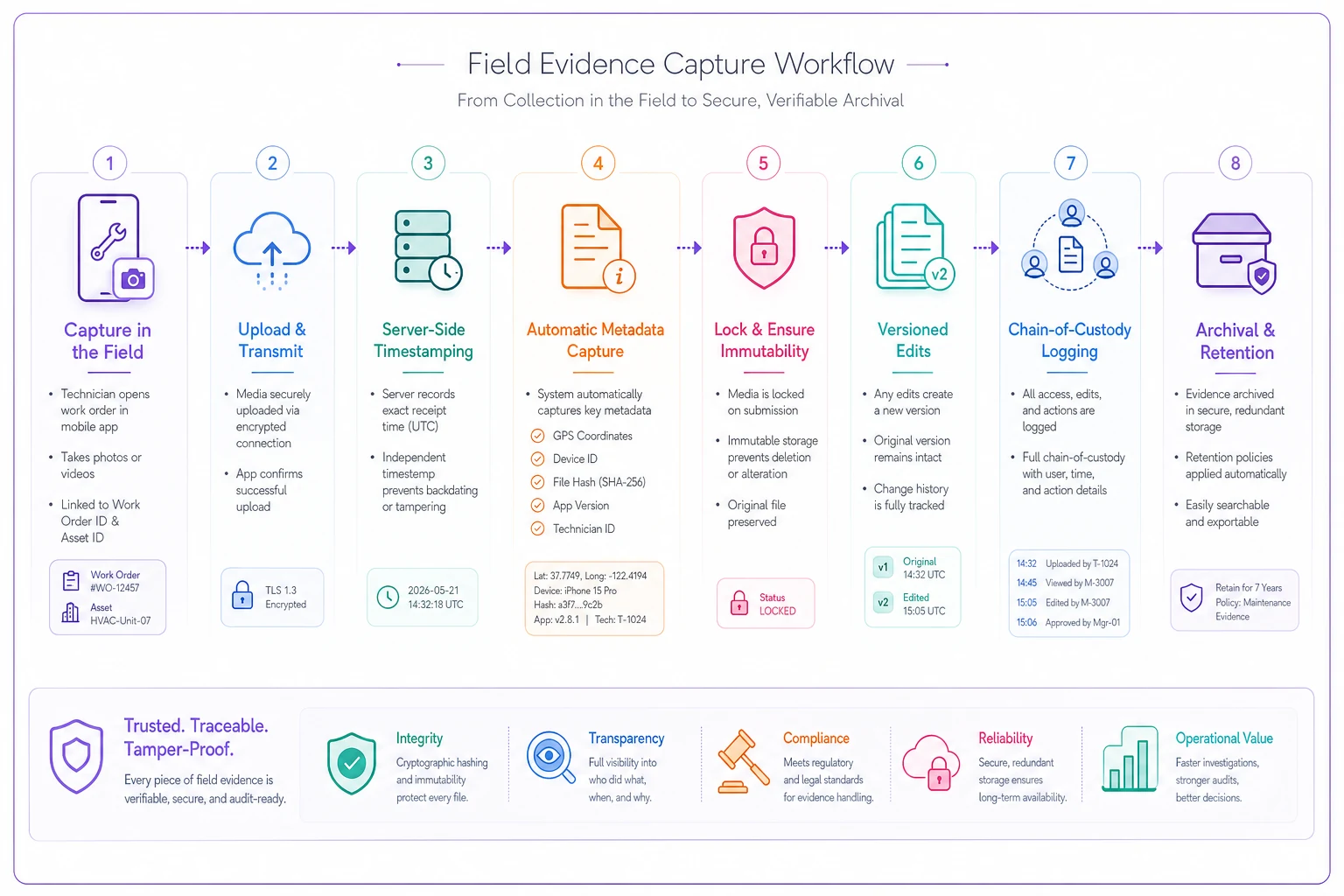
The core rule: evidence is captured inside the system of record, not captured elsewhere and imported later. The moment a photo lives on a personal phone before it enters the CMMS, you've created an untraceable gap. Capture directly through the mobile work-order app so the file is stamped and locked at the point of creation.
A workable capture standard for photos and video:
-
Capture in-app, tied to the open work order. No camera roll, no texting. The file inherits the work order ID, asset ID, and user at the moment of capture.
-
Require context shots. For evidence-grade jobs, require a minimum set: asset nameplate, the specific condition or component, and a wide shot showing location. A single close-up of a leak proves almost nothing about which asset.
-
Preserve original resolution and metadata. No aggressive client-side compression that strips EXIF. The system should retain the original file and generate any compressed versions separately.
-
Timestamp from a trusted server clock, not the device. Device clocks can be changed. A server-side timestamp at upload is far harder to dispute, and you keep both.
-
Lock on capture. Once submitted as evidence, the file is immutable. Edits create a new version; they never overwrite.
Here's a quick visual to explain the capture-to-record workflow.
For meter readings and measurements, the same logic applies: capture the value against the specific asset and work order, timestamp it server-side, and where possible attach a photo of the actual gauge or instrument display as corroboration. A typed "245 PSI" is a claim. A typed 245 next to a photo of the gauge reading 245 is evidence.
The metadata that has to ride along
This is the part that gets skipped, and it's the part that decides whether evidence is admissible. Free-text notes are useful but they aren't structured metadata. You need defined, mandatory fields attached to every piece of evidence.
-
Asset identifier (the unique CMMS asset ID, not a description)
-
Work order number it was captured against
-
Capture timestamp (server-side, UTC plus local)
-
Location data (GPS coordinates and/or verified site ID)
-
Captured-by (authenticated user, not "tech on site")
-
Device identifier (which device produced the file)
-
Evidence type (photo, meter reading, certificate, signature, video)
-
File hash (a checksum generated at capture to prove integrity later)
-
Related regulatory or contractual requirement, where applicable
That last one matters more than people expect. Tagging evidence to the requirement it satisfies — a specific code, a warranty condition, an inspection mandate — is what makes it retrievable years later when someone asks "prove you met this obligation." Without that tag, you have evidence you can't find, which is functionally the same as having none.
The file hash is worth calling out specifically. Generating a checksum at the moment of capture and storing it lets you demonstrate later that the file is byte-for-byte identical to what was originally captured. It's the cleanest way to defend integrity, and it costs nothing once it's built into the capture flow.
Chain of custody without the forensics-lab overhead
Chain of custody sounds heavy, but for maintenance evidence it comes down to one principle: every point where evidence changes hands or changes state should be logged automatically, with a person and a timestamp attached.
-
Capture (who, when, where, on what device)
-
Submission into the record
-
Any access or download by a user
-
Any version created
-
Any transfer to an external party (lab, legal, insurer)
-
Retention actions (hold applied, or eventual disposal)
The key word is automatically. If maintaining chain of custody depends on someone remembering to fill out a log, it will fail at scale. It has to be a byproduct of using the system, not a separate task.
Physical samples — oil, water, environmental swabs — are the one place you'll still need a hybrid approach. The digital record should capture the handoff: sample pulled at [timestamp] by [tech], sealed with [seal ID], transferred to [carrier] at [timestamp], received by [lab] at [timestamp]. When the lab report comes back, it links to that same chain by seal ID, closing the loop. This is exactly the discipline that makes root-cause work defensible — a corrective action is only as strong as the evidence behind the failure it's addressing, which is why evidence chains are central to a solid work-order-linked RCA process.
Compression and retention rules that don't quietly destroy your case
Two technical decisions cause a surprising amount of self-inflicted damage.
Compression. Storage costs push teams to compress aggressively, and well-meaning IT policies sometimes re-compress or transcode files during backup or migration. Every re-compression is a chance for opposing counsel to argue the file was altered. The rule: always retain the original, unmodified file with its capture hash. Serve compressed versions for day-to-day viewing if you want, but the original is the evidence and it never gets touched.
Always retain the original, unmodified file with its capture hash.
| Evidence type | Typical retention driver | Practical minimum |
|---|---|---|
| Safety inspection records | Regulatory (varies by jurisdiction) | Life of asset + statute of limitations |
| Calibration certificates | Quality/compliance requirement | Duration of cert validity + margin |
| Warranty-related service evidence | Warranty term | Full warranty period + claim window |
| Contractor work verification | Contract + dispute window | Contract term + limitation period |
| General PM photos | Internal policy | 3–7 years, business-defined |
| Incident/failure evidence | Litigation hold | Indefinite until hold released |
The critical mechanism sitting on top of all of this is the legal hold. When litigation or an investigation is reasonably anticipated, normal retention stops for relevant evidence. If your team disposes of records on schedule after a hold should have applied, that's spoliation, and courts treat it harshly. The policy needs a defined trigger and a way to freeze affected evidence instantly across all sites.
The sign-off templates that make it official
Capture standards and metadata make evidence technically sound. Sign-off makes it organizationally defensible — it shows the evidence was reviewed and accepted under a governed process, not just dumped into a folder.
Two sign-off layers are worth building templates for.
Operational/technical sign-off. For evidence-grade jobs — calibrations, safety-critical inspections, warranty-required service — a supervisor confirms the evidence set is complete and meets the capture standard before the work order can close. The template checks:
-
All required context shots present
-
Mandatory metadata fields populated
-
Readings corroborated where required
-
Chain of custody intact for any samples
-
Evidence tagged to the applicable requirement
Legal/finance sign-off. This is a lighter-touch, periodic review — not every work order, but a defined cadence and any high-stakes event. Legal confirms the retention and hold framework is being followed and that evidence practices meet current regulatory expectations. Finance signs off where evidence underpins financial positions: warranty claims, insurance recoveries, capitalized work, or contractor disputes with real dollars attached. The point isn't approval theater. It's establishing that responsible parties reviewed the evidence framework and can attest to it — which is exactly what a court or auditor wants to see.
-
Periodic legal review cadence defined
-
Finance review for evidence with financial impact
-
Escalation path for high-stakes or unusual cases
Keep these templates short. A sign-off template nobody completes because it takes too long protects nothing.
A short real scenario
A regional property operator running around 18 commercial sites got hit with a warranty denial on a rooftop unit — the manufacturer claimed a required semi-annual service wasn't performed. The team had done the service. What they didn't have was defensible proof: photos lived on a former tech's device, the work order notes said "serviced RTU" with no asset-level detail, and there was no way to prove the one photo they found came from that unit on that date.
They lost the initial claim. The disputed repair came in a bit over $40k.
The fix wasn't complicated, but it was systemic. They moved all evidence capture into the mobile work order, made asset ID, nameplate photo, and server timestamp mandatory on warranty-relevant PMs, and turned on automatic chain-of-custody logging. Retention got mapped to warranty terms so nothing critical aged out early.
About a year later a second, similar dispute came up. This time they produced a complete, timestamped, asset-tagged evidence set with an intact custody trail in under an hour. The manufacturer approved the claim without escalation. The difference wasn't that they started doing better work — the work was always fine. The difference was that this time the work was provable.
When this level of rigor makes sense — and when it doesn't
Not every photo needs forensic treatment. Applying full admissibility standards to a routine filter change is wasted effort, and over-engineering the policy is how you get technicians quietly routing around it.
This makes sense for: safety-critical inspections, regulated compliance work, calibration, warranty-dependent service, high-value assets, environmental sampling, and anything involving contractors where disputes are plausible.
-
safety-critical inspections
-
regulated compliance work
-
calibration
-
warranty-dependent service
-
high-value assets
-
environmental sampling
-
anything involving contractors where disputes are plausible
This is overkill for: low-value routine PMs with no regulatory or financial exposure, where a standard timestamped in-app photo is plenty.
-
low-value routine PMs with no regulatory or financial exposure
Who should be careful about rushing in: small single-site operations with low turnover and minimal legal exposure. A lightweight version — capture in-app, timestamp, asset ID, sensible retention — covers most of the risk without the full sign-off machinery. Build the heavier version when you have multiple sites, real turnover, or assets and contracts large enough that a dispute could actually hurt.
Scope it by consequence. Ask what happens if this specific evidence gets challenged and you can't defend it. If the answer is a shrug, keep it light. If the answer is a six-figure claim or a regulatory citation, that's where the policy earns its keep.
Bringing it together as one system
The reason evidence fails isn't any single missing step. It's that capture, metadata, custody, retention, and sign-off are usually handled by different people, in different tools, with no shared standard connecting them. A photo captured well but retained badly still fails. Perfect retention on evidence with no provenance still fails. It's a chain, and it breaks at the weakest link every time.
The organizations that stay genuinely audit-ready treat evidence as a single connected workflow inside their work-order system — where capturing correctly, tagging correctly, tracking custody, and honoring retention are all just consequences of doing the job normally, not extra chores bolted on top. When it works, nobody thinks about it day to day. And on the day someone finally challenges you, you don't scramble. You pull the record, and the record holds.
That's the whole point of a maintenance field evidence policy: to make sure the proof exists before you find out you need it — because by the time you need it, it's already too late to create it.
Ready to optimize your maintenance operations?
Join 2,000+ facilities using Openfixit to reduce unplanned outages, extend asset life, and improve operational efficiency.