

Most procurement pain around spares doesn't show up in the purchase price. It shows up eighteen months later, when a 40-week lead-time motor fails and you realize the "cheaper" vendor you picked back then doesn't stock it, doesn't offer expedite, and quoted you a part that's now obsolete. The invoice looked fine. The outcome didn't.
That gap — between the number on the PO and the actual cost of owning and sourcing a critical spare over its life — is where a real maintenance procurement strategy earns its keep. For long-lead and critical items specifically, the usual purchasing reflexes (lowest quote, standard reorder points, hold stock just in case) quietly work against you.
This is a systems article. The point isn't "negotiate harder." It's how procurement, inventory, maintenance planning, and finance have to move together when the parts in question can idle a line for weeks.
Why critical spares break normal procurement logic
Normal procurement logic optimizes for throughput: lots of transactions, predictable demand, consumables that turn over. ABC analysis, reorder points, economic order quantities — all of that assumes you'll buy the part again soon enough to learn from your mistakes. If you want the fast-moving end of your inventory handled well, the mechanics of that are covered in our ABC analysis and 90-day reorder-rule sprint.
-
Demand is near-zero until it's catastrophic. You might buy one in a decade. There's no statistical rhythm to lean on.
-
Lead time dwarfs failure warning. A part that takes 30+ weeks to arrive doesn't care that your sensors gave you three days' notice.
-
The cost of being wrong is asymmetric. Overstock costs you carrying charges. Understock costs you a shutdown that can run tens of thousands a day.
That asymmetry is the whole game. For these items you're not minimizing purchase cost — you're buying down the risk of an expensive, extended outage. The moment procurement treats a critical spare like a commodity line item, the strategy is already broken. If you're working through how to forecast demand for these rare-failure parts in the first place, the probabilistic spare-parts forecasting approach for low-frequency assets is a better starting point than any reorder-point formula.
Total cost of ownership is the only number that matters here
For critical spares, purchase price is maybe a third of the real cost. The rest hides in lead time, holding, obsolescence, and the downtime you're insuring against. A maintenance-aware TCO model forces all of that into one comparison.
Eliminate downtime with proactive maintenance.
Openfixit helps you plan, track, and complete maintenance efficiently—maximizing asset reliability.
- Centralized asset management
- Automated maintenance scheduling
- Inventory and parts tracking
No credit card required
Here's a working template for the cost elements you should be stacking up on any critical-spare sourcing decision:
| Cost element | What it captures | Where teams underestimate it |
|---|---|---|
| Unit purchase price | Quoted cost of the part | Usually the only thing compared |
| Expedite premium | Cost to compress lead time in an emergency | Often 2–4x base price, rarely modeled |
| Carrying cost | Capital, space, insurance, obsolescence risk | Commonly pegged at 18–25% of part value/year |
| Lead-time risk cost | Expected downtime during replenishment gap | The big one — often ignored entirely |
| Obsolescence exposure | Risk the part is discontinued before use | Higher for electronics, controls, legacy drives |
| Supplier reliability discount | Likelihood vendor actually delivers on time | Soft factor, but it's real money |
The useful move is to run two scenarios for each candidate part: stock it on-site versus source it on failure. For the source-on-failure case, you multiply expected downtime (lead time × daily downtime cost × probability of failure in the period) and compare that to the carrying cost of just holding the thing.
A quick example. Say you've got a critical VFD for a chilled-water pump:
-
Part cost
~$12k
-
Lead time if you order on failure
~22 weeks
-
Daily downtime cost (partial cooling loss, workarounds)
roughly $2k–$3k/day on affected days
-
Estimated failure probability over 5 years
low, but not negligible — call it 15–20%
Holding it costs maybe $2,200–$3,000 a year in carrying charges, so roughly $11k–$15k over five years. Sourcing on failure blows past that fast once you account for a 22-week gap, even at a modest downtime estimate. Stocking wins here — not because the part is expensive, but because the gap is lethal. Flip the lead time to three weeks and the math reverses completely.
That's the point of running TCO per item instead of per policy. You stop making blanket "we stock critical spares" or "we don't carry slow movers" rules and start making defensible, item-level calls.
Consignment: the lever most teams forget to pull
There's a middle path between owning inventory and gambling on lead time, and a lot of maintenance teams never seriously negotiate for it. Consignment — where the supplier stocks the part on your site or a nearby hub and you only pay when you consume it — shifts carrying cost and obsolescence risk onto the vendor while keeping the part physically within reach.
It sounds like a free lunch. It isn't, and knowing when it actually works is the difference between a smart arrangement and an ongoing operational headache.
When consignment actually makes sense
-
The part is high-value and low-turn, so carrying cost is the main pain point
-
The supplier has other customers using the same part (so they can rebalance stock)
-
You have reliable consumption tracking — you can prove what you used and when
-
Lead times are long enough that you genuinely need the part on-site
-
You have a trust relationship with the vendor and clean audit trails
When consignment is a bad idea
-
The part is so specialized that only you use it — the vendor carries all the obsolescence risk and will price that in, erasing the benefit
-
Your consumption reporting is messy, which turns reconciliation into a monthly dispute
-
Storage conditions matter (temperature, humidity, shelf life) and you can't guarantee them
-
You can't physically segregate consigned stock from owned stock, so counts drift
Who should not do this
-
Teams without disciplined storeroom controls shouldn't rush into consignment. It multiplies your bookkeeping burden before it reduces your cash burden. If you can't currently tell owned stock apart from borrowed stock with confidence, fix that first. Layering consignment on top of a chaotic storeroom just creates a new category of thing to argue about with your supplier every month.
Automate monthly consignment reconciliations where possible to prevent reconciliation drift and supplier disputes.
Teams without disciplined storeroom controls shouldn't rush into consignment. It multiplies your bookkeeping burden before it reduces your cash burden. If you can't currently tell owned stock apart from borrowed stock with confidence, fix that first. Layering consignment on top of a chaotic storeroom just creates a new category of thing to argue about with your supplier every month.
Consignment vs stocking: a decision workflow
Here's a repeatable way to decide which route each critical spare takes. Walk every long-lead or single-point-of-failure item through it:
-
Flag criticality. Is failure a safety, compliance, or production-stopping event? If no, this item probably belongs in your normal inventory process, not this one.
-
Pull the lead time. Anything under ~4 weeks rarely justifies stocking or consignment — source on failure and move on.
-
Run the TCO comparison. Stock-it vs source-on-failure, using the table above. If stocking clearly wins on TCO, go to step 4.
-
Test consignment eligibility. Does the supplier carry it for others? Can you track consumption cleanly? If yes to both, request a consignment quote.
-
Compare the three options side by side. Owned stock, consigned stock, source-on-failure — pick the lowest-TCO option that meets your risk tolerance.
-
Set the contract terms that lock in the assumptions you just modeled (lead time, expedite, obsolescence handling). More on that next.
-
Record the decision and the assumptions. When someone questions the inventory sitting on the shelf two years later, you want the reasoning documented.
A simple visual of this flow helps teams run the checklist.
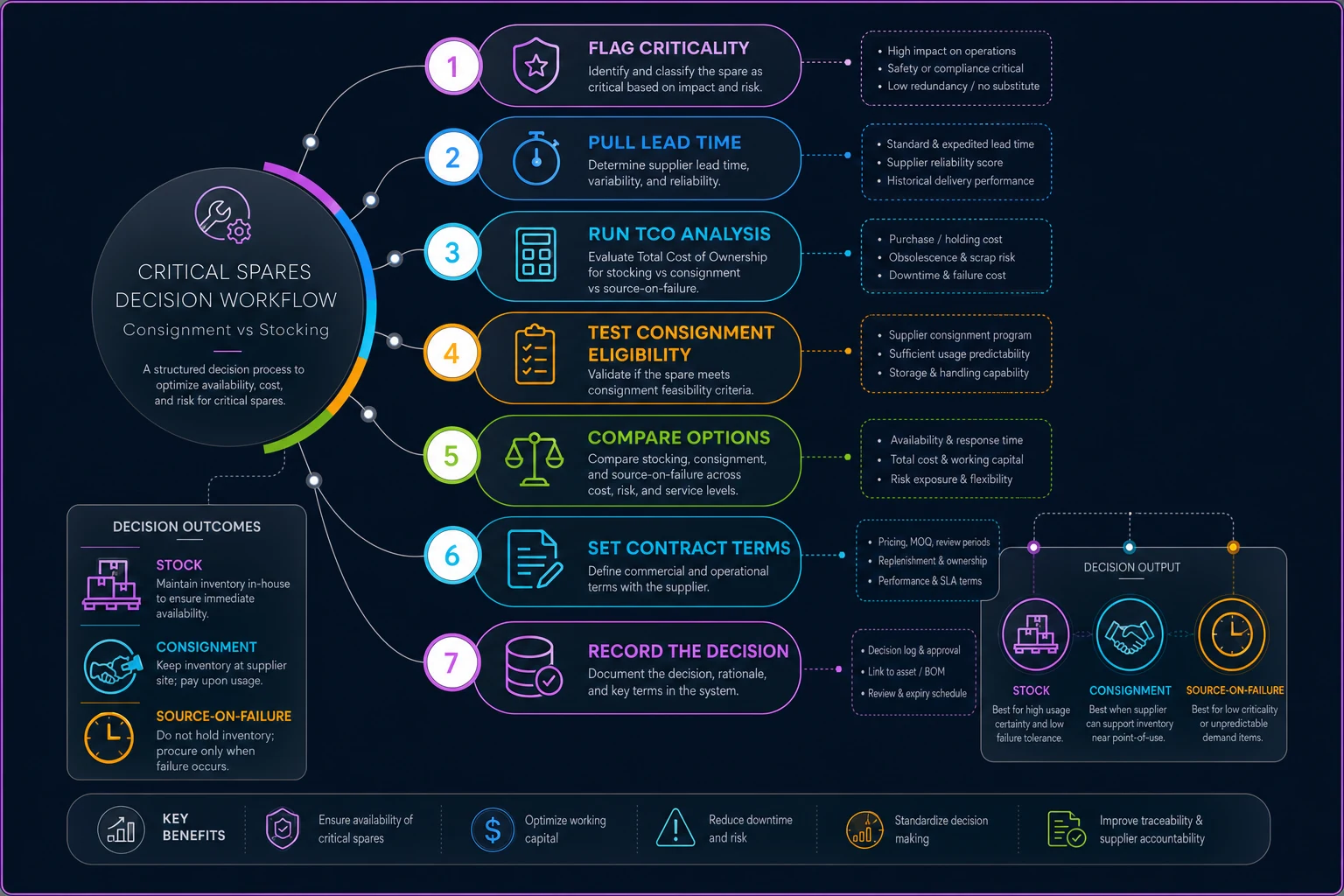
The step most teams skip is #7. A decision without recorded assumptions turns into an argument during the next budget cycle, and the person defending the spare usually loses because they can't reconstruct why it was stocked in the first place.
Contract language that does the actual work
Procurement strategy lives or dies in the contract. For critical spares, a handful of clauses carry most of the protection. These are the levers worth fighting for, with sample language you can adapt.
Guaranteed lead time with penalties. Don't accept "typical lead time is 20 weeks." Accept committed lead time.
> "Supplier guarantees delivery of listed critical spares within [X] weeks of purchase order. For each week of delay beyond the committed lead time, Supplier shall credit Buyer [Y]% of the item purchase price, up to [Z]%."
Last-time-buy and obsolescence notice. This is the clause that saves you when a manufacturer discontinues a part.
> "Supplier shall provide Buyer no less than [180] days written notice prior to discontinuing any listed part, including a final last-time-buy opportunity and, where available, recommended form-fit-function replacements."
Expedite terms, pre-negotiated. Agree the emergency price before the emergency.
> "In the event of a documented production-critical failure, Supplier shall provide expedited fulfillment within [X] days at a premium not to exceed [Y]% of the standard unit price."
Consignment reconciliation and title. For consigned stock, be explicit about who owns what and when title transfers.
> "Consigned inventory remains the property of Supplier until consumed by Buyer. Title transfers upon Buyer's documented consumption. Both parties shall reconcile consigned inventory [monthly], and Buyer shall be invoiced only for confirmed consumption within that period."
Price protection. Lock pricing for the contract term so your five-year TCO model doesn't get wrecked by a quiet 30% increase at reorder.
> "Unit prices for listed critical spares shall remain fixed for [24] months, with any subsequent increase capped at [X]% annually and requiring [90] days notice."
None of this is exotic. The reason teams don't have these clauses is usually that spares get bought transactionally — one PO at a time — instead of under a standing agreement where terms like these can actually be negotiated. The fix is consolidating your critical-spare suppliers into contracts worth negotiating over, which ties directly into broader supplier segmentation and performance-based contracting work.
What breaks at scale
One site with a tidy storeroom and one buyer can wing a lot of this on tribal knowledge. Multiply that across a dozen facilities and the cracks show up fast.
Duplicated stock nobody can see. Three sites each quietly stock the same $12k drive "just in case" because none of them can see the others' inventory. That's $36k parked when $12k plus a transfer agreement would cover the fleet. The failure here isn't procurement judgment — it's visibility. Without a shared, accurate view of what's on which shelf, every site rationally over-insures.
Inconsistent criticality definitions. Site A's "critical" is Site B's "nice to have." When the definitions drift, your TCO models aren't comparable and your consignment negotiations lose leverage, because you can't present a vendor with consolidated demand.
Contract terms that live in people's heads. The buyer who negotiated the great expedite clause leaves, and nobody knows the term exists. The next emergency gets handled at list price plus rush fees because the lever was never recorded against the part.
Reconciliation drift on consigned stock. At one site, monthly consignment reconciliation is annoying. Across ten sites with inconsistent consumption logging, it becomes a standing dispute with your supplier — and a reason they'll refuse to renew the arrangement altogether.
The through-line: at scale, critical-spare procurement stops being a purchasing problem and becomes a coordination and data problem. The right answer isn't a better negotiator — it's a system where inventory, criticality ratings, lead times, and contract terms are visible across sites and tied to the assets they protect. A CMMS that links spare parts to asset records, tracks consignment separately from owned stock, and holds the contract metadata (lead time, expedite, last-time-buy dates) against each part is what keeps the strategy from decaying back into transactional buying. Not because the software is magic, but because it keeps the assumptions behind every stocking decision in one place where the next person can actually find them.
A short real scenario
A mid-sized food processor running four plants had a recurring problem with long-lead electrical spares — drives, specialty motors, a couple of PLC modules. Their pattern was predictable: no stock, failure, panic order, two-to-five-week emergency gap, partial production loss. Over a couple of years they'd absorbed several of these events, each running somewhere in the range of $20k–$40k in combined downtime and expedite fees.
They did the unglamorous work: built a critical-spare list across all four plants, ran TCO on each line, and found the duplication. Two plants were separately stocking the same motor; two others were carrying nothing on parts that should've been stocked. They consolidated. For the genuinely rare, high-value items they negotiated consignment with their main drive supplier, who already served the region and could rebalance stock. For the single-use specialty items where consignment didn't pencil out, they stocked those outright and locked in last-time-buy clauses.
Nothing about this was dramatic. But over the following year they avoided at least two emergency-order scenarios that would've cost real money, freed up roughly $25k–$30k in redundant inventory by eliminating duplicated stock, and — maybe more importantly — stopped making these calls by gut feel. The decisions were recorded, the contracts held the terms, and the next failure was a planned swap instead of a fire drill.
The takeaway
Critical-spare procurement goes wrong when it inherits the habits built for consumables: chase the lowest quote, buy transactionally, let each site fend for itself. For long-lead and single-point-of-failure parts, that approach quietly accumulates risk that only becomes visible during an outage.
A real strategy runs on three things working together — TCO analysis that prices in lead time and downtime, a clear-eyed read on when consignment beats stocking (and when it doesn't), and contracts that lock in the lead time, expedite, and obsolescence protections your models assume. Keep those decisions and their assumptions visible across your sites, revisit them as lead times and failure rates shift, and the next 40-week part failure stops being the event that defines your quarter.
Critical-spare procurement goes wrong when it inherits the habits built for consumables: chase the lowest quote, buy transactionally, let each site fend for itself. For long-lead and single-point-of-failure parts, that approach quietly accumulates risk that only becomes visible during an outage.
A real strategy runs on three things working together — TCO analysis that prices in lead time and downtime, a clear-eyed read on when consignment beats stocking (and when it doesn't), and contracts that lock in the lead time, expedite, and obsolescence protections your models assume. Keep those decisions and their assumptions visible across your sites, revisit them as lead times and failure rates shift, and the next 40-week part failure stops being the event that defines your quarter.
Ready to optimize your maintenance operations?
Join 2,000+ facilities using Openfixit to reduce unplanned outages, extend asset life, and improve operational efficiency.