


Most maintenance teams run every supplier through the same procurement template. The HVAC firm servicing your chillers, the guy who does quarterly fire extinguisher checks, the elevator contractor with a captive-market monopoly — all get the same PO structure, the same net-30 terms, the same annual renewal ritual. And then everyone wonders why some vendors quietly bleed money while others somehow always hit their marks.
The problem isn't that your vendors are bad. It's that your maintenance supplier strategy treats a critical uptime partner and a commodity supplier as if they were the same economic relationship. They're not. And when you pay them the same way, you get the same mediocre behavior across the board — because nobody's contract actually rewards the outcomes you care about.
This is a systems article, not a negotiation-tips article. Segmentation and pay-for-performance contracts only work when they connect to how work actually flows through your operation: how work orders get assigned, how SLAs get measured, how invoices get validated, and how a vendor's economics change as you scale from three sites to thirty. Here's how the whole thing fits together — and where it tends to break.
Why one contract template quietly costs you money
Here's the pattern. A facilities team inherits a vendor list built up over a decade. Nobody segmented it. Every supplier is on a time-and-materials or flat-annual arrangement, and the contracts were written by whoever happened to be in procurement that year.
The economic mismatch shows up in two directions at once.
Your critical vendors are underpaid for outcomes. The chiller contractor keeping your data center cool is on the same margin structure as the landscaping crew. There's no financial upside for them to respond in two hours instead of eight, so they don't. Uptime is your problem, not theirs — the contract made sure of that.
Your commodity vendors are overpaid for effort. T&M contracts reward hours on site. The more inefficient the vendor, the more they bill. You're literally paying a premium for the vendors who are worst at their jobs.
A typical example: a mid-sized property group had roughly 40 active vendors across 12 buildings. When they finally sorted spend, about 70% of their maintenance dollars went to 9 vendors — but those 9 were on the exact same contract terms as the other 31. The critical relationships had zero performance leverage baked in, and the long tail was eating admin time that far outweighed its actual value.
That's the core failure: contract structure that ignores the strategic weight of the relationship. Fixing it starts with segmentation.
Segmenting your supplier portfolio
Segmentation isn't an ABC spreadsheet you fill out once and forget. It's a way of deciding how much contract sophistication each relationship deserves, because you can't run pay-for-performance mechanics on 40 vendors and stay sane. You reserve the complex contracts for the relationships where they actually pay off.
Eliminate downtime with proactive maintenance.
Openfixit helps you plan, track, and complete maintenance efficiently—maximizing asset reliability.
- Centralized asset management
- Automated maintenance scheduling
- Inventory and parts tracking
No credit card required
-
Uptime criticality — if this vendor is late or sloppy, does something you care about go down?
-
Spend and substitutability — how much do you spend, and how easily could you replace them?
Cross those and you get four practical tiers.
| Tier | Profile | Contract approach | Payment mechanic |
|---|---|---|---|
| Strategic | High uptime impact, high spend, hard to replace (chillers, elevators, critical BAS) | Full pay-for-performance with SLA-linked payments | Base fee + performance bonus/penalty tied to uptime & response |
| Leverage | High spend, lower uptime risk, replaceable (general HVAC, electrical) | Competitive fixed-price with SLA credits | Fixed price with penalty deductions for missed SLAs |
| Bottleneck | Low spend, high uptime risk, few alternatives (proprietary systems, sole-source parts) | Relationship + availability guarantees | Retainer for guaranteed response windows |
| Commodity | Low spend, low risk, easily replaced (janitorial supplies, filters, landscaping) | Simple standardized terms | Flat rate or catalog pricing |
The mistake most teams make is spending all their negotiation energy on the Leverage tier — because that's where the big invoices are and it feels like where savings live — while ignoring the Bottleneck tier entirely. Bottleneck vendors are the ones who can hold your uptime hostage. A sole-source elevator vendor with no availability guarantee is a bigger operational risk than the general HVAC contractor you could swap out in a week. Segment by risk, not just by dollars.
One thing that surprises people: vendors move tiers as you grow. The local contractor who was a perfectly fine Commodity supplier at three sites becomes a coordination nightmare at fifteen, because now you're managing fifteen separate relationships instead of one regional agreement. Re-segment annually, and watch for vendors who've quietly drifted into a tier they were never contracted for.
Building the pay-for-performance contract
Once you know which vendors are Strategic, the contract structure follows a clear logic. Pay-for-performance isn't about penalizing people — it's about making the vendor's P&L move in the same direction as your uptime. When they win, you win.
-
A base fee that covers the vendor's real cost. If your base is too thin, the vendor games the performance metrics or walks. The base should keep them whole on a normal month — the performance layer is the upside.
-
Defined, measurable SLAs tied to your operational reality. Response time, resolution time, first-time-fix rate, uptime percentage for the assets they own. These have to be things your CMMS actually captures, or the contract is unenforceable.
-
A bonus/penalty band that's meaningful but bounded. This tends to work in the range of ±10–20% of the base fee. Below 10% nobody changes behavior; above 25% vendors start pricing in the risk and your base creeps up to compensate.
-
A shared-savings clause for the top tier. If a vendor's proactive work measurably reduces your emergency call volume or extends asset life, they share in the savings. This is what turns a contractor into a partner.
Sample contract language
> Performance-Based Compensation. Contractor shall receive a monthly Base Fee of $[X]. In addition, Contractor shall be eligible for a Performance Adjustment of up to ±15% of the Base Fee, calculated monthly based on the Service Level metrics defined in Exhibit A.
> Response SLA. For Priority 1 (uptime-critical) work orders, Contractor shall arrive on-site within [2] hours of dispatch, verified by the work-order timestamp in the Client's maintenance system. Each Priority 1 response exceeding the SLA by more than [30] minutes shall reduce the monthly Performance Adjustment by [2%], up to the defined penalty cap.
> Uptime Bonus. For the Assets listed in Exhibit B, Contractor shall receive a Performance Bonus of [5%] of Base Fee for each full month in which asset availability meets or exceeds [99.0%], as measured by logged downtime events in the Client's maintenance system.
> Shared Savings. Where Contractor's documented preventive interventions reduce Priority 1 emergency call volume for covered Assets below the trailing twelve-month baseline, Contractor shall receive [25%] of the verified cost reduction, reconciled quarterly.
Notice the recurring phrase: as measured by the Client's maintenance system. That's not boilerplate. It's the whole game.
The part everyone underestimates: measurement plumbing
A pay-for-performance contract is only as good as your ability to measure it without a fight. This is where most of these programs quietly die. The contract says "2-hour response for Priority 1," but nobody can produce a clean, undisputed record of when the work order was dispatched and when the tech actually arrived. So every penalty becomes a negotiation, the vendor pushes back, and after a few months of arguments you stop enforcing it.
-
Dispatch timestamps that both sides trust — the clock starts when the work order is created and sent, not when someone remembers to log it.
-
Arrival verification that isn't just the vendor's word. Badge-ins, geolocation, or timestamped photos tied to the specific work order. This is exactly why an arrival-verification SOP with badge, photo and GPS tied to work orders matters so much — without it, your response SLA is unenforceable in any dispute.
-
Resolution and downtime records captured in the same system, so uptime bonuses reconcile against logged events rather than anyone's memory.
Tie arrival verification to badge-ins and timestamped photos linked to the work-order ID to minimize disputes.
If those records live in email threads and vendor invoices, you don't have a performance contract — you have a suggestion. The measurement has to be a byproduct of normal work-order flow, not a separate reporting burden someone has to remember to complete.
This connects directly to broader vendor governance. Segmentation tells you who gets performance contracts; the day-to-day scorecards and dispute handling tell you whether the contracts hold up. If you haven't built that layer yet, the work-order-centric approach in taming contractor variability with SLA scorecards and dispute playbooks is the operational foundation these contracts sit on top of.
A real scenario: from flat fees to aligned incentives
A regional cold-storage operator ran 6 facilities with refrigeration as the obvious uptime priority — a compressor failure could spoil product worth far more than any repair bill. Their refrigeration vendor was on a flat annual maintenance contract, around $180k across the sites, plus T&M for anything that broke.
The behavior that structure produced was predictable. The vendor did the bare-minimum PMs, billed emergency callouts at premium T&M rates, and had no real reason to prevent failures — every breakdown was extra revenue for them. The operator was running roughly 30 or more emergency compressor calls a year.
-
Base fee slightly lower than the old flat contract, covering scheduled PMs.
-
A response SLA of 90 minutes for Priority 1, verified against work-order timestamps and site badge-ins, with penalty deductions for misses.
-
An uptime bonus tied to logged refrigeration availability per site.
-
A shared-savings clause on reductions in emergency call volume versus the prior year.
Within the first year, emergency calls dropped to somewhere in the low teens. The vendor's total take actually went up — they earned real bonus money — but the operator's all-in refrigeration spend fell by roughly $40k–$50k because they weren't paying premium T&M on 30 breakdowns anymore. More importantly, they lost far less product. Both sides ended up better off, which is the entire point of getting vendor economics aligned.
The interesting detail: the vendor liked it. Predictable base income plus upside for doing good work beat the old model where they were the villain every time something broke.
When this makes sense — and when it doesn't
Pay-for-performance is powerful, but it's not free. Each of these contracts costs you measurement discipline and negotiation effort. Spend that where it pays back.
When it makes sense:
-
The vendor genuinely controls the outcome you're paying for. If uptime depends on your own operators or on parts you supply, you can't fairly put it on the vendor.
-
You can measure the SLAs cleanly from your own systems.
-
The relationship is Strategic or Bottleneck tier — high uptime stakes.
-
The spend is large enough that a ±15% swing is worth the vendor's attention.
When it's a bad idea:
-
Commodity vendors. Putting a shared-savings clause on your filter supplier is pure overhead. Standardize the terms and move on.
-
When your measurement plumbing isn't ready. If you can't produce trusted timestamps and downtime logs, every penalty becomes a brawl. Fix the data first.
-
Sole-source Bottleneck vendors with real leverage over you. A pure penalty contract with a vendor you can't replace often backfires — they price in the risk or simply refuse. Availability retainers and relationship-building usually work better there than punitive SLAs.
Teams whose work orders are inconsistently created, whose dispatch times aren't logged, or whose arrival records are unreliable should hold off entirely. You'll spend more time arguing about the metrics than benefiting from them. Get the operational recordkeeping solid, then layer performance economics on top.
Rolling it out without blowing up your vendor relationships
You don't convert 40 contracts at once. The teams that succeed treat this as a staged program.
-
Segment the full portfolio into the four tiers. Be honest about which vendors are truly Strategic versus which just have big invoices.
-
Pick 2–3 Strategic vendors for the first performance contracts — ideally ones where you already have clean measurement data.
-
Baseline current performance for 60–90 days before writing penalty language, so your SLA targets are grounded in reality, not wishful thinking.
-
Draft the contract with the vendor in the room. The single biggest predictor of success is whether the vendor believes the metrics are fair. Show them the data, agree on the measurement method, set the bands together.
-
Run one full quarter before enforcing full penalties — a "measurement dry run" builds trust and surfaces data problems while stakes are low.
-
Standardize the Commodity tier in parallel, collapsing your long tail into fewer, simpler agreements to free up admin time.
-
Re-segment annually and move vendors between tiers as spend, risk, and your site count change.
A quick checklist before you sign any performance-based contract:
-
[ ] Every SLA maps to a field your maintenance system actually captures
-
[ ] Dispatch and arrival timestamps are trusted by both parties
-
[ ] Downtime and resolution events are logged in one place
-
[ ] The base fee genuinely covers the vendor's normal-month cost
-
[ ] Penalty/bonus band is meaningful (±10–20%) but capped
-
[ ] There's a dispute-resolution path that doesn't require a lawyer for routine misses
-
[ ] Someone owns monthly reconciliation and it's on a calendar
Running this checklist before signing has saved more than a few teams from performance contracts that looked great on paper and fell apart in month two when nobody could agree on what the dispatch timestamp actually meant.
Here's a simple rollout workflow to visualize the stages.
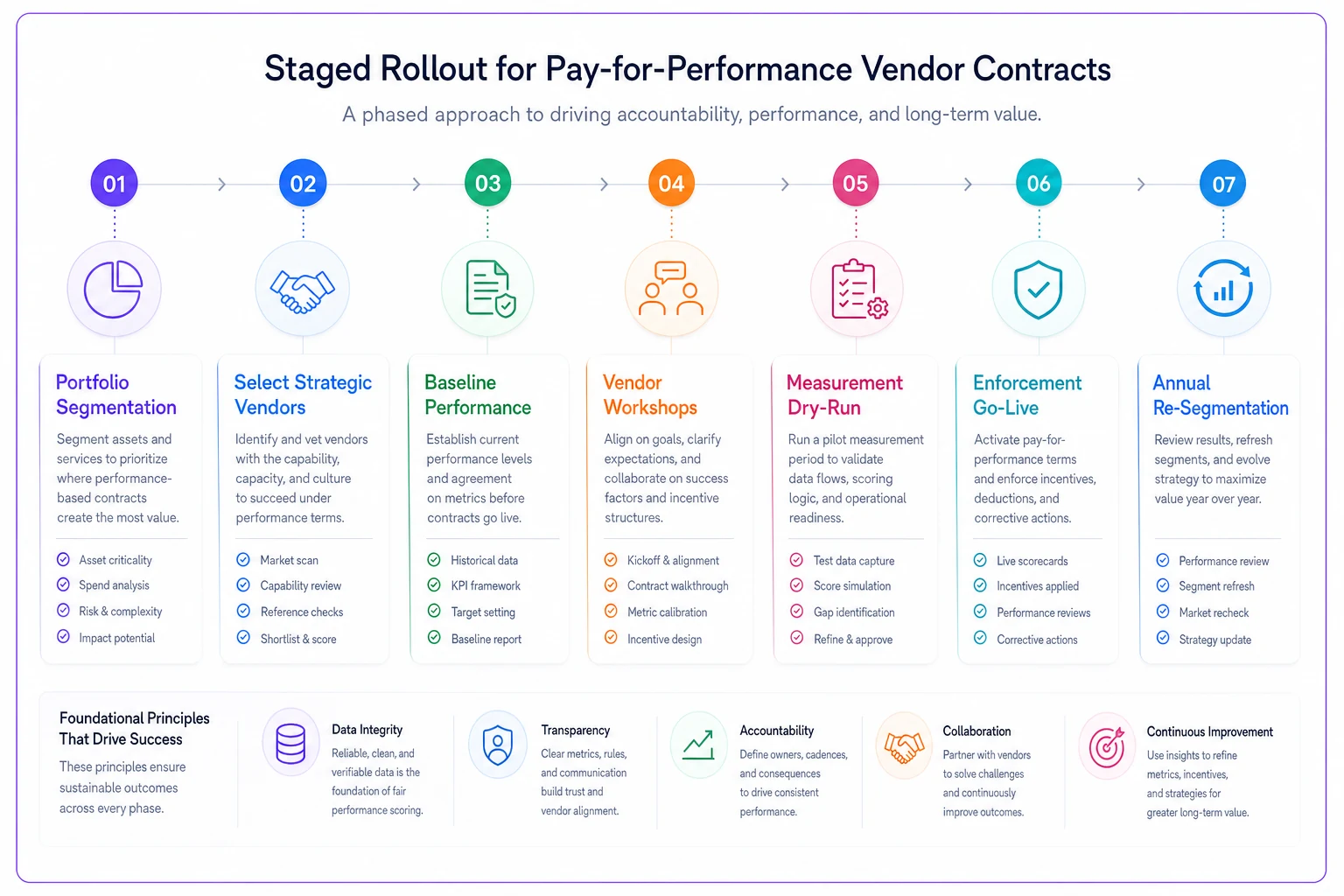
Use the workflow to keep stakeholders aligned and to show vendors the staged approach before you start penalties.
The system view
Segmentation and pay-for-performance belong together because they're two halves of the same idea: spend your contract sophistication where uptime and dollars justify it, and pay vendors in a way that makes their incentives match yours. Do one without the other and you get complexity with no payoff, or aligned incentives pointed at the wrong relationships.
What ties it all together is measurement. Segmentation tells you which vendors deserve performance contracts. Performance contracts define the SLAs. But it's your work-order data — clean dispatch times, verified arrivals, logged downtime — that turns those contracts from paper into behavior. When the maintenance system captures the record as a natural byproduct of work getting done, enforcement stops being a fight and starts being an automatic monthly reconciliation.
Start small, prove it on your two or three most critical vendors, and let the results make the case for the rest of the portfolio. The vendors worth keeping will appreciate a contract that finally rewards them for being good at their jobs — and the ones who push back on a fair, well-measured performance deal are telling you something useful about which tier they really belong in.
Ready to optimize your maintenance operations?
Join 2,000+ facilities using Openfixit to reduce unplanned outages, extend asset life, and improve operational efficiency.