
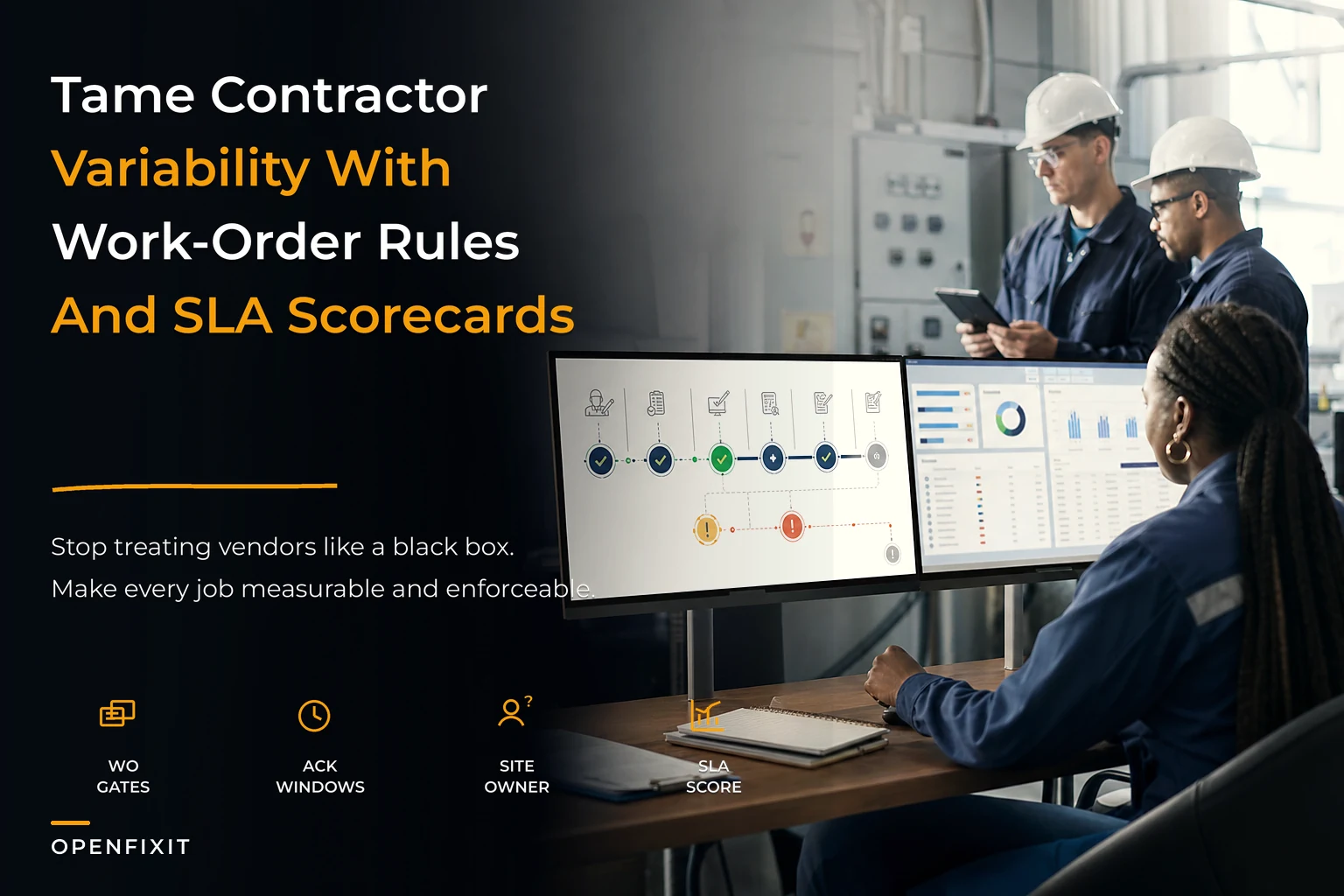

Managing maintenance contractors shouldn't feel like gambling. Yet most facility managers run their vendor relationships on hope and handshake agreements, then wonder why response times vary wildly and quality swings from excellent to barely acceptable depending on which tech shows up.
After watching facilities across manufacturing plants, commercial properties, and healthcare systems struggle with contractor chaos, one thing becomes clear: the problem isn't finding good contractors. It's managing them consistently once they're in your ecosystem. The difference between facilities that control their vendor relationships and those that get controlled by them? A proper maintenance vendor governance framework built around work orders, not vague promises.
The real maintenance vendor governance problem
Walk into any facility operation running multiple contractors and you'll find the same mess. HVAC contractor A shows up within two hours for emergencies. HVAC contractor B takes eight hours but charges less. The elevator vendor has their own portal that nobody checks. The fire suppression team sends invoices that don't match any work order numbers. Meanwhile, your CMMS shows nearly half of external work orders missing completion timestamps because contractors "forget" to update the system.
This isn't a contractor quality issue. It's a governance vacuum.
Most facilities try fixing this with blanket service agreements that read like legal novels but miss the operational reality. These contracts focus on liability and insurance certificates while ignoring actual work patterns. They define "emergency response" as four hours but never specify if that's portal-to-portal or on-site arrival. They promise 95% first-time fix rates without defining what counts as "fixed" versus "temporarily operational."
The governance gap compounds when you scale. A single-site facility manager can personally track vendor performance through relationships and memory. Spread that across twelve sites with rotating contractors and the wheels fall off. Site A doesn't know Site B just fired the same electrical contractor for repeated no-shows. The corporate team sees invoice totals but not response-time patterns. Regional managers inherit vendor relationships without performance history.
What breaks this cycle is shifting from relationship-based vendor management to systematic work-order-centric governance. Not another spreadsheet nobody updates. Not quarterly business reviews that turn into complaint sessions. A living system that tracks real performance against specific commitments, escalates problems before they become crises, and creates accountability without constant oversight.
Why work orders must drive contractor governance
The fundamental flaw in traditional vendor management is measuring the wrong things at the wrong level. Facilities track contract compliance, invoice accuracy, and insurance certificates. These matter for procurement and legal. They tell you nothing about operational performance.
Eliminate downtime with proactive maintenance.
Openfixit helps you plan, track, and complete maintenance efficiently—maximizing asset reliability.
- Centralized asset management
- Automated maintenance scheduling
- Inventory and parts tracking
No credit card required
Work orders contain the truth about contractor performance. Not the polished metrics in quarterly presentations, but the messy operational reality. A work order shows when the request came in, when the contractor acknowledged it, when they actually arrived, what they found, what they fixed, and what they couldn't complete. String together hundreds of these data points and patterns emerge that no amount of vendor meetings will reveal.
Consider a typical HVAC service contractor managing 40 rooftop units across your portfolio. Their contract promises four-hour emergency response and 48-hour standard response. Sounds clear until you dig into the work orders. Emergency calls to Building A average 2.3 hours. Building B averages 5.7 hours. Why? Building B is forty minutes farther from their shop, and they're dispatching from there instead of the satellite location they promised.
Or look at completion patterns. The contract specifies 90% first-time completion rate. Work orders reveal they hit 94% on belt replacements and filter changes but only 67% on compressor issues. They're padding stats with preventive maintenance while failing on complex repairs. You'd never catch this in aggregate reporting.
The work-order lens also exposes coordination failures between contractors. The electrical contractor closes their ticket after restoring power to an AHU. The HVAC contractor opens a new ticket because the unit won't restart after power loss. Both bill full service calls for what's really one problem. Work orders linked properly would show this pattern repeating monthly, costing thousands in duplicate charges.
This granular view enables real governance because it measures what actually impacts your operation: response speed by location and priority, completion quality by work type, coordination between trades, and accurate problem diagnosis rates. These metrics affect uptime, not just vendor scorecards.
Building the three-tier scorecard system
Raw work-order data tells stories but doesn't drive action. You need a scoring framework that translates operational performance into clear accountability levels. The three-tier system works because it matches how facilities actually operate: operational metrics for daily management, efficiency metrics for monthly reviews, and strategic metrics for contract decisions.
Tier 1: Operational Performance (Weekly Monitoring)
-
Emergency response time by site and shift
-
First-time completion rate by work category
-
Critical asset downtime caused by contractor delays
-
Safety incident rate per 100 work orders
-
CMMS compliance (updating tickets within 4 hours)
Set absolute thresholds here, not averages. If emergency response must be under 4 hours, every breach counts. A contractor averaging 3.8 hours with three 8-hour outliers needs different management than one consistently hitting 3.5–4 hours.
Tier 2: Efficiency Metrics (Monthly Review)
-
Diagnostic accuracy (problem found matches initial assessment)
-
Parts usage variance from similar repairs
-
Rework rate within 30 days
-
Schedule adherence for preventive maintenance
-
Documentation quality score
Track trends, not just snapshots. A contractor whose diagnostic accuracy drops from 78% to 64% over three months likely has a training or staffing problem brewing.
Tier 3: Strategic Value (Quarterly Evaluation)
-
Total cost per work order by type
-
Asset lifecycle impact (equipment lasting longer or failing faster)
-
Innovation contributions (process improvements suggested and implemented)
-
Cross-contractor coordination score
-
Compliance audit performance
Weight these based on your operation's priorities. A pharmaceutical facility might weight compliance at 40% while a commercial property weights cost-per-ticket at 40%.
The scoring must tie to consequences. Tier 1 failures trigger same-day calls and correction plans. Tier 2 trends prompt monthly meetings and improvement roadmaps. Tier 3 results drive contract modifications or replacements.
One mid-sized hospital system implemented this framework across eight facilities and 23 maintenance contractors. Within six months, emergency response times improved by roughly 30% just from contractors knowing they were being measured consistently. More importantly, they identified three chronically underperforming vendors that looked fine in quarterly reviews but consistently failed operational metrics.
Site-specific onboarding templates that actually work
Generic contractor onboarding creates generic problems. Every site has quirks that contractors discover through expensive mistakes. The loading dock at Building C requires a specific key card and escort after 6 PM. The chiller plant at Site 7 has an undocumented bypass valve that must be closed before service. The executive floor follows different approval protocols than standard floors.
Build site-specific onboarding packages that contractors must acknowledge before their first dispatch. Not 50-page manuals nobody reads, but operational checklists covering what typically trips contractors up in their first 90 days.
The Core Site Package:
Access and Security
-
Entry points and hours
-
Badge/key requirements by area
-
Escort requirements for sensitive zones
-
Parking locations and restrictions
-
Check-in procedures by shift
Critical Systems Map
-
Utility shutoff locations
-
Emergency power transfer switches
-
Fire system test requirements
-
BMS access points and credentials
-
Known problem areas requiring special handling
Communication Protocols
-
Work order acknowledgment timeline
-
Update requirements during service
-
Escalation contacts by issue type
-
Site-specific documentation standards
-
Parts ordering procedures
Operational Constraints
-
Noise restrictions by area and time
-
Hot work permit requirements
-
Shutdown approval processes
-
Tenant/occupant notification rules
-
Equipment-specific lockout procedures
Package this as a progressive checklist, not a document dump. Week 1 covers access and basic safety. Week 2 adds system locations. Week 3 introduces documentation requirements. Staged onboarding ensures contractors absorb critical information without getting overwhelmed upfront.
Track completion through your CMMS. Gate work order assignment to onboarding status—contractors can't receive dispatches until they've completed relevant modules. This seems harsh until you calculate the cost of one contractor accidentally triggering a fire evacuation because nobody mentioned the smoke detector isolation procedure.
A distribution center running 18 contractors reduced first-90-day incidents by more than half after implementing staged site packages. More tellingly, contractor satisfaction also improved because technicians arrived prepared instead of fumbling through their first visits.
Dispute resolution playbooks by failure type
Vendor disputes follow predictable patterns. The invoice doesn't match the work order. The response time exceeded SLA but the contractor claims the clock started differently. The repair failed within warranty but the contractor blames operating conditions. Without clear resolution paths, these disputes drag for weeks, poisoning relationships and delaying fixes.
Build resolution templates for your five most common dispute types. Not legal frameworks, but operational decision trees that resolve issues quickly.
Response Time Disputes
-
Pull CMMS timestamp for work order creation
-
Check contractor acknowledgment timestamp
-
Verify on-site arrival (badge swipe, photo timestamp, or technician check-in)
-
If gaps exist, check for documented delays (traffic alerts, prior emergency, site access issues)
-
Calculate actual response time using agreed measurement points
-
If contractor failed
Document violation, apply scorecard penalty
-
If measurement unclear
Split difference, clarify measurement for future
Resolution timeline: 48 hours maximum
Quality/Rework Disputes
-
Verify original work order scope and completion notes
-
Check if failure mode matches original issue
-
Review parts used versus manufacturer specifications
-
Determine if operating conditions changed post-repair
-
If contractor error
Contractor covers rework at no charge
-
If new issue
New work order at standard rates
-
If unclear
Independent assessment by manufacturer or mutual third party
Resolution timeline: 5 business days
Scope Creep Arguments
-
Compare final invoice to work order scope
-
Check for documented scope change approval
-
Review technician notes for discovered conditions
-
Verify if additional work was emergency-prevention or convenience
-
If approved
Pay additional charges
-
If emergency-prevention
Pay with documentation for future scoping
-
If unauthorized convenience
Reject additional charges
Resolution timeline: 72 hours
These playbooks must be shared during onboarding, not held back until disputes arise. Contractors who know the resolution process upfront document better and dispute less. They also can't claim surprise when decisions go against them—the playbook was clear from day one.
Connecting governance to CMMS workflows
Your CMMS holds the data, but most facilities never configure it to enforce governance. Work orders flow through without capturing contractor-specific fields. Reports show completion rates but not broken down by vendor. The system becomes a work tracking tool instead of a governance platform.
Reconfigure your CMMS workflows to embed governance checkpoints. When a contractor-assigned work order closes, require:
-
Actual arrival time (not just acknowledgment)
-
Diagnostic finding before repair approval
-
Parts source documentation
-
Completion photo with timestamp
-
Next recommended action if applicable
Here's a simple visual to show the workflow of a governed work order.
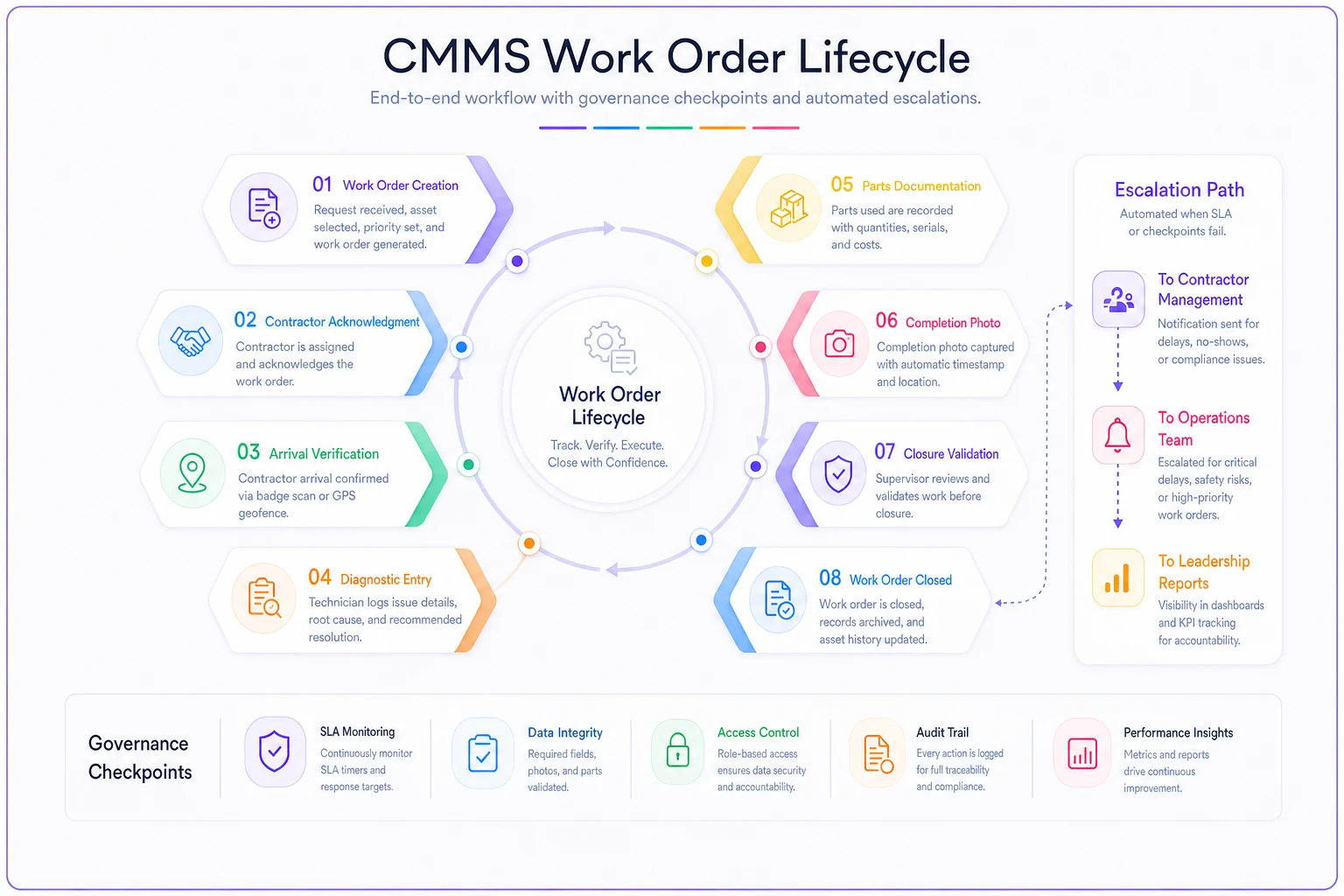
Require at least one timestamped photo for every closure to make dispute resolution fast and objective.
Build validation rules that reject incomplete submissions. A contractor can't close a ticket without entering actual arrival time. They can't mark "complete" without uploading at least one tagged photo. This feels bureaucratic until you're defending an invoice dispute six months later with no documentation of what actually happened.
Create contractor-specific dashboards visible to both parties. The contractor sees their rolling 30-day scorecard metrics. You see all contractors ranked by current performance. No more quarterly surprises—performance gaps appear in real time.
Automate escalations based on governance triggers. If a contractor hasn't acknowledged an emergency work order within 30 minutes, alerts fire to contractor management and your operations team. If their monthly diagnostic accuracy drops below 70%, an improvement plan requirement generates automatically. The system enforces governance so you're not manually policing every interaction.
The disputes you'll face in month one
Rolling out maintenance vendor governance triggers predictable resistance. Contractors comfortable with loose oversight suddenly face measurement. Your team comfortable with relationship management must enforce standards. Internal stakeholders question why trusted vendors now get scorecards.
"This adds bureaucracy we don't need"
Contractors claim the documentation requirements slow them down. They're fixing equipment, not writing reports. Counter this by showing how proper documentation prevents rework and disputes. That 5-minute update saves a 2-hour argument later.
"Every site is different, standards won't work"
Site managers defend their special contractors and unique situations. Yes, sites differ—that's why you have site-specific onboarding. But response time standards and documentation requirements should be universal. Let local relationships flourish within system constraints.
"Our good contractors will leave"
The fear that governance drives away quality vendors. Reality: good contractors appreciate clear expectations and fair measurement. They're often getting undercut by vendors who lowball bids and underdeliver. Governance levels the field.
"The scoring seems arbitrary"
Contractors question why diagnostic accuracy matters more than response time, or vice versa. Make weights transparent and tie them to operational impact. Show how a 10% improvement in diagnostic accuracy reduces repeat visits by 25%. Numbers defeat opinions.
Document every dispute in month one. Not to punish, but to refine. If three contractors interpret response time differently, your definition needs work. If everyone fails documentation requirements, the interface might be too complex. Early disputes reveal system gaps before they become systematic failures.
When contractors game your scorecards
Any measurement system invites gaming. Contractors learn what you measure and optimize for scores, not service. The emergency response metric is 4 hours? They classify everything as "urgent" to buy time. First-time fix rate matters? They declare temporary fixes "complete" then return later for actual repairs.
Cherry-picking work orders
Contractors grab easy preventive maintenance tickets to pad completion rates while complex repairs sit. Assign work orders rather than letting contractors self-select. Track acceptance rates—contractors refusing complex work get flagged.
Response time manipulation
Contractors acknowledge tickets immediately then don't dispatch for hours, claiming they "responded" at acknowledgment. Define response clearly: on-site arrival for emergency, scheduled commitment for standard. Use badge swipes or GPS verification for arrival times.
Parts blame gaming
Every delay becomes a "parts availability issue," which often doesn't count against contractors. Require documentation of parts requests with timestamps. If they didn't order parts within 24 hours of diagnosis, the delay counts against them.
Documentation flooding
Contractors upload dozens of photos and pages of notes, making review impossible while technically meeting requirements. Set maximum documentation limits and require structured updates. Quality over quantity.
The solution isn't more rules but better metrics. Instead of measuring first-time fix rate, measure repeat failures within 30 days. Instead of response time, measure total downtime from request to resolution. Harder-to-game metrics drive real performance.
Building better contracts from governance data
After six months of governance data, you have real ammunition for better contracts. Not theoretical SLAs but performance standards based on actual capability. You know Contractor A consistently hits 2.5-hour emergency response—so why accept a 4-hour SLA? You know electrical work has a 15% rework rate across all vendors—build in warranties and penalties.
-
Set SLAs at the 75th percentile of actual performance
-
Build penalties for patterns, not individual failures
-
Reward improvement trends, not just achievement
-
Include cross-contractor coordination requirements
-
Specify documentation standards with examples
Structure contracts to encourage the right behavior. Instead of hourly rates that reward slow work, use flat rates by work type based on your historical data. Instead of penalizing individual SLA breaches, penalize monthly patterns that indicate systematic problems.
One property management firm restructured all vendor contracts after a year of governance data. They moved from hourly to flat-rate pricing for around 80% of work orders, reducing invoice disputes by 90%. They set differentiated SLAs by building priority rather than blanket standards, improving response to critical sites by 40% while actually extending allowed response to low-priority locations. Total maintenance costs dropped 12% while uptime improved.
The ROI nobody calculates correctly
Facilities measure vendor governance ROI through cost savings and compliance metrics. They miss the operational impacts that dwarf the direct savings. Yes, catching invoice errors and reducing rework saves money. But the real value comes from less visible improvements.
Reduced coordination overhead
When contractors know expectations and systems enforce standards, your team spends less time managing vendors. One facility manager reported recovering over 10 hours weekly from vendor management after implementing systematic governance.
Faster issue resolution
Clear dispute playbooks and documented performance history turn multi-week arguments into 48-hour resolutions. Equipment comes back online sooner. Calculate the uptime value, not just the invoice adjustment.
Improved contractor capability
Contractors facing consistent measurement and feedback improve their operations. Response times tighten. Diagnostic accuracy improves. Documentation quality rises. You're not just managing vendors better—you're creating better vendors.
Knowledge retention
When a facility manager leaves, their vendor relationships and institutional knowledge usually walk out too. Systematic governance preserves performance history, dispute patterns, and improvement plans. New managers inherit intelligence, not just contracts.
Predictable budgeting
Historical governance data enables accurate maintenance budgeting. You know HVAC contractors average $340 per emergency call and roughly 2–3 emergency calls per unit annually. That's a real number, not a guess.
| Benefit | Description |
|---|---|
| Reduced coordination overhead | When contractors know expectations and systems enforce standards, your team spends less time managing vendors. One facility manager reported recovering over 10 hours weekly from vendor management after implementing systematic governance. |
| Faster issue resolution | Clear dispute playbooks and documented performance history turn multi-week arguments into 48-hour resolutions. Equipment comes back online sooner. Calculate the uptime value, not just the invoice adjustment. |
| Predictable budgeting | Historical governance data enables accurate maintenance budgeting. You know HVAC contractors average $340 per emergency call and roughly 2–3 emergency calls per unit annually. That's a real number, not a guess. |
Track these indirect benefits. When your CFO questions the time invested in vendor governance, show them the reduction in emergency maintenance costs from better contractor response. Show them the decrease in equipment downtime from improved first-time fix rates. Show them the labor hours recovered from systematic dispute resolution.
Making governance stick through operational integration
The best vendor governance system means nothing if nobody uses it consistently. Most facilities launch with enthusiasm then watch adoption fade as urgent work pushes governance tasks aside. The system becomes another ignored compliance requirement rather than an operational tool.
Morning stand-ups include contractor scorecard review
Start each day reviewing overnight contractor performance. Which vendors have open emergencies? Who's falling behind on PM schedules? This takes three minutes but keeps governance visible daily.
Work order creation requires vendor assignment
Can't create a contractor work order without selecting from approved vendors with current scorecards. This forces the question: is this vendor performing well enough for this critical repair?
Weekly site reports include a vendor section
Every site's weekly report must include a vendor performance summary. Not a lengthy analysis, just a few bullets: who's exceeding standards, who's struggling, what's being done. This creates site-level ownership.
Monthly contractor calls follow a standard agenda
First 10 minutes: review scorecard metrics. Next 10 minutes: discuss improvement opportunities. Last 10 minutes: upcoming work coordination. Same structure every month so contractors know what to prepare.
AI-powered operational software helps here by automating the mundane governance tasks that people tend to skip. The system can track response times automatically through integration timestamps, flag documentation gaps before work orders close, and generate scorecard updates without manual calculation. That automation frees your team to focus on relationship management and improvement initiatives rather than data entry and chasing down missing fields.
The key is making governance easier than non-governance. When pulling contractor performance takes two clicks instead of two hours, people actually do it. When dispute resolution follows a clear template instead of endless email threads, managers use the process. When the system automatically enforces documentation standards, contractors comply because they have no choice.
Conclusion: From vendor chaos to operational control
Maintenance vendor governance isn't about creating paperwork or punishing contractors. It's about building a system where performance is transparent, expectations are clear, and improvements happen systematically rather than through crisis and complaint.
Facilities still running on relationships and informal vendor management will keep fighting the same battles: surprise invoice overruns, finger-pointing when equipment fails, great contractors at some sites and disasters at others. They'll keep having the same quarterly business reviews where everyone promises to do better but nothing actually changes because there's no systematic way to measure or improve.
Meanwhile, facilities running proper vendor governance progressively improve their contractor ecosystem. Poor performers get coached or replaced. Good performers get rewarded and retained. Work order backlogs clear systematically because contractor capacity is visible and manageable. Asset data stays clean because contractors follow documentation standards. The entire maintenance operation becomes more predictable.
The path from vendor chaos to governance control isn't complex. Start with work-order-centric measurement. Build practical scorecards that track what matters. Create site-specific onboarding that prevents predictable failures. Establish clear dispute resolution paths. Then embed these tools into daily operations so governance happens automatically, not through heroic effort.
Your contractors might grumble initially about the structure. But the good ones quickly realize that clear expectations and fair measurement help them succeed too. They waste less time in disputes. They get paid faster when documentation is clean. They can prove their value with data instead of promises.
That shift—from managing relationships to managing performance—is where the real operational leverage lives. Facilities that get there run better maintenance operations at lower cost with less drama. The ones that don't keep rolling the dice on contractor performance and wondering why the results never improve.
Ready to optimize your maintenance operations?
Join 2,000+ facilities using Openfixit to reduce unplanned outages, extend asset life, and improve operational efficiency.