

Most calibration programs fail in the same boring way. Not with a dramatic instrument failure, but with a pressure gauge on a non-critical air line getting the exact same monthly attention as the temperature probe controlling a pharmaceutical cold room. Same interval logic. Same reminder emails. Same technician scrambling at month-end. And when the auditor shows up asking for the certificate on that cold room probe, half the time nobody can find it — or the last cal was three weeks past due and nobody caught it.
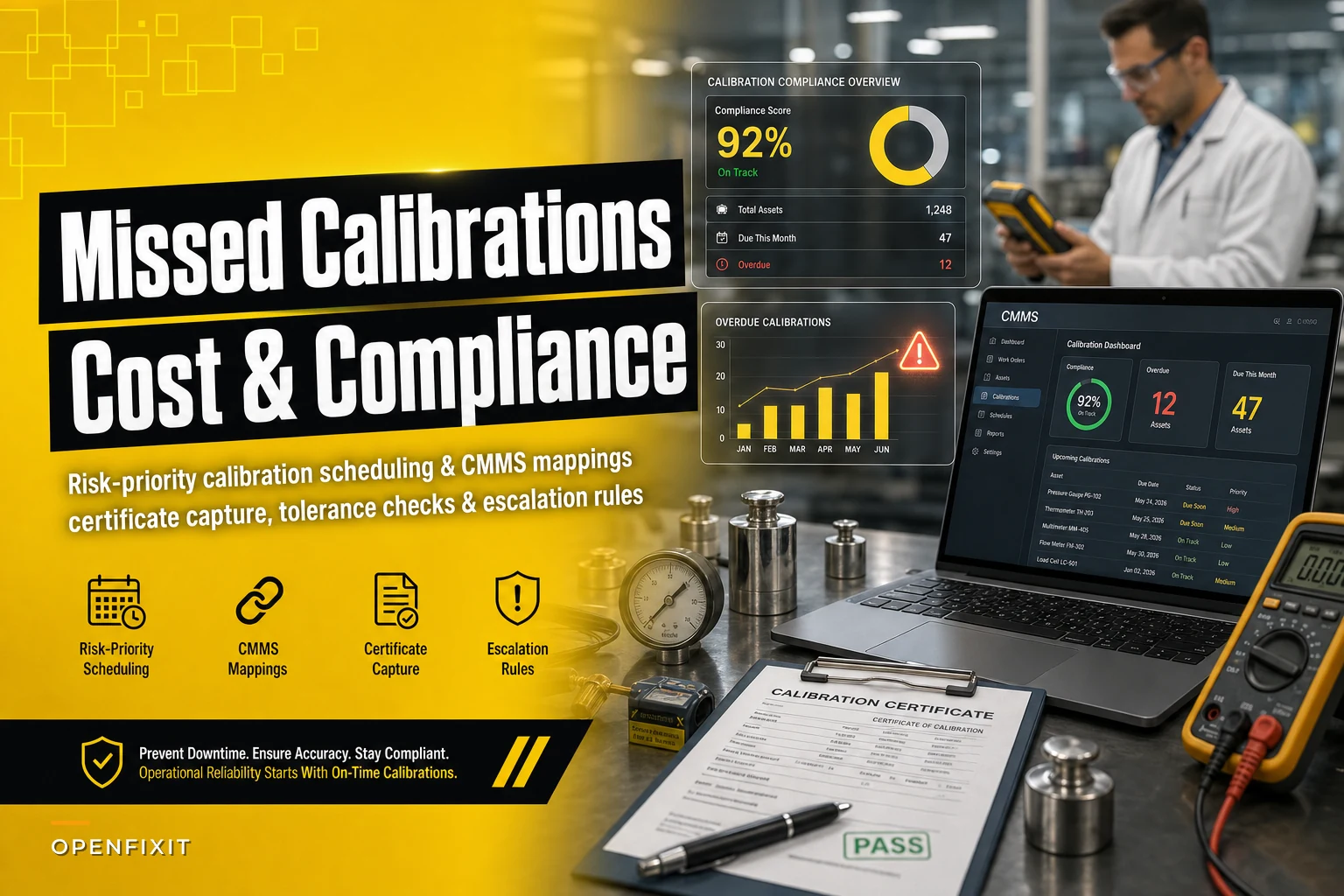
That flat, everything-is-equal approach is the root problem. When your calibration scheduling CMMS setup treats a $40 utility gauge and a legally-mandated safety interlock as equal priorities, you end up over-servicing trivial stuff and under-protecting the assets that actually carry compliance risk. This post is about fixing that: building a risk-priority calibration SOP where the metadata in your CMMS does the sorting — capturing certificates, running tolerance checks, deciding outsourced vs. in-house, and escalating the misses that matter before they become audit findings.
The failure pattern nobody documents
Here's how it plays out in a typical mid-size facility. Calibration lives in a spreadsheet or a basic PM module. Every instrument has a due date. Reminders fire. Technicians knock them out in whatever order is convenient — usually the easy, accessible ones first. The hard-to-reach or shutdown-required calibrations slide.
Nobody notices, because the schedule shows "10 calibrations due this month, 8 completed." That 80% completion rate looks fine on a dashboard. The problem is which 2 got skipped. In real operations, the deferred ones are almost always the high-consequence instruments — the ones requiring a line shutdown, a specialized outside lab, or a specific standard. Those are exactly the calibrations tied to product quality, safety, or a regulator's checklist.
So you get a system that reliably completes low-risk work and reliably defers high-risk work. That's not a scheduling problem. That's a prioritization problem, and no amount of reminder emails fixes it.
The second failure is the certificate. A technician or outside lab performs the cal, the paper certificate ends up in an email inbox, a shared drive folder, or a clipboard in the shop. The CMMS work order gets closed as "complete" with no evidence attached. Twelve months later during an audit, the calibration happened but you can't prove it happened. In a compliance context, undocumented equals didn't happen.
Build the metadata layer first, before you touch the schedule
You can't run risk-priority scheduling until each instrument carries the metadata that defines its risk and its handling. This is the unglamorous part everyone skips, and it's why their programs stay flat.
Eliminate downtime with proactive maintenance.
Openfixit helps you plan, track, and complete maintenance efficiently—maximizing asset reliability.
- Centralized asset management
- Automated maintenance scheduling
- Inventory and parts tracking
No credit card required
At minimum, every calibrated asset in your CMMS needs these fields populated:
-
Consequence class — what breaks if this instrument drifts out of tolerance (safety, regulatory, product quality, or utility/comfort)
-
Regulatory tie — the specific standard, reg, or customer spec that requires this cal, if any
-
Tolerance limits — the acceptable range and, separately, the alert range you use before hitting the limit
-
As-found / as-left capture — fields to record actual readings, not just pass/fail
-
Calibration source — in-house capable, or which outside lab and their accreditation scope
-
Standard/reference used — which master standard was used and its own due date
-
Certificate requirement flag — does a signed certificate need to be attached before the WO can close
That last field is the one that quietly saves you during audits. If the CMMS won't let the work order close without an attached certificate on flagged assets, your evidence gap disappears by design.
One practical note: don't invent a five-tier risk scoring model with weighted formulas. Facility teams don't maintain those. Three or four consequence classes that map cleanly to how you'd actually respond is enough. If you've already built out a risk-based inspection approach, your calibration classes should mirror the same logic so technicians aren't learning two different vocabularies.
Start by populating consequence class and certificate requirement on your safety and quality assets first — it yields the biggest audit protection for the least effort.
One practical note: don't invent a five-tier risk scoring model with weighted formulas. Facility teams don't maintain those. Three or four consequence classes that map cleanly to how you'd actually respond is enough. If you've already built out a risk-based inspection approach, your calibration classes should mirror the same logic so technicians aren't learning two different vocabularies.
Risk-priority scheduling: what actually changes
Once the metadata exists, the schedule stops being a flat list of due dates and becomes a sorted queue. The core rule is simple: priority drives sequencing, and interval drives frequency — they're two different things.
A high-consequence instrument might have a longer interval (some safety devices are annual) but a top scheduling priority, meaning when it's due, it does not slip. A low-consequence gauge might be monthly but sits at the bottom, and if it slips a week, nobody escalates.
Here's how the priority tiers translate into real handling:
| Consequence class | Example instrument | Slip tolerance | Escalation trigger | Certificate required |
|---|---|---|---|---|
| Safety / regulatory | Gas detector, safety relief valve, cold-chain probe | 0 days | At due date minus lead time | Yes — signed |
| Product quality | In-line pH, weigh scale, flow meter on batch line | 3–5 days | At due date | Yes |
| Process (non-critical) | Secondary pressure gauge, ambient RH sensor | 2 weeks | Weekly digest | Optional |
| Utility / comfort | Corridor thermostat, non-process gauge | Flexible | Monthly review | No |
The important shift: your scheduling logic now front-loads safety and quality calibrations at the start of their due window, not the end. In practice that means a safety instrument due on the 30th gets scheduled and pushed for the 15th–20th, giving you a buffer if the outside lab is backed up or the line can't be shut down on the first attempt.
Below is a simplified view of how a calibration event flows through a risk-priority system, from instrument metadata through to certificate capture and escalation:
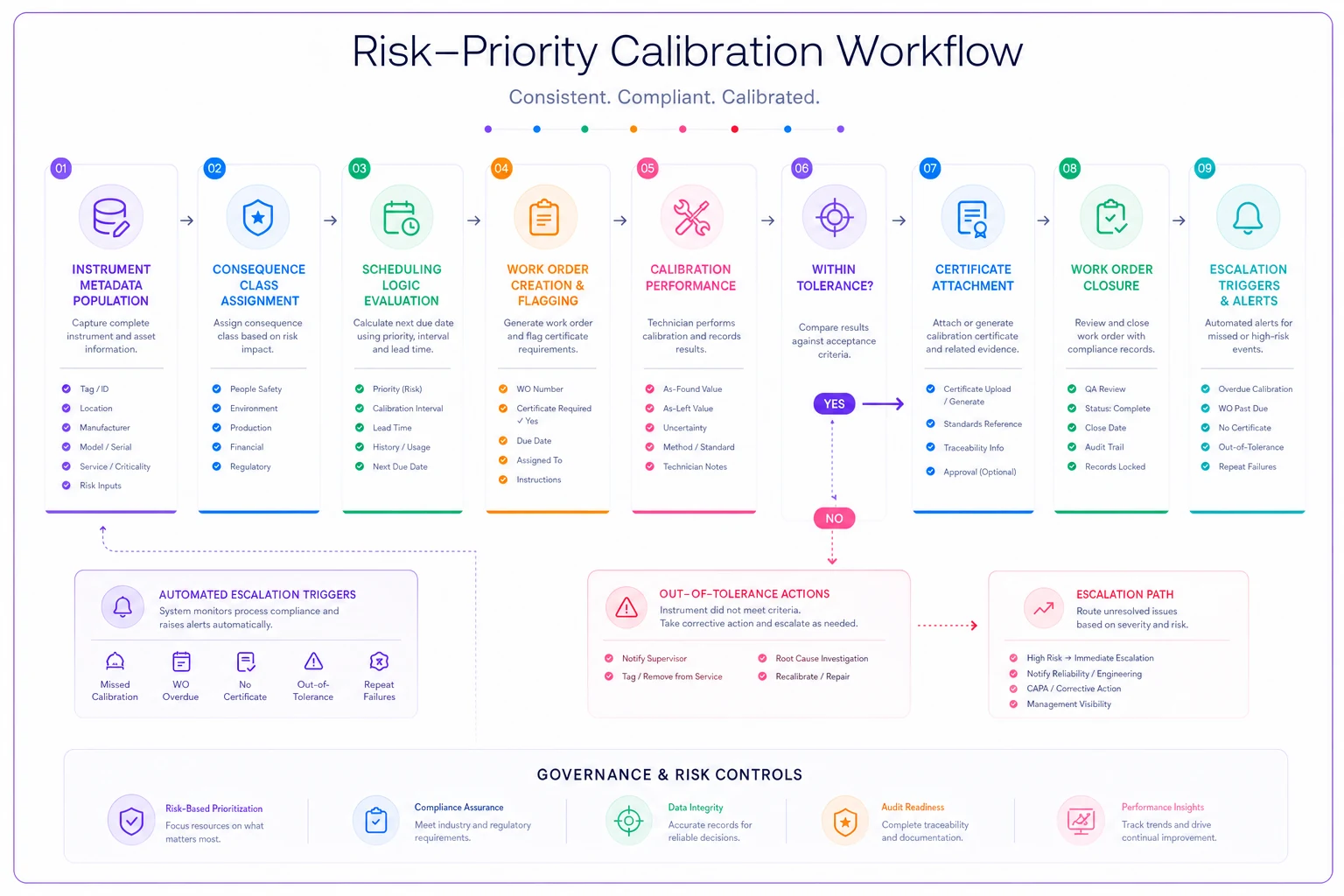
This flow isn't complicated, but most facilities are missing two or three steps in it — usually the alert band check and the certificate attachment gate.
Tolerance checks that catch drift before it's a failure
Pass/fail is not enough. An instrument that passes calibration but came in at 95% of its tolerance limit is telling you something — it's drifting, and next cycle it'll likely fail. If your CMMS only records "pass," you lose that signal entirely.
Capture as-found and as-left readings, then set an alert band inside the tolerance limit. A workable approach:
-
Technician (or lab) records the as-found reading against each test point.
-
CMMS compares as-found against the tolerance limit and the alert band.
-
If as-found is inside tolerance but outside the alert band, the asset gets flagged for interval review — it's drifting faster than expected.
-
If as-found is out of tolerance, an out-of-tolerance (OOT) event triggers
the work order can't close normally, and a review task spawns to assess impact on anything measured since the last good cal.
That step 4 is the one that matters for compliance. An OOT on a quality instrument means everything it measured since the last known-good calibration is now suspect. If you don't have an automated trigger for that, the impact assessment gets skipped — and you find out about it when a customer complaint or audit forces the question months later.
This is where AI-assisted checks earn their place quietly. Instead of a technician eyeballing whether an as-found reading is creeping toward its limit, the platform flags the drift pattern across cycles — spotting that a particular flow meter has been trending toward its upper limit for three calibrations straight and is likely to fail next cycle. That's a maintenance decision surfaced before it becomes a compliance event, without anyone building a manual trend chart.
Outsourced vs. in-house: let the metadata decide
One of the messier parts of calibration is deciding what your team handles and what goes to an accredited lab. Teams usually decide this ad hoc, which means it changes based on who's on shift and how busy they are — exactly the kind of inconsistency that produces gaps.
The decision should be baked into the asset metadata, not made fresh each cycle. A few clear rules:
-
Send out when the calibration requires a standard more accurate than your in-house reference, when accreditation (ISO 17025) is required by the reg or customer, or when the instrument needs specialized equipment you don't own.
-
Keep in-house when you have the reference standard, the competency is documented, and there's no accreditation requirement — this is your cost-saver for high-volume, low-risk instruments.
When the CMMS knows an asset's source is "outside lab," the scheduling logic automatically adds lead time. A lab that needs two weeks turnaround plus shipping means the work order should generate 3–4 weeks before the due date, not on it. This single adjustment prevents the most common outsourced-cal miss: the instrument comes due, someone realizes it has to ship out, and now you're already late before the box leaves the building.
When outsourcing more actually makes sense
If your in-house standards are themselves overdue for calibration, or your documented technician competency is thin, sending more work out is cheaper than the risk you're carrying. A facility running its own cals with an uncertified master standard is producing certificates that won't survive scrutiny anyway.
When keeping it in-house makes sense
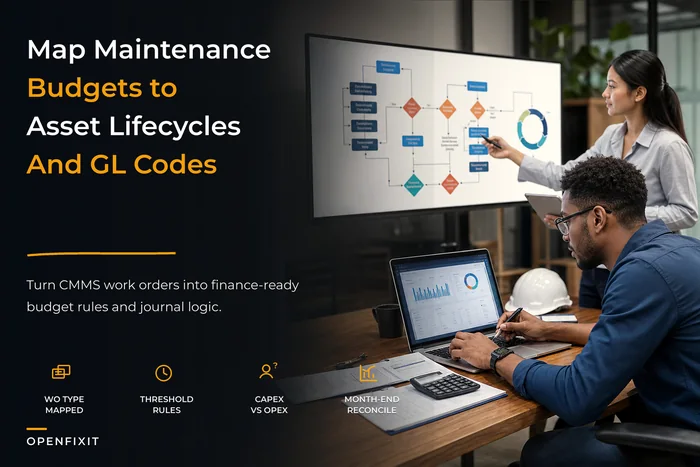
High-volume, low-consequence instruments where lab turnaround would create constant scheduling pressure. If you've got 200 pressure gauges on utility lines, shipping those out monthly is absurd — that's an in-house program with a properly maintained reference. The cost math here follows the same discipline you'd apply when you map maintenance budgets to asset lifecycles: the outsourced line item should be defensible against the risk it retires.
Certificate capture: close the evidence gap by design
The certificate problem deserves its own workflow, because it's where audit findings actually originate. The fix is making the certificate part of work order closure, not an afterthought.
The workflow, described plainly:
A calibration work order for a flagged asset generates with a required attachment condition. The technician or lab completes the cal. Before that work order can move to "complete," someone attaches the signed certificate — a PDF from the lab or a photo of the in-house record. The CMMS reads key fields from that document (cal date, next-due date, standard used, pass/OOT status) and either validates them against the work order or prompts a human to confirm. The certificate now lives attached to the asset's history, not buried in an inbox.
The AI-assisted layer here is document reading. Instead of a coordinator manually transcribing certificate data into fields, the platform extracts the calibration date, expiry, and result from the uploaded certificate and populates the record. It flags mismatches — say, the certificate shows a next-due date that doesn't match the interval in the system. Small thing, but it catches a surprising number of errors before they compound into a scheduling gap.
The payoff is retrieval. When an auditor asks for the last three certificates on a specific instrument, it's two clicks from the asset record, not a folder-diving expedition. Certificate retrieval speed is a genuinely underrated audit metric — teams that produce evidence instantly project competence, and teams that stall project the opposite.
Escalation: the part that separates compliant programs from lucky ones
Reminders are not escalation. A reminder emails the technician. Escalation means that when a high-consequence calibration is trending toward missed, the right people get pulled in with increasing urgency, and the miss is visible to someone accountable.
A tiered escalation that actually works:
-
Lead time reached, not scheduled → notify technician and supervisor. For outsourced items, this fires weeks early.
-
Due date reached, incomplete (safety/regulatory class) → notify facility manager, log a compliance exception. Not a soft nudge.
-
Past due (safety/regulatory) → the instrument's downstream process gets flagged, and depending on your rules, the asset may need to be tagged out-of-service until calibrated.
-
OOT event on quality instrument → automatic impact-review task assigned, with the affected measurement window populated.
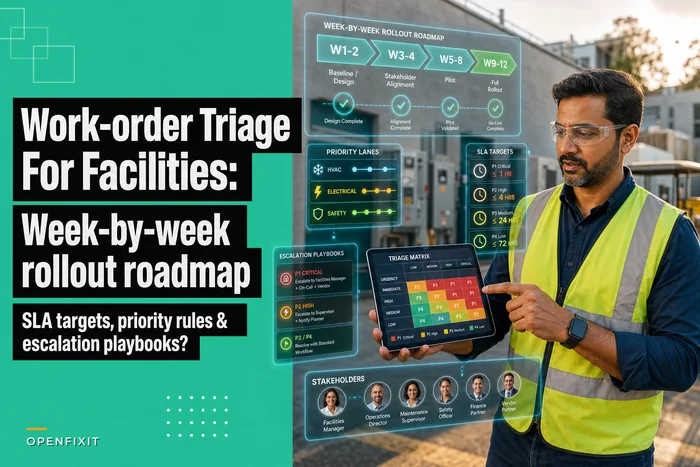
The design principle: escalation intensity should match consequence class, not the raw count of overdue items. Five overdue utility gauges is a housekeeping issue. One overdue gas detector is a stop-everything event. A flat overdue count buries the second inside the first. If your escalation logic mirrors the same tiered thinking behind a solid work-order triage matrix, you keep one consistent priority language across all your maintenance work instead of a separate island for calibration.
A real scenario
A regional food-processing facility ran calibration out of a shared spreadsheet with monthly reminder emails. Around 60 instruments across two lines — a mix of in-house gauges and outside-lab probes. On paper, completion sat around 85% most months.
The gap surfaced during a customer audit. The auditor asked for certificates on three temperature probes controlling a critical cook step. Two certificates were found after roughly 40 minutes of searching. The third probe's last documented cal was seven weeks past due — it had needed a line shutdown that kept getting deferred in favor of the easier gauges. That single gap turned into a corrective-action request and a follow-up audit.
The rebuild took a few weeks. Every instrument got a consequence class, tolerance and alert bands, and an outside-lab lead-time flag. The scheduling logic front-loaded the safety and quality cals. Certificate attachment became mandatory to close flagged work orders. Escalation split into tiers so the cook-step probes couldn't slip quietly behind an aggregate completion percentage.
Over the following two quarters, overdue high-consequence calibrations dropped to essentially zero, because they could no longer hide inside an 85% number. Certificate retrieval went from "go find it" to under a couple of minutes. Formalizing in-house handling for the low-risk gauges trimmed the outside-lab spend by roughly $4k–$6k a year — money that had been going to send out cals the team was fully capable of doing themselves. Nothing dramatic on the top line, but the compliance exposure that started the whole thing was gone.
Who should not overbuild this
If you're running a small shop with a dozen non-regulated instruments and no external audit exposure, a full risk-priority SOP with automated escalation is more machinery than you need. A simple due-date list and disciplined certificate filing will serve you fine. The complexity is worth it specifically when you have a mix of consequence classes and a regulator or customer who will actually ask for evidence.
Don't try to launch all of this at once. Populate metadata on your safety and quality instruments first — that's usually 20–30% of the list carrying 90% of the risk. Get those front-loaded, escalating, and certificate-locked. The utility gauges can stay on a simple list until you get to them. A calibration program that perfectly manages every trivial gauge but still lets one gas detector slip has solved the wrong problem.
If you're also thinking about how calibration gaps feed into broader ESG or sustainability reporting obligations, there's a useful angle on aligning maintenance visibility with ESG requirements worth reading alongside this.
The core idea to keep
Missed calibrations rarely happen because a team is careless. They happen because the scheduling system can't tell the difference between an instrument that matters and one that doesn't — so easy work crowds out important work, and the aggregate completion number looks healthy the whole time.
Fix the metadata, let priority and interval work as separate levers, lock certificates into work-order closure, and make escalation match consequence. The dashboard might still show 85% completion. The difference is you'll know, with certainty, that the 15% left over is the stuff that doesn't matter.
Ready to optimize your maintenance operations?
Join 2,000+ facilities using Openfixit to reduce unplanned outages, extend asset life, and improve operational efficiency.