

Most maintenance SLAs read like a lawyer and a procurement manager argued for an afternoon and then gave up. Response times, uptime percentages, a few penalty clauses, a monthly report nobody opens. Fine on paper. Then you try running them across 14 sites with three different vendors and a CMMS configured by someone who left two years ago, and the whole thing quietly falls apart.
The real problem isn't bad drafting. It's that SLAs are written to describe activity instead of outcomes, and they live in a Word document instead of inside the system that actually tracks work. So nobody can tell whether the vendor is hitting targets until the end-of-quarter review — which is exactly when it's too late to do anything about it.
This article is about wiring the whole thing together. Building an SLA taxonomy that maps cleanly onto CMMS metrics, weighting those metrics to reflect real risk, defining escalation paths that trigger automatically, and writing procurement clauses that still hold up when you grow from 5 sites to 50. Not a template you copy once. A system that holds as the portfolio scales.
Why activity-based SLAs break the moment you have more than one site
There's a pattern that shows up constantly. A single-site facility writes an SLA with a vendor: "respond within 4 hours, resolve within 24." It works, more or less, because one person — the site manager — knows the context. They know the "resolved" work order on the air handler was actually a band-aid, and they lean on the vendor informally to come back and do it right.
That informal knowledge is doing enormous load-bearing work. And it doesn't scale.
Add sites. Now the person signing off on "resolved" isn't the person who felt the consequence. The vendor closes the ticket, the metric looks green, and three weeks later the same chiller trips again. In the CMMS it reads as two separate incidents, both resolved on time. The SLA says the vendor performed well. The building says otherwise.
This is the core failure of activity-based SLAs: they measure whether someone showed up and touched the asset, not whether the problem stayed fixed. When you're small, tribal knowledge papers over the gap. As you scale, the gap becomes the dominant signal, and your SLA dashboard turns into something that reassures everyone while actual reliability slowly drifts.
The first sign of this usually isn't a formal complaint — it's a disconnect. Leadership sees 97% SLA compliance. Site techs are frustrated. Both are telling the truth, because they're measuring completely different things.
Start with the taxonomy, not the targets
Before you set a single number, you need a structure that separates the kinds of commitments you're making. Mixing them together is how SLAs become unmeasurable.
Eliminate downtime with proactive maintenance.
Openfixit helps you plan, track, and complete maintenance efficiently—maximizing asset reliability.
- Centralized asset management
- Automated maintenance scheduling
- Inventory and parts tracking
No credit card required
-
1. Response commitments — how fast someone engages. Easy to measure, weak signal of quality. Keep them, but don't let them dominate.
-
2. Restoration commitments — how fast the asset returns to service. Better signal, but still vulnerable to the band-aid problem.
-
3. Outcome commitments — did the fix hold? Measured by recurrence windows and failure-free periods after closure.
-
4. Portfolio-health commitments — the vendor's aggregate effect on a class of assets across sites: PM completion quality, mean time between failures trending correctly, backlog not growing.
Most teams write everything at layers 1 and 2 because those are easy to pull from the CMMS. The leverage is almost entirely at layers 3 and 4. A chiller vendor who responds in 2 hours but whose repairs recur within 30 days is worse than one who takes 6 hours and whose fixes hold for a year — and your SLA should say so, out loud, with weighting behind it.
Mapping each layer to a CMMS field
An SLA is only real if the metric behind it comes out of the system automatically. If someone has to calculate it by hand each month, it will quietly stop being calculated. Every commitment needs a defined CMMS source.
| SLA layer | Commitment example | CMMS metric source | Common failure point |
|---|---|---|---|
| Response | Acknowledge priority-1 WO within 1 hr | Timestamp delta: created → acknowledged | Auto-acknowledge rules fake the timestamp |
| Restoration | Restore critical asset within 8 hrs | Timestamp delta: created → status "operational" | "Operational" set before verification |
| Outcome | No recurrence of same failure code within 45 days | Linked WOs on same asset + failure code | Recurrences logged as new, unlinked tickets |
| Portfolio health | PM completion ≥95% on-time per asset class | PM compliance report, filtered by vendor/class | Techs back-date completions to hit the number |
Notice the right-hand column. Every one of these metrics has a gaming path, and if you don't design against it, your vendors — and sometimes your own team — will find it. The outcome layer is the hardest to game and the hardest to configure, which is exactly why most teams skip it, and why skipping it guts the whole SLA.
The recurrence metric in particular depends on your failure-code discipline and asset hierarchy being clean. If the same pump failure gets logged three different ways, you'll never detect the pattern. This is where your work-order triage matrix and consistent priority and failure-code rules stop being nice-to-haves and become the foundation the SLA literally runs on.
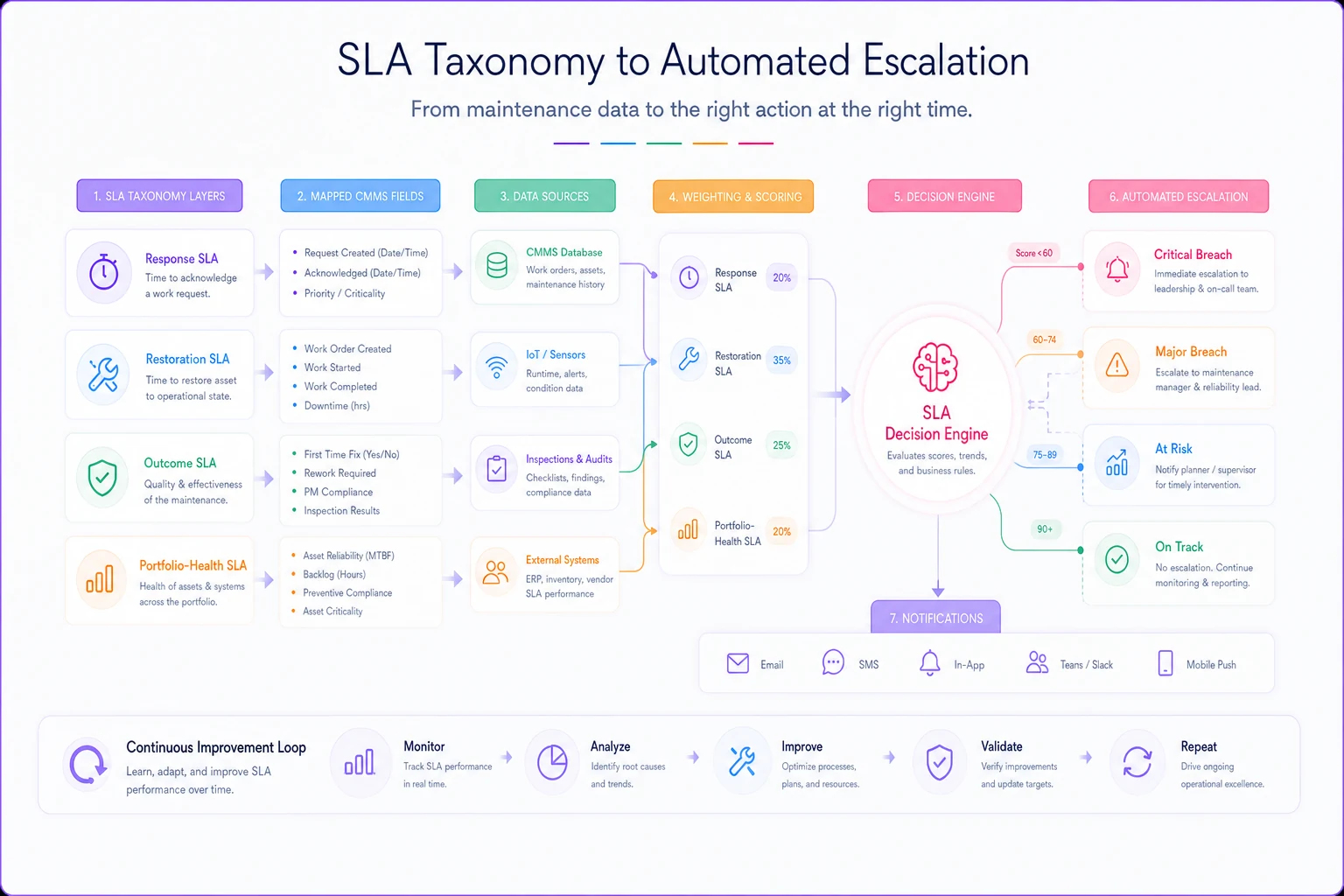
A simple diagram like this helps teams align the taxonomy to the CMMS fields and escalation logic.
Weighting: where risk actually lives
A flat SLA treats a failed restroom exhaust fan the same as a failed emergency generator. Nobody actually believes those are equal, but the math treats them identically unless you build weighting in.
Weighting does two things. First, it makes the composite SLA score reflect real operational risk, so a vendor can't bury a critical miss under a pile of trivial wins. Second, it tells escalation when to get loud — a weighted breach on a life-safety asset should wake someone up; a weighted breach on a low-criticality asset should just accumulate on a scorecard.
-
Asset criticality (1–5)
consequence of failure — safety, compliance, revenue, occupant impact.
-
Commitment layer weight
outcome and portfolio-health commitments weighted heavier than response, because that's what you actually care about.
-
Recurrence multiplier
a breach on an asset that has already breached this quarter counts for more. Repeat offenders should score worse, not get averaged back toward the middle.
The part teams consistently get wrong: they weight by asset cost instead of asset consequence. A $4,000 pump serving a critical process can matter far more than a $40,000 rooftop unit serving a storage area. The weighting has to come from a criticality assessment, not the purchase order.
Weight by operational consequence, not purchase price.
A simple worked version: a priority-1 generator restoration breach at criticality 5, outcome-layer weight 3, with a recurrence multiplier of 1.5 produces a weighted penalty score of 22.5. A low-criticality fan missing a response target — criticality 2, response-layer weight 1, no recurrence — scores 2. On a flat SLA both show up as "one breach." Weighted, one triggers a management review and the other just gets noted. That's the difference between an SLA that directs attention and one that drowns it.
Escalation paths that trigger from the system, not from someone remembering
The weakest link in almost every SLA is the escalation path, because it usually depends on a human noticing. Someone has to see the breach, decide it matters, find the right contact, and chase it. At one site with an engaged manager, that works. Across a portfolio, escalation-by-vigilance fails constantly — not because people are lazy, but because they're busy and the breach is buried somewhere in a queue of 200 open work orders.
Outcome-based SLAs need escalation that fires off the metric automatically. The CMMS watches the timestamp or recurrence condition, and when a weighted threshold is crossed, it routes the escalation without anyone having to catch it.
-
Tier 0 — Soft nudge. Approaching threshold (e.g., 75% of restoration clock elapsed). Automated reminder to the assigned vendor or tech. No human escalation yet.
-
Tier 1 — Breach, low weight. Logged against the vendor scorecard. Visible in the weekly review. No interruption.
-
Tier 2 — Breach, high weight. Immediate notification to the site lead and vendor account manager. Clock starts on a resolution plan.
-
Tier 3 — Critical or repeat breach. Notification up to portfolio or regional level. Triggers a formal review and can activate contractual remedies.
The design principle is that escalation intensity matches weighted risk. If every breach pages the regional manager, they'll mute the channel inside a week and you're back to relying on vigilance. If nothing escalates automatically, critical breaches hide in the queue. The weighting model calibrates this — it decides which tier a breach lands in.
This is also where outcome-based SLAs connect directly to vendor governance. An escalation that fires automatically and lands on a scorecard is worth ten angry emails, because it's defensible and it builds a record over time. If you're formalizing how you hold contractors accountable, the mechanics of a work-order-centric vendor governance system are the natural companion here — the SLA defines the breach, the governance system turns repeated breaches into consequences.
Procurement clauses that survive the jump from 5 sites to 50
This is where good SLA design usually dies. The clauses are written for the deal in front of you, not the portfolio you'll have in three years. Then you grow, onboard new vendors, and every contract measures outcomes slightly differently. Now you can't compare vendors against each other, and you can't run one scorecard across the portfolio.
-
They reference the taxonomy, not specific numbers. The contract says "outcome-layer commitments measured by recurrence window per the standard SLA schedule." The actual thresholds live in an appendix you can update without reopening the contract. This is the single most important move for scale — it decouples the legal document from the operational targets.
-
They mandate CMMS data as the system of record. The vendor agrees that CMMS timestamps and failure codes are authoritative. No parallel spreadsheets, no "our logs say we were on time." If it's not in the CMMS, it didn't happen. This kills disputes before they start.
-
They define the metric calculation, not just the target. "Restoration time" has to specify: clock starts at WO creation, stops at verified operational status, pauses only for documented access delays. Vague definitions are where every dispute originates.
-
They include a recurrence and credit mechanism. A fix that fails inside the outcome window doesn't just reset the clock — it reopens the original obligation, no new charge. That's what makes the SLA outcome-based in contract terms, not just operationally.
-
They scale penalties by weighted score, not flat per-breach fees. A single penalty-per-miss structure punishes trivial misses and under-punishes critical ones. Tie remedies to the weighted model.
When outcome-based clauses make sense — and when they don't
Outcome-based SLAs aren't free. They require clean CMMS data, disciplined failure coding, and a vendor relationship mature enough to accept being measured on results. Forcing them in the wrong situation is a mistake.
When they make sense:
-
You have multiple sites and vendors you need to compare on the same terms.
-
Your assets have meaningful criticality differences (most facilities do).
-
Your CMMS data quality is good enough that recurrence and PM-completion metrics are trustworthy.
-
The vendor has enough control over the outcome to be fairly held to it.
When they're a bad idea:
-
Your asset hierarchy and failure codes are a mess. Outcome metrics will be garbage, and you'll be penalizing vendors based on bad data — a fast way to destroy the relationship.
-
You're measuring something the vendor can't actually control. If restoration depends on parts you supply and you're the bottleneck, don't put a restoration SLA on them.
-
Single small site with one trusted vendor. The overhead isn't worth it; informal accountability still works at that scale.
Who should not do this yet: teams mid-cutover, or whose CMMS adoption is shaky enough that techs aren't reliably closing work orders with accurate timestamps. Fix the data foundation first. An outcome-based SLA built on unreliable data is worse than no SLA, because it manufactures confident-looking numbers that are wrong.
A short real scenario
A regional operator running retail-adjacent facilities — around 18 sites, HVAC-heavy, two primary mechanical vendors — had the classic split. Leadership saw roughly 96% SLA compliance. Site managers were escalating the same rooftop-unit failures by email, repeatedly, with no real leverage.
When they rebuilt the SLA around outcomes, the first change was adding a 45-day recurrence window to the restoration commitment and linking recurring failures to the original work order in the CMMS. The response targets didn't change. But suddenly the 96% compliance number dropped closer to 80% once recurring fixes stopped counting as clean wins.
That wasn't the vendors getting worse. It was the metric finally telling the truth.
Over the following couple of quarters, with weighted escalation firing automatically on repeat breaches, failures on the worst-performing asset class fell by roughly a third, and the volume of manual escalation emails from site managers dropped off noticeably. The vendors didn't love the recurrence clause at first. But because the CMMS was the agreed system of record, disputes that used to drag on for weeks mostly ended in one conversation — the data wasn't really arguable.
The outcome that mattered most wasn't a compliance percentage. It was that leadership and the field finally saw the same picture.
Tying it together: the SLA is a system, not a document
Outcome-based maintenance SLAs work because they stop treating the SLA as a contract clause and start treating it as a control loop. The taxonomy defines what you're committing to. The CMMS mapping makes those commitments measurable automatically. The weighting makes the measurements reflect real risk. The escalation paths turn breaches into action without depending on anyone remembering. And the procurement clauses keep all of it consistent as you add sites and vendors.
Pull any one of those pieces out and the rest degrades. Good outcome metrics but manual escalation means you'll miss breaches. Good escalation with flat weighting means you'll cry wolf until people stop listening. Clean weighting with vague procurement clauses means a dispute every quarter. They're interdependent, which is why bolting a recurrence clause onto an otherwise activity-based SLA rarely fixes anything — you have to rebuild the whole loop.
If you're going to do this, start where the data already supports it. Pick one asset class with clean failure coding, build the full loop around just that class, and prove the recurrence and escalation logic works before rolling it across the portfolio. Teams that try to rewrite every SLA at once usually stall. The ones that nail one asset class, show leadership a metric that finally matches what the field is experiencing, and then expand — those are the ones that end up with SLAs people actually trust.
Ready to optimize your maintenance operations?
Join 2,000+ facilities using Openfixit to reduce unplanned outages, extend asset life, and improve operational efficiency.