

The difference between facilities that pass audits and those that scramble during regulatory visits isn't luck—it's how they organize inspection evidence. Most facility teams treat inspections as isolated events, disconnected from their CMMS, scattered across spreadsheets, and misaligned with actual regulatory requirements.
Teams that map inspection data directly to regulatory frameworks catch problems months before they become violations. Those who don't end up with boxes of paper records, failed audits, and equipment failures that "nobody saw coming."
Think about your current inspection process. A technician completes a fire extinguisher inspection. Where does that data go? Maybe into the CMMS as a closed work order. Maybe onto a paper form filed somewhere. The photo showing the gauge reading? Probably on someone's phone. The signature confirming completion? Could be digital, could be paper, might not exist.
Multiply that across every inspection type, every asset, every month. That's the real problem.
The inspection evidence problem nobody talks about
A pharmaceutical facility in New Jersey taught me a lot about how inspection failures actually happen. They had 47 different inspection types running—fire systems, HVAC validation, pressure vessels, electrical panels, emergency lighting. Perfect attendance on every inspection. Still failed their FDA audit badly.
The problem wasn't missing inspections. It was evidence organization. When the auditor asked for proof of quarterly HVAC filter changes in the clean room, the maintenance manager spent three hours digging through work orders, photos on technicians' phones, and paper logbooks. They found everything eventually, but the damage was done. The auditor noted "inadequate documentation systems" and flagged them for reinspection.
This happens more than people admit. Teams complete inspections religiously but can't produce evidence when it matters. Your risk-based inspection strategy for facilities breaks down not because you're skipping inspections, but because your evidence lives in seventeen different places.
Think about your current inspection process. A technician completes a fire extinguisher inspection. Where does that data go? Maybe into the CMMS as a closed work order. Maybe onto a paper form filed somewhere. The photo showing the gauge reading? Probably on someone's phone. The signature confirming completion? Could be digital, could be paper, might not exist.
Multiply that across every inspection type, every asset, every month. That's the real problem.
Mapping inspection requirements to actual regulations
Most facilities run inspections based on what they've always done, not what regulations actually require. Teams doing monthly inspections on equipment that only needs annual checks, while completely missing quarterly requirements on critical safety systems—it's more common than you'd think.
Eliminate downtime with proactive maintenance.
Openfixit helps you plan, track, and complete maintenance efficiently—maximizing asset reliability.
- Centralized asset management
- Automated maintenance scheduling
- Inventory and parts tracking
No credit card required
Start with the actual regulatory text. Not what your predecessor told you, not what the inspection company suggests—the actual requirements. For a typical facility, you're looking at:
OSHA requirements:
-
Monthly fire extinguisher visual inspections (29 CFR 1910.157)
-
Annual fire extinguisher maintenance checks
-
Quarterly emergency eyewash station activation
-
Annual crane inspections with load testing
NFPA 25 for fire systems:
-
Weekly visual inspection of sprinkler control valves
-
Monthly inspection of fire pumps (run test)
-
Quarterly main drain tests
-
Annual internal pipe inspections
EPA requirements (if applicable):
-
Weekly visual inspections of storage tanks
-
Monthly inspection of secondary containment
-
Annual integrity testing
State and local codes:
-
Elevator inspections (varies by state)
-
Boiler inspections (varies by pressure rating)
-
Backflow preventer testing (typically annual)
Where teams consistently get tripped up: they create one giant inspection schedule without mapping each requirement back to its source regulation. When regulations change—and they do—nobody knows which inspections to update.
Build your inspection matrix differently. Create a table that shows each asset type, the specific regulation requiring inspection, how frequently it's required, what type of evidence you need (visual, measurement, certification), and what non-compliance actually costs you.
| Asset Type | Regulation | Frequency | Evidence Required | Non-Compliance Risk |
|---|---|---|---|---|
| Fire extinguishers | OSHA 29 CFR 1910.157 | Monthly (visual), Annual (maintenance) | Signed inspection tag, maintenance record | Citation, fine |
| Sprinkler control valves | NFPA 25 | Weekly | Visual log, supervisor sign-off | Insurance void, citation |
| Emergency eyewash stations | OSHA 29 CFR 1910.151 | Quarterly activation | Activation record, photo | OSHA citation |
| Fire pumps | NFPA 25 | Monthly run test | Run log, flow data | Insurance void |
| Storage tanks | EPA (varies) | Weekly visual | Visual inspection log | EPA fine, cleanup liability |
| Cranes | OSHA 29 CFR 1910.179 | Annual with load test | Certification, load test report | Immediate shutdown order |
This becomes your source of truth. When someone asks why you inspect cooling towers monthly, you point to the exact regulation. When budget cuts threaten inspection programs, you show the compliance risk in plain terms.
The evidence bundle system that survives audits
Traditional filing systems fail because they organize by date or asset, not by regulatory requirement. An auditor doesn't care about your chronological filing system—they want evidence mapped to their checklist.
Organize evidence bundles by regulatory requirement, not inspection type. Each bundle contains:
-
The regulation reference – exact citation and requirement text
-
Inspection schedule – showing planned vs. completed
-
Evidence trail – work orders, photos, measurements, certifications
-
Deviation records – any missed inspections with explanations
-
Corrective actions – what you did about findings
A medical device manufacturer in Minnesota restructured their entire evidence system around FDA requirements rather than equipment types after failing three consecutive audits. Each FDA requirement got its own digital folder with all related inspection evidence.
During their next audit, when the FDA asked about equipment calibration under 21 CFR 820.72, they pulled up one folder containing every calibration certificate for the past two years, deviation reports for late calibrations, corrective action plans, and trending data.
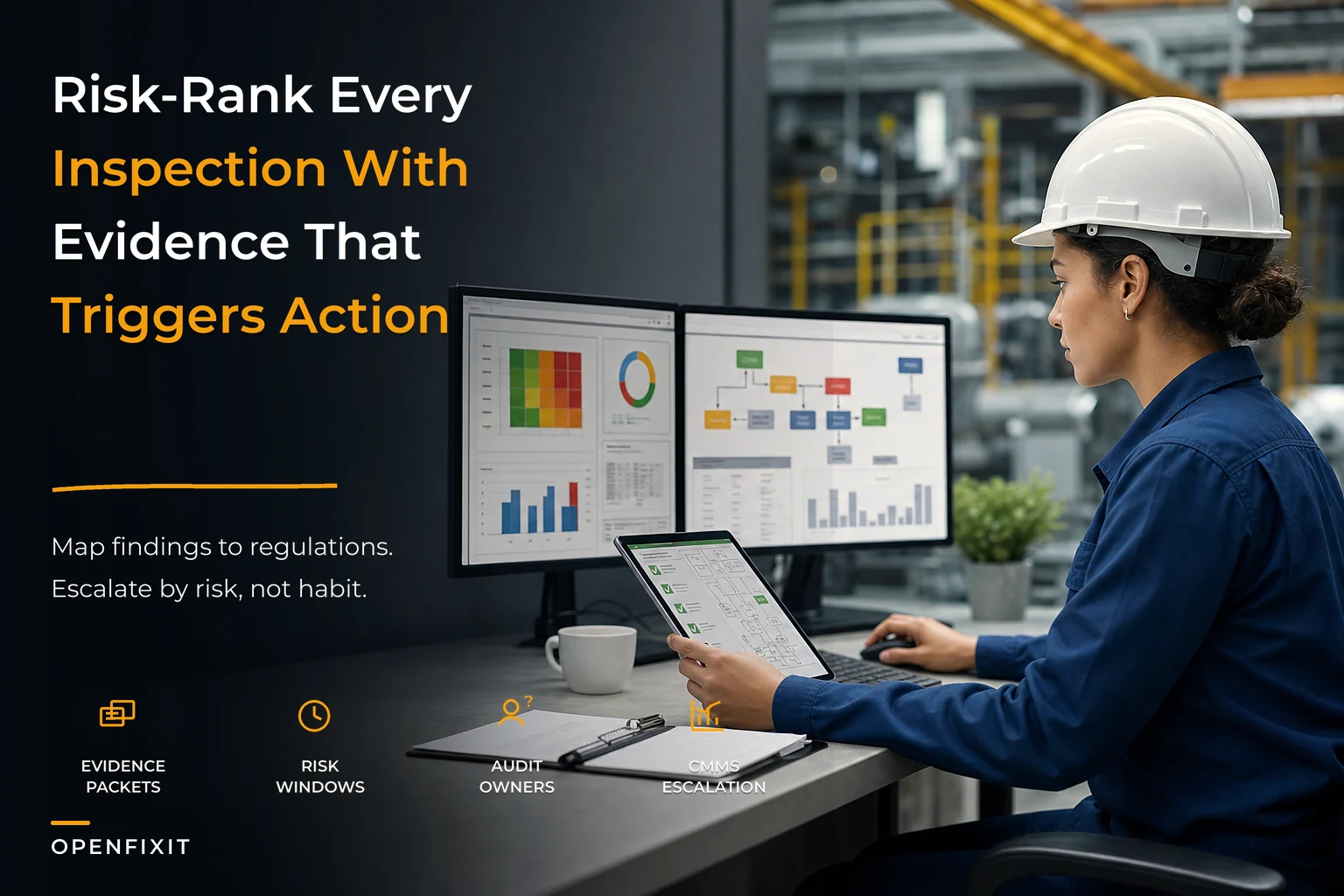
Assign a single owner to update evidence bundles weekly so packets stay audit-ready.
The audit that usually took three days wrapped up in a day and a half. The auditor actually complimented their documentation system.
Building CMMS escalation rules that prevent disasters
Your CMMS shouldn't just track inspections—it should flag problems before they compound. Most facilities set up basic PM schedules and call it done. That's how critical findings get buried in closed work orders until equipment fails or regulators show up.
Level 1 – Critical safety/compliance items:
-
Overdue by 1 day
Email facility manager
-
Overdue by 3 days
Email director
-
Overdue by 7 days
Email VP + create incident report
-
Finding requires immediate shutdown
Level 2 – High-risk operational items:
-
Overdue by 7 days
Email facility manager
-
Overdue by 14 days
Email director
-
Major findings trigger automatic follow-up inspection in 30 days
Level 3 – Standard compliance items:
-
Overdue by 14 days
Email supervisor
-
Overdue by 30 days
Email facility manager
-
Findings tracked but not immediately escalated
The part most teams miss: escalation rules for inspection findings, not just overdue inspections.
When a technician notes "excessive vibration" during a pump inspection, what happens? In most systems, nothing. It sits in the work order notes until the pump fails six months later. Build escalation rules based on finding keywords:
-
"Leak" triggers immediate notification
-
"Crack" generates high-priority work order
-
"Excessive wear" schedules follow-up inspection in 30 days
-
"Out of calibration" locks out equipment until corrected
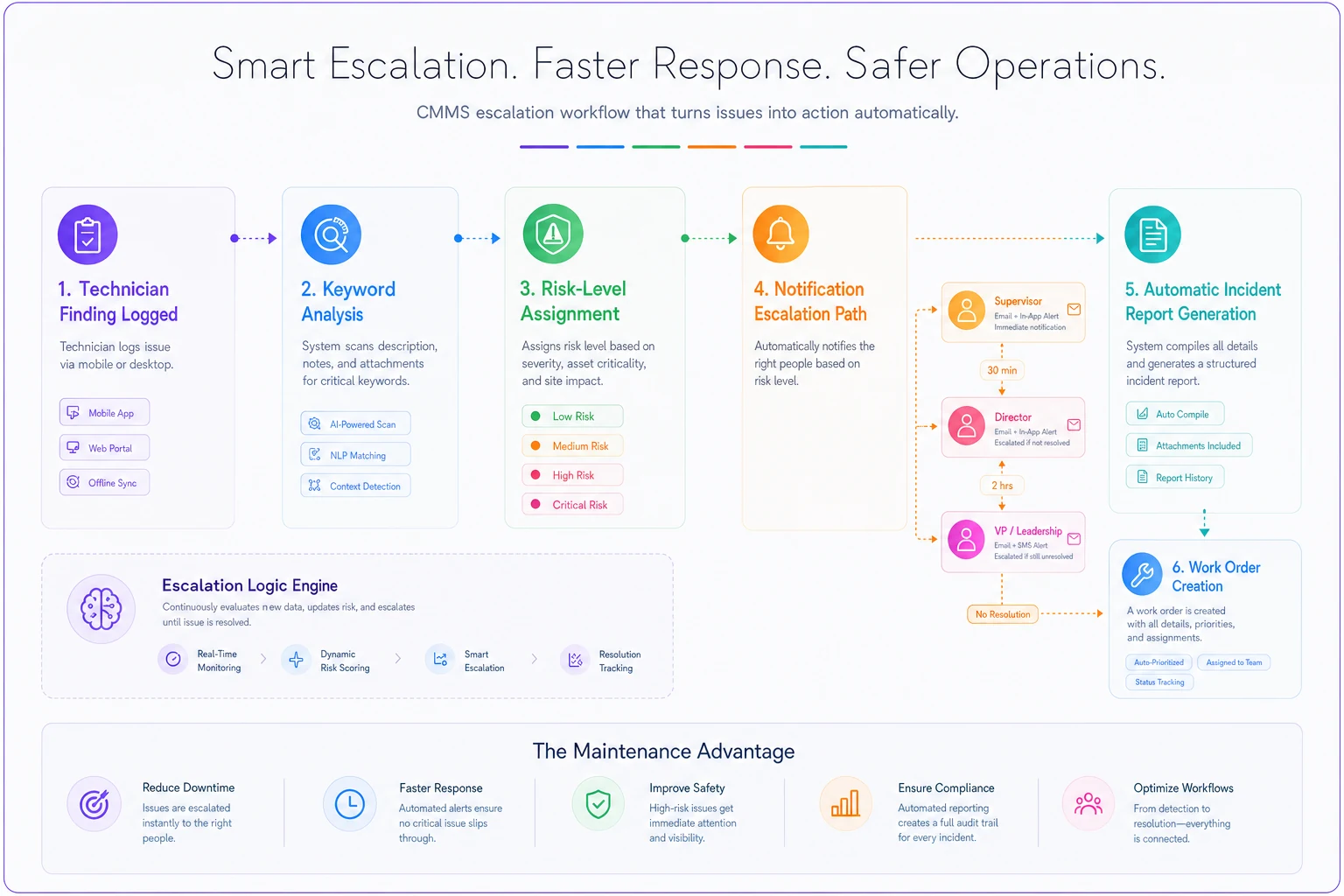
This diagram shows how findings escalate from technician notes to leadership notifications and incident reports.
A food processing plant in Iowa implemented keyword-based escalations and caught a developing ammonia leak about three weeks before it would have triggered an evacuation. The phrase "unusual odor" in an inspection report triggered an automatic high-priority investigation work order.
The inspection automation trap
Everyone wants to automate inspections. Install sensors, eliminate manual rounds, reduce labor costs. Sounds great until you realize automated systems create their own inspection requirements.
A distribution center in Texas learned this firsthand. They installed vibration sensors on all critical motors to replace monthly manual inspections. Worked well for eight months. Then during an OSHA inspection, they got cited for not maintaining proper inspection records. Automated monitoring doesn't eliminate the documentation requirement—it just changes what you need to document.
They ended up having to prove:
-
Sensors were calibrated quarterly
-
Alert thresholds were technically justified
-
Someone actually reviewed the automated data
-
Failures triggered appropriate responses
They went from around two hours of monthly manual inspections to six hours of monthly data validation and sensor maintenance.
Automation works when you design it correctly. The key: automate data collection, not decision-making. Use sensors to supplement human inspections, not replace them. Your risk-based inspection strategy for facilities should blend automated monitoring with human verification.
Temperature sensors on refrigeration units can collect data continuously, but a technician still does weekly rounds to verify readings against handheld instruments, check for physical issues sensors can't detect, ensure automated alerts are functioning, and document regulatory compliance.
When inspection programs actually prevent failures
Most facilities run inspections to satisfy regulations. The smart ones use inspections to prevent recurring failures before they happen.
A hospital in Atlanta transformed their inspection program from compliance checkbox to predictive maintenance tool. Instead of just noting "bearing noise," they started tracking noise levels on a simple scale:
-
1 = No audible noise
-
2 = Slight noise during operation
-
3 = Noticeable noise
-
4 = Loud noise
-
5 = Grinding/severe noise
After six months, a pattern emerged. Bearings progressing from 2 to 3 within 30 days consistently failed within 60–90 days. They adjusted their replacement threshold from 4 down to 3—moving from reacting to failures to preventing them.
Equipment failures dropped roughly 40% in the first year. Not from more inspections, but from using inspection data more deliberately.
Your inspection data tells stories if you structure it correctly. Pressure readings trending upward signal a developing blockage. Shifting vibration patterns point to alignment issues. Increasing temperature differentials suggest insulation degrading. Extending cycle times mean efficiency is dropping. None of that surfaces if you're capturing "checked – OK" instead of actual measurements.
Risk ranking that matches operational reality
Generic risk matrices fail because they treat all facilities the same. A hospital's critical assets look completely different from a manufacturing plant's. Your risk ranking should reflect your specific compliance landscape and operational priorities.
Build your risk assessment around four factors:
Compliance impact:
-
Will failure trigger a regulatory violation?
-
What's the penalty for non-compliance?
-
How long to remediate if caught?
Operational impact:
-
Does failure stop production?
-
Can you work around it?
-
How long to repair or replace?
Safety impact:
-
Could failure injure someone?
-
Is an environmental release possible?
-
Any public health implications?
Financial impact:
-
Repair and replacement cost
-
Downtime cost
-
Potential fine amount
-
Insurance implications
Score each factor 1–5, but weight them based on your facility's priorities. A pharmaceutical facility might weight compliance at 40%, while a warehouse weights operational impact at 40%.
This changes things in practice. A monthly generator inspection might score low on everything except compliance—but if compliance is weighted heavily, it becomes a critical item.
Evidence templates that auditors actually accept
Generic inspection forms waste everyone's time. Auditors ignore half the fields, technicians skip sections, and managers can't extract anything useful. Build templates that match regulatory requirements precisely.
Take fire extinguisher inspections. Most forms have 20 fields. But OSHA 1910.157 only requires verification that the extinguisher is in its designated place, there's no obstruction to access or visibility, the pressure gauge shows operable range, fullness is confirmed by weight or hefting, there's no obvious physical damage, and operating instructions face outward.
Six checks. Not twenty. Your template should match those requirements exactly, with fields for location verification, access clearance, specific PSI reading, weight check completion, physical condition description if damaged, and instruction visibility. Add inspector name, signature, date, time, any deficiencies found, corrective actions taken, and photo attachment points. That's it.
Technicians finish faster. Auditors see exactly what they need. Managers can actually spot trends.
The 90-day inspection transformation
Overhauling inspection programs in one shot usually fails. Teams get overwhelmed, compliance slips, and everyone reverts. A phased approach maintains compliance while building better systems underneath.
Days 1–30: Audit and map current state
Don't change anything yet. List all current inspection types, find the actual regulations behind each, identify gaps between requirements and practice, and document where evidence currently lives. Just understand what you have.
Days 31–60: Build the framework
Still running old inspections, but building new infrastructure in parallel. Create the regulation-to-requirement matrix, design the evidence bundle structure, build CMMS escalation rules, and develop risk ranking for assets.
Days 61–90: Pilot and refine
Pick one critical system—fire protection works well. Implement new templates and evidence system, run parallel with old system for one month, and refine based on technician feedback.
A pharmaceutical manufacturer in North Carolina used this approach and transitioned their entire inspection program without a single compliance violation. They started with clean room HVAC inspections—critical but contained scope. Once that worked, they expanded.
The key is keeping your old system running while the new one takes shape. No compliance gaps, no scrambling during audits.
Connecting inspection data to maintenance decisions
Inspection data sitting in closed work orders helps nobody. Facilities serious about preventing failures connect inspection findings directly to maintenance planning.
A university campus with 47 buildings found that nearly 70% of HVAC failures over a five-year period had inspection findings documented two to three months beforehand. The findings were there—buried in work order notes nobody reviewed.
They built a simple connection system:
-
Critical findings generate immediate work orders
-
Moderate findings trigger planning notifications
-
Minor findings aggregate into seasonal PM tasks
-
Trends automatically adjust PM frequencies
When three consecutive monthly inspections show increasing belt wear, the system generates a belt replacement work order for the next PM. When vibration readings trend upward, it triggers a balance and alignment check.
This isn't complex—it's basic if-then rules in your CMMS. But it transforms reactive maintenance into predictive maintenance using data you're already collecting.
The compliance bundle that makes audits boring
Perfect audits shouldn't be exciting. Auditor asks for evidence, you provide it immediately, everyone moves on. No scrambling, no drama, no findings.
Master compliance binder (digital):
-
Regulatory requirement matrix
-
Annual inspection schedule
-
Evidence bundle index
-
Deviation log with explanations
-
Corrective action tracking
-
Trend analysis reports
Quick-pull packets by system:
-
All fire system inspections + test results
-
HVAC validation + filter changes
-
Electrical inspections + infrared scans
-
Safety system checks + certifications
-
Environmental compliance + monitoring
Living dashboard for leadership:
-
Inspection completion percentage
-
Open findings count
-
Overdue corrective actions
-
Upcoming regulatory deadlines
-
Risk heat map by area
When the auditor arrives, hand them the master binder. When they ask about specific systems, pull the pre-organized packet.
A medical device facility in California maintains their audit bundles on a weekly cadence—someone spends about two hours each week updating evidence packets. When FDA arrived for a surprise inspection, what typically took three days of frantic searching became a smooth four-hour review.
Making inspection data work for operations
Your risk-based inspection strategy for facilities should improve operations, not just satisfy regulators. But most inspection data never makes it past the compliance team.
A logistics facility in Memphis changed this by making inspection data visible across departments. They built a simple morning dashboard showing equipment at risk based on recent findings, predicted failures in the next 30 days, upcoming compliance deadlines, and critical findings from the day before.
Operations managers started showing up to maintenance planning meetings. When they understood that delaying a compressor PM meant risking a shutdown during peak season, they approved the downtime immediately. The conversation changed.
Connect your inspection program to operational planning and the dynamic shifts quickly. That bearing temperature trending upward isn't just a maintenance problem—operations needs to plan around potential downtime. That fire pump failing a flow test affects emergency procedures across the building.
When to break your own inspection rules
Rigid inspection schedules break down when operational reality intervenes. Facilities that survive understand when to flex without breaking compliance.
A chemical plant in Louisiana figured this out during hurricane season. Do you complete scheduled inspections with a Category 4 storm 48 hours out, or focus on storm prep?
They developed a deviation protocol:
-
Document why the inspection was delayed
-
Assess risk of the delay
-
Define recovery timeline
-
Get written approval from facility manager
-
Complete makeup inspection within a defined window
-
File deviation report with evidence bundle
This isn't about skipping inspections—it's about managing reality. When your only generator technician is out sick, when a critical production run can't stop, when severe weather is coming—you need a documented process for handling deviations. Hidden deviations become compliance violations. Documented ones with recovery plans show mature management.
The technology stack that actually helps
Facilities drown in inspection technology that doesn't integrate. Separate systems for fire inspections, HVAC monitoring, infrared scanning, vibration analysis—each with its own database, its own reports, its own problems.
The facilities getting this right don't need more technology. They need connected technology. Your CMMS should be the hub, not another silo.
-
All inspection data flows to the CMMS
-
All evidence links to work orders
-
All findings trigger defined actions
They didn't buy new systems. They connected existing ones. The infrared camera software exports to the CMMS. The vibration analyzer uploads to the same asset records. Mobile inspection apps create work orders directly.
When everything connects, patterns surface. A motor showing high temperature in infrared scans also has increasing vibration readings and unusual noise notes from rounds. Three data sources pointing to one problem, automatically flagged before it becomes a failure.
AI-powered operational software can make these connections automatically—identifying patterns that would otherwise get missed and flagging developing issues before they escalate. But it only works when your data flows into centralized systems rather than scattered spreadsheets and paper forms. You can't automate what you haven't organized.
Making inspections matter to technicians
The best inspection program fails if technicians treat it as paperwork. They check boxes, skip details, miss problems—not from laziness, but from not understanding why any of it matters.
A facility in Phoenix changed this by showing technicians the direct connection between their work and prevented failures. Every month they posted failures prevented by inspection findings, money saved from early detection, safety incidents avoided, and regulatory violations prevented.
When a technician's note about "unusual bearing noise" prevented a $75,000 chiller failure, it went on the break room board. When inspection findings prevented an OSHA violation, the technician got recognized at the all-hands meeting.
Recognition helps, but making the job easier matters just as much. Mobile apps with photo capability, voice-to-text for notes, pre-populated forms based on asset history, historical data visible during inspection, and automatic work order generation from findings all reduce friction. The easier you make quality inspections, the more likely they get done right.
From compliance burden to operational advantage
Your risk-based inspection strategy for facilities shouldn't be about checking boxes for auditors. It should be about preventing failures, optimizing maintenance, and protecting your operation from surprises.
Facilities that get this right don't do more inspections—they do smarter ones. They map requirements to regulations precisely. They organize evidence before auditors ask. They connect findings to maintenance decisions automatically. They make inspection data visible to the people making operational decisions.
Most importantly, they treat inspections as operational intelligence. Every inspection teaches them something about their facility. Every finding prevents a future problem. Every data point feeds better decisions.
Start with the evidence problem. Fix how you organize and store inspection data. Build from there—adding risk ranking, escalation rules, and automation at a pace your team can absorb. Don't try to change everything at once.
The goal isn't perfect compliance—it's operational reliability that makes compliance automatic. When your inspection program prevents failures and improves reliability, regulatory compliance becomes a natural byproduct. Your audits become boring. Your equipment stops surprising you. Your team stops fighting fires and starts preventing them. That's when the strategy is actually working.
Ready to optimize your maintenance operations?
Join 2,000+ facilities using Openfixit to reduce unplanned outages, extend asset life, and improve operational efficiency.