
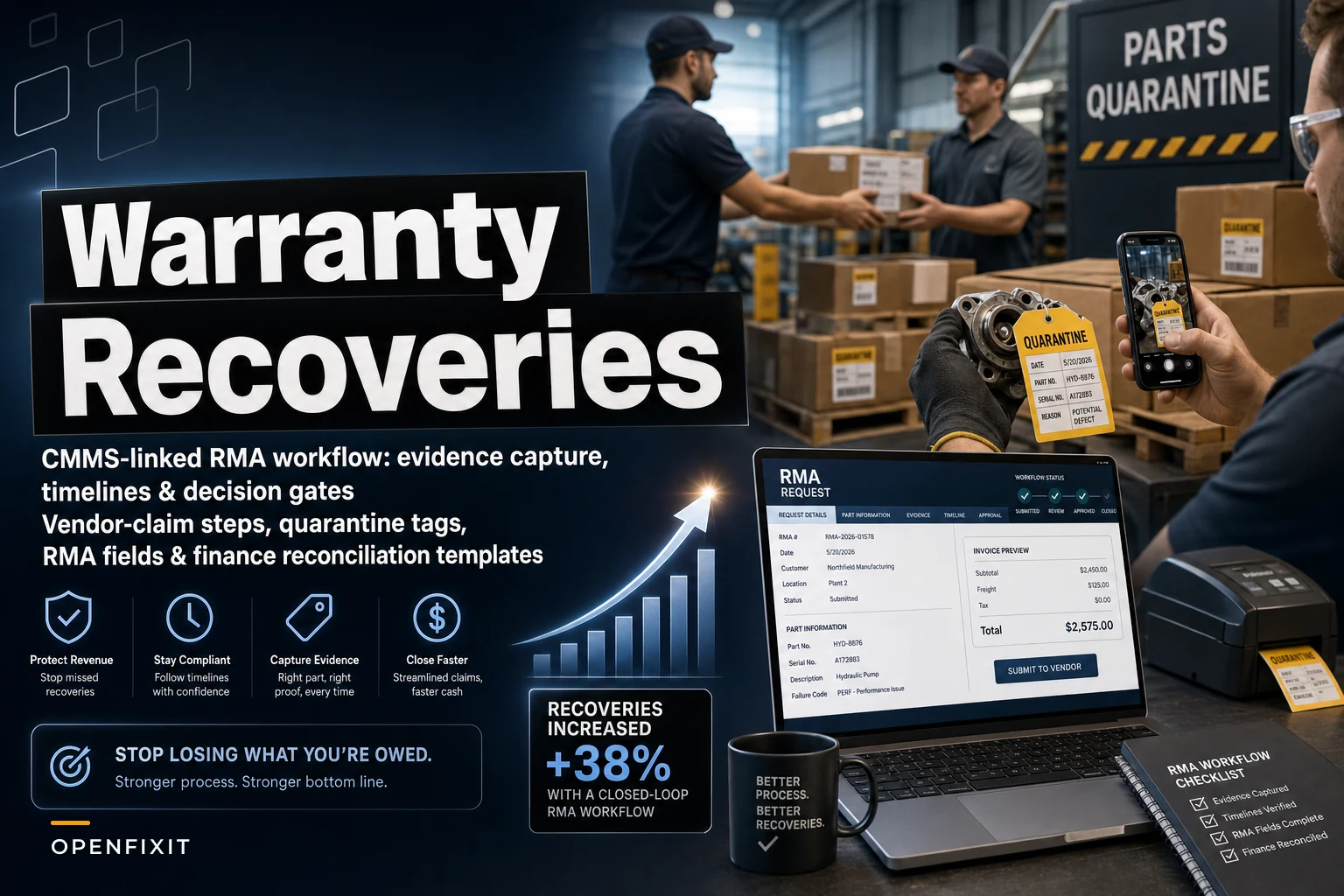

Here's a number that should bother any maintenance leader: in most facilities operations, somewhere between 15% and 30% of in-warranty repairs get paid out of the operating budget when the manufacturer should have covered them. Nobody steals that money. It just slips through the gap between the technician who fixed the thing, the warranty terms nobody read, and the finance team that booked the invoice.
The failure almost never looks dramatic. A compressor fails at month 14 on a 36-month warranty. A technician swaps it, closes the work order, moves on. The old unit goes in the scrap bin. Six weeks later the replacement cost hits the GL as a normal repair expense. The claim window closes. And the recovery — maybe $1,800, maybe $4,500 — is gone because the evidence needed to file the claim was thrown away the day the job finished.
This is a process problem, and that's actually good news, because process failures are fixable with clear decision gates and some discipline in the CMMS. Here's exactly where the money leaks and how to build a warranty claims CMMS process that captures it before the window shuts.
Where the leak actually starts: the first 30 minutes of the work order
The biggest reason warranty recoveries fail isn't bad paperwork at the end. It's the decision that never gets made at the beginning.
When a technician opens a corrective work order, the question "is this asset under warranty?" almost never comes up. The tech sees a broken fan motor, diagnoses it, and goes into fix-it mode. By the time anyone wonders whether the vendor should pay, the failed part has been removed, possibly tossed, and the serial numbers are gone.
This happens because warranty status tends to live in three different places that don't talk to each other:
-
Purchase records sit in accounting or a procurement folder somewhere
-
Install dates live in the asset record (if someone entered them correctly)
-
Warranty terms are buried in a PDF that hasn't been opened since commissioning
So the tech has no fast way to know. And even when the asset record says "warranty expires 2026-08-14," that field is often wrong — copied over during a migration and never validated. If you've been through a system switch, you already know how fragile these fields get. It's the same reason auditability during a CMMS cutover takes such deliberate attention. Warranty dates are exactly the kind of field that survives a migration looking fine while being completely unreliable.
The fix is a hard decision gate at work-order creation. Before a corrective WO moves to "in progress," the system or the planner has to answer one question: warranty, maintenance, or unknown? "Unknown" is a valid answer — it just triggers a 10-minute lookup instead of silently defaulting to "maintenance."
The decision gate: warranty vs maintenance
Not every failure on an in-warranty asset is a covered claim. Teams get burned in both directions — they miss legitimate claims, or they waste time filing claims that get denied, which eventually trains everyone to stop bothering.
Eliminate downtime with proactive maintenance.
Openfixit helps you plan, track, and complete maintenance efficiently—maximizing asset reliability.
- Centralized asset management
- Automated maintenance scheduling
- Inventory and parts tracking
No credit card required
A clean decision gate sorts failures quickly. Here's the logic that holds up across most equipment categories:
| Condition | Likely warranty | Likely maintenance | Notes |
|---|---|---|---|
| Component failure within term, normal use | ✅ | Core claim case — file it | |
| Failure caused by missed PM / no records | ✅ | Manufacturer will demand PM proof | |
| Wear item (filters, belts, seals) | ✅ | Almost always excluded | |
| Installation defect, recent commission | ✅ | Often covered by installer, not OEM | |
| Failure after unauthorized repair | ✅ | Voids most warranties | |
| Intermittent fault, no clear root cause | ⚠️ | ⚠️ | Capture evidence, decide after diagnosis |
The pattern worth internalizing: warranty claims live or die on whether you can prove the failure was the manufacturer's problem, not yours. Two things have to be true. The part failed inside the term, and you maintained it according to the manufacturer's schedule. If you can't produce PM records showing the required service was done, most OEMs will deny the claim — and they're within their rights to do it.
This is the quiet reason good PM compliance pays off in ways that never show up on a KPI dashboard. Every missed PM on a high-value asset isn't just a reliability risk. It's a warranty claim you've already disqualified.
Evidence requirements: what you must capture before the part leaves the building
Once the gate flags a possible warranty situation, the clock starts and the evidence rules kick in. The evidence has to be captured during the repair, because almost none of it can be reconstructed afterward.
Here's what actually survives a manufacturer's claims review:
-
Asset identity — serial number and model of the failed unit, photographed on the nameplate, not transcribed (transcription errors kill claims)
-
Failure documentation — photos or video of the actual failure mode before removal, plus any error codes or BAS alarms
-
Failed part retention — the defective component tagged with the WO number and quarantined, not scrapped (many OEMs require the part back for inspection)
-
Timestamps — failure date, diagnosis date, repair date, captured automatically rather than entered later
-
PM history snapshot — proof the required maintenance was performed, pulled from the asset's work-order history
-
Technician notes — plain-language description of what failed and the observed cause
-
Replacement part details — what went in, cost, and the invoice reference
The field that gets skipped most is part retention. A technician's instinct is to clear the scrap and move on. For anything that might become a claim, the rule has to be firm: failed part goes into a quarantine bin with the WO number on the tag until the claim is resolved or the retention window closes. One tagged shelf in the storeroom recovers more money than any amount of post-hoc paperwork.
Failed parts should be quarantined with the WO number on the tag until the claim is resolved or the retention window closes.
If your technicians are already capturing structured photos and measurements as part of their normal field routine, this is a small addition. If they aren't, that's the foundational problem to solve first — warranty evidence is just a stricter version of good field documentation.
Timelines: the windows that actually close on you
Warranty recovery is a game played against three different clocks, and they rarely line up.
-
Claim notification window — Some OEMs require you to notify them of a failure within a set period (often 30 days) separate from filing the full claim. Miss this and the claim is dead even if everything else is perfect.
-
Claim filing window — The full submission deadline, usually tied to the repair date, commonly 60–90 days out.
-
Part return window — If they want the failed component back, there's a shipping deadline triggered by the RMA issuance.
The common mistake is treating "warranty" as a single deadline. A team will capture solid evidence, feel like they're on top of it, and blow the 30-day notification requirement while still deciding whether to file. The claim never fails on evidence — it fails on the calendar.
Build the timeline into the work order as explicit sub-tasks with due dates:
-
Day 0
Failure logged, warranty gate triggered
-
Day 0–2
Notify manufacturer (opens the claim, gets a reference number)
-
Day 2–5
RMA requested and received
-
Day 5–10
Failed part shipped (if required)
-
Day 10–45
Claim package submitted
-
Ongoing
Track credit/reimbursement through to finance reconciliation
The notification step — the fast, early, almost trivial one — is what gets dropped most often. The repair is done, the equipment is running, the pressure is off. That's exactly when the money quietly starts walking away.
RMA capture: the step that connects maintenance to money
The RMA (Return Merchandise Authorization) is the bridge between "we think the vendor should pay" and "the vendor has agreed to look at it." It's also where a lot of claims quietly die in someone's email inbox.
A typical breakdown: the technician or planner calls the manufacturer, gets an RMA number verbally or by email, and it never makes it back into the work order. Three weeks later nobody can find it, the return shipment is late, and the claim lapses.
Treating the RMA number as a required field on the warranty claim record — linked to the originating work order — fixes this. The RMA should capture:
-
RMA / claim reference number
-
Date issued and return deadline
-
Shipping instructions and tracking once sent
-
Expected credit or replacement terms
-
Contact person at the manufacturer
The workflow matters more than the form. When a claim opens, it should carry the WO number so the full evidence package — serials, photos, PM history — travels with it. When the RMA comes in, it attaches to that same record. When finance sees a credit, they can trace it back to the exact repair. That end-to-end thread is what turns scattered activity into a recoverable claim.
Quick visual of the RMA-to-finance workflow.
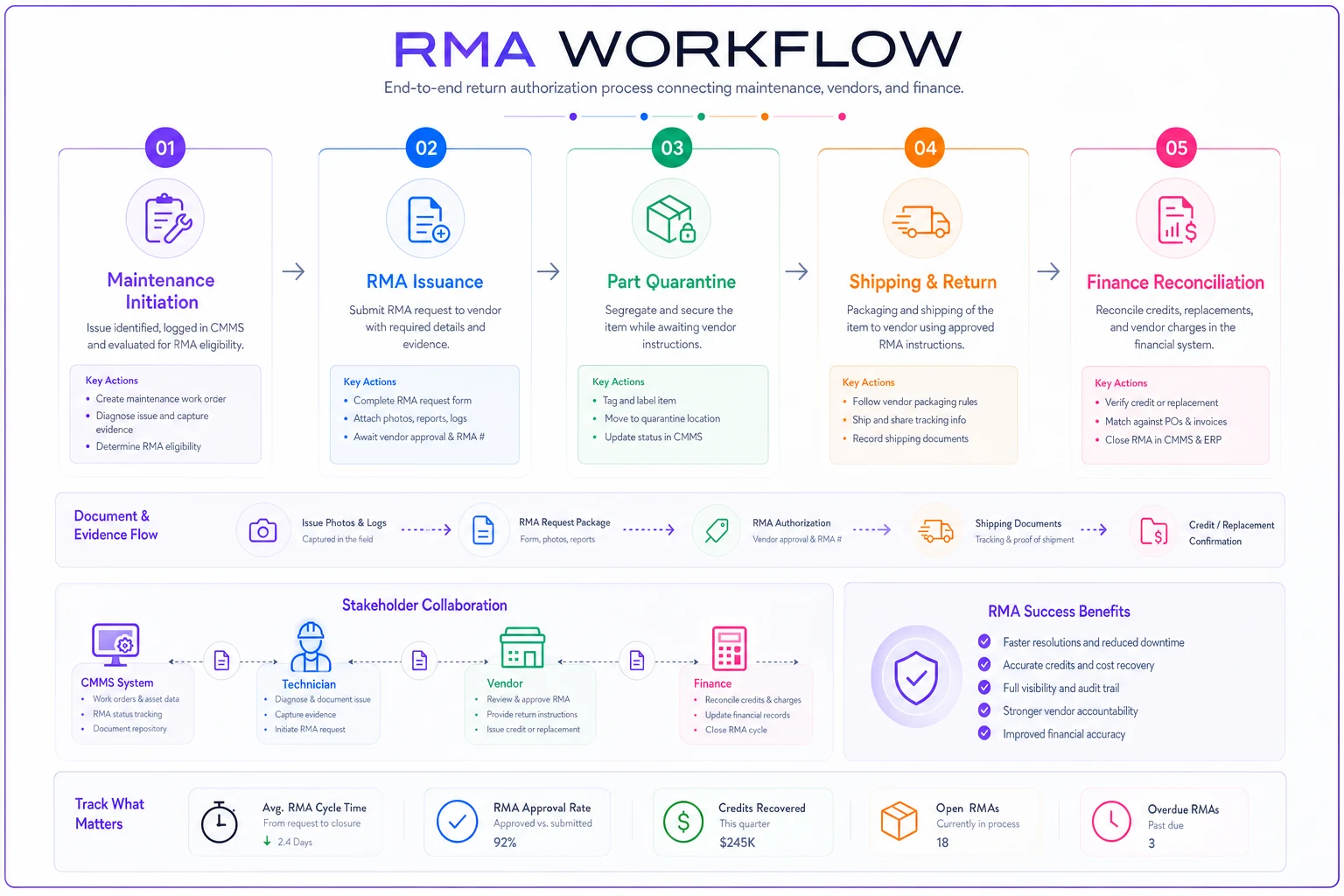
The RMA should carry the WO number so the full evidence package travels with it and finance can trace credits back to repairs.
Finance reconciliation: closing the loop so the money actually lands
This is the part almost everyone forgets, and it's where recoveries evaporate even after a successful claim. The manufacturer issues a credit. It shows up as a line on a vendor statement. Nobody connects it back to the original repair expense, so the recovery never gets credited against the right cost center and nobody knows whether the claim actually paid out.
Reconciliation is the step that proves the whole process worked. Without it, you're filing claims on faith.
| Field | Purpose |
|---|---|
| WO number | Links back to the repair |
| Original repair cost booked | What hit the budget |
| Claim amount filed | What you asked for |
| Expected recovery | Credit, replacement part, or labor reimbursement |
| Actual recovery received | What landed |
| Date reconciled | When finance confirmed the credit |
| Variance / notes | Why filed ≠ received |
The variance column is the one that earns its keep. When you consistently see the gap between what you filed and what you actually recovered, you learn which manufacturers pay cleanly and which ones contest every claim. That intelligence feeds directly into procurement decisions. This is the same discipline behind mapping maintenance costs through to accounting — a recovery you can't trace through the GL isn't really a recovery, it's a hope.
Lightweight AI automation genuinely helps here in a few specific ways: flagging vendor credit lines that likely correspond to open claims, nudging the planner when a notification deadline is approaching, and surfacing closed warranty-eligible work orders that never got a claim opened. None of that replaces judgment. It just stops the quiet, calendar-driven leaks that no busy team catches manually.
A real scenario: mid-size distribution facility
A regional distribution operation running dock levelers, HVAC rooftop units, and material-handling equipment pulled a year of corrective work orders and cross-checked them against warranty terms. They found roughly 40 repairs on in-warranty assets over the prior 12 months. About a dozen were legitimate, provable claims — the rest were wear items or failures where PM records were missing and would have been denied anyway.
They had filed exactly two.
Those twelve recoverable claims represented somewhere in the range of $22k–$28k in parts and some labor reimbursement, most of it now unrecoverable because evidence was gone and windows had closed. The painful part wasn't the one big compressor claim. It was the eight or nine mid-sized ones — $1,500 to $3,000 each — that individually felt too small to chase and collectively added up to real money.
After putting a warranty gate at WO creation, a quarantine-and-tag rule for failed parts, and a simple reconciliation tracker, the next two quarters looked different. They opened claims on the majority of eligible failures and recovered a bit over half of what they filed — the rest denied on technicalities or partial labor exclusions. Net, they recovered close to $9k in two quarters on a process that cost them maybe an extra 15 minutes per corrective work order and one labeled shelf in the storeroom.
When this is worth the effort — and when it isn't
This workflow earns its keep when you operate a meaningful number of warranted, higher-value assets — rooftop HVAC, refrigeration, large motors, material-handling gear, newer BAS components. The claims are big enough and frequent enough to justify the discipline.
It's less worth building out if your asset base is mostly older equipment well past warranty, or if your corrective volume is small. In that case, a quarterly manual review of any failures on recently installed assets catches the occasional claim without the overhead.
And it's a bad idea to build this if your PM compliance is weak, because you'll generate a pile of claims that all get denied for lack of maintenance records — which demoralizes the team and teaches everyone the process doesn't work. Fix PM discipline first. Warranty recoveries are downstream of maintenance records you can actually produce.
The bottom of it
Warranty recovery isn't a finance task bolted onto the end of a repair. It's a decision made in the first thirty minutes of a work order, an evidence trail captured while the technician's hands are still on the equipment, a set of deadlines that feel unurgent until they're not, and a reconciliation step that proves the money actually came back. Break any one of those links and the recovery disappears — quietly, every time, with no alarm and no one to blame.
The teams that consistently recover this money aren't smarter or luckier. They stopped leaving the decision to memory and built the gate, the evidence rule, the clock, and the reconciliation into the normal flow of work. The parts you throw away today are the claims you can't file tomorrow.
Ready to optimize your maintenance operations?
Join 2,000+ facilities using Openfixit to reduce unplanned outages, extend asset life, and improve operational efficiency.