


Most maintenance teams already have the evidence. The failure history is in the work orders. The warranty terms sit in a folder somewhere. The asset is throwing the same fault code for the third time this quarter, and the technician has written "same issue as last month" in the notes.
And yet — the RMA never gets filed. The capital replacement never makes it into next year's budget. Finance books the repair as an operating expense because that's how the invoice happened to land. The manufacturer's warranty quietly expires while the same pump keeps eating $1,200 service calls.
This is the gap almost nobody designs for. Not the maintenance work itself — teams are usually competent at fixing things. The breakdown happens in the handoff between maintenance knowing something and finance and procurement doing something about it. A maintenance finance operating model is the connective tissue that closes that gap deliberately, instead of hoping someone remembers to send an email.
Why the evidence rarely turns into money
CMMS data and financial systems live in different worlds, run by people who rarely talk in the same vocabulary.
A technician thinks in symptoms, assets, and downtime. A buyer thinks in POs, vendors, and payment terms. An accountant thinks in GL codes, capitalization thresholds, and audit trails. When a compressor fails under warranty, all three need to act — but each is waiting for a signal in a format they recognize, and no one owns the translation.
-
The repair gets done fast (good), but the warranty claim never happens because filing an RMA isn't anyone's job (expensive).
-
The asset failure clearly justifies replacement, but by the time it reaches finance, it's a one-line request with no evidence behind it, so it gets deferred.
-
Costs pile up as scattered work-order line items, none big enough to trigger a capital conversation, until the annual number is shocking and nobody can explain it.
What ties these together isn't laziness. It's the absence of a pipeline — a defined path where a piece of maintenance evidence automatically becomes a decision with an owner, a deadline, and a paper trail. Without that, follow-through depends on individual heroics, and heroics don't scale.
What actually breaks as you add sites and assets
At a single facility with one diligent maintenance lead, informal follow-through can work. That person remembers the warranty on the rooftop units. They personally chase the RMA. They know which repairs are creeping toward replacement territory.
Eliminate downtime with proactive maintenance.
Openfixit helps you plan, track, and complete maintenance efficiently—maximizing asset reliability.
- Centralized asset management
- Automated maintenance scheduling
- Inventory and parts tracking
No credit card required
Add a second and third site, rotate a few people, and the whole thing quietly falls apart.
-
Warranty leakage compounds. Each site independently pays for repairs that should've been covered. Individually it's noise. Across twelve buildings it's real money — often five figures a year that simply evaporates.
-
Capex-vs-opex classification drifts. Different sites code similar work differently, so finance can't compare buildings and the audit gets messy. (This is worth pairing with a defensible classification standard — the logic in mapping maintenance budgets to asset lifecycles and finance becomes the backbone of the whole operating model.)
-
Procurement loses leverage. When replacement decisions are made reactively and one-off, you never bundle purchases, never negotiate, never plan. You just buy whatever, whenever, at list price.
-
Capital decisions arrive too late. The evidence to justify a replacement existed for a year, but it never got assembled into a case before the budget cycle closed.
Scale doesn't create these problems. It reveals them. The informal handoffs that felt fine at one site were never actually a system — they were one person's memory, and memory doesn't distribute.
The operating model: evidence to decision, deliberately
The fix isn't more discipline from individuals. It's a defined set of pipelines that route specific kinds of evidence to specific decisions, each with a gate and an owner. Think of it as plumbing, not willpower.
A maintenance finance operating model has five moving parts working together:
-
Evidence triggers — the specific CMMS conditions that should force a financial or procurement decision.
-
Decision pipelines — the defined path each trigger follows, from work order to action.
-
Templates — standardized RMA forms, capital request formats, and GL coding rules so nothing gets stuck in translation.
-
SLAs — deadlines on each step so decisions don't rot in someone's inbox.
-
Governance gates — approval checkpoints that verify the evidence is real and the follow-through actually happened.
The connections matter more than any single component here.
Evidence triggers: teaching the system what deserves a decision
Not every work order needs a finance conversation. The art is defining the handful of conditions that genuinely should.
A workable set of triggers usually looks something like this:
-
Asset under warranty AND corrective work order opened → RMA pipeline.
-
Third failure on the same asset within a rolling 12 months → reliability/replacement review.
-
Repair cost exceeds X% of replacement value → capex-vs-opex decision gate.
-
Cumulative annual maintenance spend on an asset crosses a threshold → capital candidate review.
-
Asset past a defined percentage of useful life AND failing → lifecycle replacement pipeline.
The exact numbers depend on your portfolio. The point is that these are rules, written down and applied consistently. The moment a technician closes a work order that hits one of these conditions, a decision should be spawned automatically — not "should be remembered." Spawned.
This is where an AI-assisted CMMS earns its keep. Instead of relying on someone to notice that a work order is the third failure this year, the platform watches the pattern and raises the flag the instant it's true — attaching the failure history, warranty status, and cost trail so the decision-maker isn't starting from zero.
Decision pipelines: what happens after the flag
A trigger with no pipeline behind it is just another alert everyone ignores. Each trigger needs a defined route.
A typical RMA pipeline, step by step:
-
Work order closes on a warranty-covered asset.
-
System auto-generates an RMA task with the asset, serial number, failure description, and warranty reference pre-filled.
-
Task routes to whoever owns warranty claims (often procurement, sometimes facilities admin).
-
RMA gets filed with the manufacturer; claim number logged against the asset record.
-
Credit or replacement received; finance reconciles it against the original repair cost.
-
Gate
no work order on that asset is marked fully "closed-financial" until the warranty outcome is recorded.
Here's a simple workflow visualization:
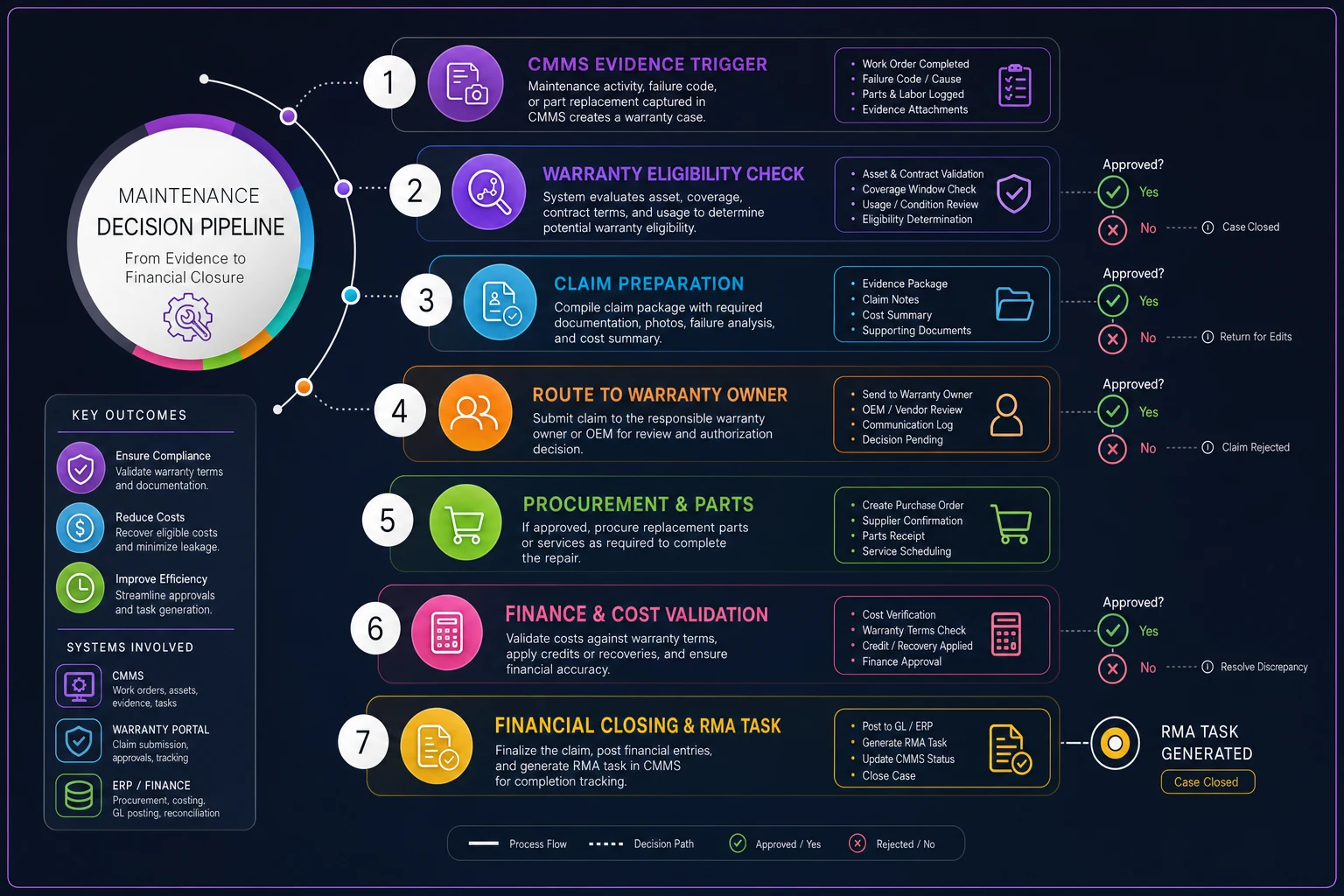
That last step is the one people skip — and the one that makes the whole thing real. Without a closing gate, RMAs get filed sometimes, which is effectively the same as rarely.
GL reconciliation rules: keeping finance honest without a fight
The friction between maintenance and finance usually comes from ambiguity. Is a $9,000 motor rebuild a repair or a capital improvement? Reasonable people disagree, and without a rule, they disagree repeatedly and slowly.
A simple version:
| Condition | Classification | GL treatment |
|---|---|---|
| Repair restores asset to original condition, cost under threshold | Opex | Maintenance expense |
| Repair extends useful life beyond original spec | Capex | Capitalize, depreciate |
| Component replacement > defined % of asset value | Capex review | Route to gate |
| Warranty-covered repair | Opex (pending credit) | Flag for reconciliation |
| Emergency repair on end-of-life asset | Opex + replacement flag | Trigger capital review |
Once these rules exist and the CMMS tags work orders against them at the moment of closing, finance stops reclassifying things three weeks later and maintenance stops getting surprised by how their costs were booked. The classification travels with the evidence.
Roles, SLAs, and the gates that force follow-through
Pipelines don't run themselves. Every step needs an owner and a clock.
A minimal but complete role map:
-
Technician / maintenance lead — generates the evidence, confirms failure details, flags warranty status at closing.
-
Warranty/RMA owner — files claims, tracks credits, closes the loop.
-
Procurement — handles replacement sourcing, bundling, vendor negotiation.
-
Finance controller — owns GL classification and reconciliation.
-
Reliability or facilities manager — owns the capital review gate and prioritization.
SLAs that keep it moving:
-
RMA filed within 5 business days of a qualifying work-order closure.
-
Capex-vs-opex classification confirmed within the current accounting period.
-
Capital candidate reviews compiled quarterly, ahead of the budget cycle — not during it.
-
Warranty reconciliation closed within 30 days of credit receipt.
Name a single warranty/RMA owner across sites to centralize filing and avoid duplicate chasing.
The governance gates are what separate a real operating model from a nice diagram:
-
Evidence gate — a decision can't proceed without the failure history, cost trail, and asset data attached. No anecdotes.
-
Financial gate — no work order reaches full closure until its GL treatment and any warranty outcome are recorded.
-
Capital gate — replacement requests must carry the reliability evidence and lifecycle position, not just a price quote.
That capital gate connects directly to how you prioritize competing spend. When several assets hit replacement territory at once, you need a defensible way to sequence them — the logic behind a project-scoring and bundling matrix for deferred maintenance plugs straight into this gate, so capital decisions come out ranked instead of first-come-first-served.
A real scenario: the warranty leak nobody was watching
A regional operator running eight light-industrial sites had a maintenance program that looked fine on paper. PMs were getting done. Work orders were closing. Uptime was acceptable.
What nobody was tracking was warranty. Across those eight sites, they were paying for repairs on relatively new HVAC and process equipment that was still under manufacturer coverage — because filing RMAs depended on individual site leads noticing, and most didn't. When they finally ran the numbers, somewhere in the range of $40k–$50k a year in covered repairs had been paid out of pocket over the prior two years. Nobody had stolen anything. The money just leaked through a gap in the handoff.
They built a straightforward operating model around it: a warranty flag on every asset record, an auto-generated RMA task on any qualifying work-order closure, one named warranty owner across all sites, and a financial closing gate so no repair fully closed until warranty status was resolved.
Within about two quarters, filed RMAs went from a handful to consistent, and recovered credits ran in the low tens of thousands annualized. The capital side improved too — the same evidence pipeline surfaced repeat-failure assets early, and three replacements made it into the budget cycle with documentation, instead of being deferred another year and racking up repair costs. The work didn't change. The routing did.
When this operating model is worth building — and when it isn't
This isn't a universal prescription. A few honest boundaries.
It makes sense when:
-
You run multiple sites or a large asset base where informal memory has stopped working.
-
You have meaningful warranty coverage that's being under-utilized.
-
Repair-vs-replace and capex-vs-opex decisions are frequent and financially significant.
-
Finance and maintenance already argue about classification — a rule set will end the fight.
It's a bad idea when:
-
You have a handful of assets and one person who genuinely tracks everything. Formalizing that adds overhead with no payoff.
-
Your CMMS data is so poor that triggers would fire on garbage. Fix data quality first — pipelines built on bad evidence produce confident bad decisions.
-
Leadership won't enforce the gates. An operating model without governance is just documentation, and documentation nobody enforces is worse than nothing, because it creates the illusion of control.
Teams still fighting basic work-order completion or asset naming chaos probably shouldn't start here either. Get the foundational data trustworthy first, then build the financial pipelines on top. The evidence has to be real before it can drive decisions.
The coordination problem underneath all of this
Step back and the pattern is clear: this was never purely a maintenance problem, a finance problem, or a procurement problem. It's a coordination problem living in the seams between them.
Each department is competent inside its own boundary. The failures happen at the handoffs — where evidence needs to become a decision, where a decision needs an owner, where an owner needs a deadline, and where the whole thing needs a gate to confirm it actually finished. The same dynamic shows up in vendor management, which is why a work-order-centric approach like taming contractor variability with SLA scorecards rhymes so closely with this: in both cases, the fix is routing accountability through the work order rather than through goodwill.
The operating model doesn't make anyone work harder. It makes the connections explicit — so that the truth your CMMS already knows reliably turns into the financial and procurement actions it implies.
Build the pipelines once, enforce the gates, and follow-through stops being a matter of who remembered. It becomes the default.
Ready to optimize your maintenance operations?
Join 2,000+ facilities using Openfixit to reduce unplanned outages, extend asset life, and improve operational efficiency.