



The technology is almost never the reason a multi-site CMMS rollout fails. You can buy the best platform on the market, configure it cleanly, migrate history perfectly, and still end up eighteen months later with Site 4 running everything on a whiteboard, Site 9 logging phantom PMs to hit compliance targets, and three regional managers quietly maintaining their own spreadsheets because "the system doesn't work for how we do things."
That's not a software problem. That's a change-management problem — and it's the part almost nobody plans for with the same rigor they apply to configuration.
Standardizing processes across sites is a political and operational exercise before it's a technical one. Each location has its own history, its own informal workarounds, its own idea of what "good enough" looks like. A rollout plan that ignores that reality — one that just pushes a global config and a training deck — produces compliance theater, not adoption.
This piece is about building the governance scaffolding that makes standardization stick: who owns what, how you make people want to comply, what you measure, and what happens when a site drifts.
Why standardization breaks between sites (and it's rarely the config)
Look at any multi-site maintenance org that's struggling to standardize and you'll find the same fault lines.
The first is autonomy that predates the rollout. Sites that ran independently for years develop their own conventions — asset naming, priority definitions, what counts as a "completed" work order. When corporate drops a standard schema on top, the site doesn't see an improvement. It sees a demotion. They lose shortcuts they built and gain paperwork they don't understand yet. So they comply on paper and route around it in practice.
The second is inconsistent data maturity. Site 1 has been running a clean CMMS for four years. Site 6 has never used one. Roll out the same expectations, same KPIs, same deadlines to both, and you punish the mature site with lowered standards while overwhelming the immature site into gaming the numbers. Uniform targets across non-uniform starting points is one of the most common — and most avoidable — mistakes in these programs.
The third is the incentive vacuum. Technicians are usually measured on wrench time and closed work orders. Nobody's measured on data quality, correct classification, or following the standard workflow. So the moment following the process slows down a job, the process loses. Every time. You cannot standardize behavior you don't reward or inspect.
And the fourth, quieter one: no enforcement teeth. Governance documents get written, everyone nods in the kickoff, and then the first time a site blows past a gate, nothing happens. Once teams figure out there are no consequences, the standard becomes optional — and optional standards don't scale.
What breaks at scale isn't any single one of these. It's the interaction. Autonomy plus uneven maturity plus no incentives plus no enforcement compounds into a program where every site is technically "live" and no two sites produce comparable data.
Start with a stakeholder map, not a training schedule
Most rollout plans jump straight to the timeline — who gets trained when, what goes live in which wave. That's premature. Before any of that, you need a clear picture of who actually influences adoption at each site, because those people determine whether the standard survives contact with the floor.
Eliminate downtime with proactive maintenance.
Openfixit helps you plan, track, and complete maintenance efficiently—maximizing asset reliability.
- Centralized asset management
- Automated maintenance scheduling
- Inventory and parts tracking
No credit card required
-
Sponsors — the executive or director who owns the budget and can override a resistant site manager. If this person goes quiet after kickoff, the program dies slowly. Their name needs to be attached to enforcement gates, not just the launch email.
-
Site champions — one credible person per location who's respected by technicians and willing to defend the new process. This is the single highest-leverage role in the whole program. A strong champion at a resistant site beats a perfect config every time.
-
Process owners — the people who own each standard
the asset hierarchy, the PM library, the work-order lifecycle, the reporting definitions. When a site wants an exception, these are the people who say yes or no.
-
Resisters and skeptics — name them explicitly. The veteran tech who thinks the old way is fine, the regional manager protecting their spreadsheet. You don't defeat them, you convert or contain them, and you can't do either if you pretend they don't exist.
The mistake here is treating stakeholders as an org chart exercise. They're not. Influence rarely follows title. The tech everyone goes to when something breaks is often more important to your rollout than the site manager. Map real influence, then assign your champions and your energy accordingly.
This is also where a solid governance structure pays off. If you already have defined roles and an enforcement cadence — the kind laid out in a pragmatic maintenance governance framework for multi-site facilities — your stakeholder map slots into an existing decision structure instead of inventing authority from scratch mid-rollout.
Here's a simple visual of the stakeholder mapping and enforcement workflow.
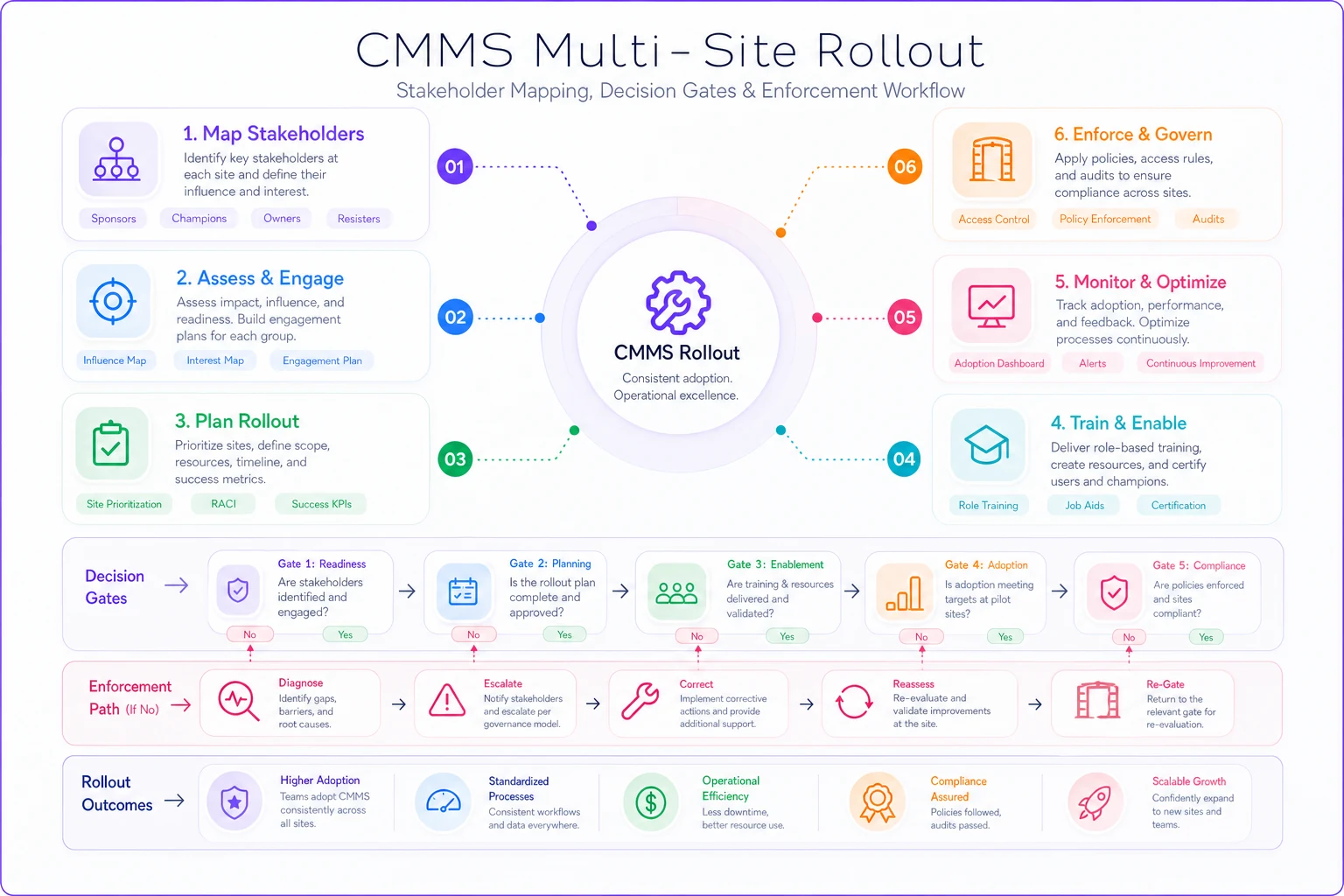
The visual ties influence to enforcement: who approves exceptions, who escalates, and where the champion sits between technicians and sponsors.
Design incentives that make the standard the path of least resistance
If following the standard is slower or harder than the workaround, people will use the workaround, and no amount of policy will stop them long-term. The design goal isn't to enforce compliance — it's to make compliance the easiest way to get through the day.
Some of that is workflow design. If logging a work order the "right" way takes eleven taps on a phone and the old way took three, you've built something people will fight. Getting mobile workflows tight and role-specific is foundational — the mobile technician adoption plan with role-based workflows and short training modules goes deep on why friction on the device kills data quality faster than anything else.
But workflow alone isn't incentive. You need to reward the behavior you want, at every level:
-
Technicians respond to time and recognition. If clean data means fewer callbacks, less duplicate work, and pre-populated job info, they feel the benefit. Tie a small piece of recognition — not just money — to data quality, not just work order volume.
-
Site champions need visible credit. When their site hits an adoption milestone, the sponsor should see it and say so publicly. Champions who get no recognition burn out and go quiet.
-
Site managers respond to peer comparison. A monthly scorecard that ranks sites does more than any memo. Nobody wants to be at the bottom two months running.
Tie small, immediate recognition (like a public shoutout) to early data-quality wins to keep champions motivated.
One pattern worth borrowing: make mature sites the reference standard rather than corporate. When Site 1 is the benchmark, other sites are chasing a peer instead of resenting headquarters. It reframes the whole thing from "corporate is imposing rules" to "we're all catching up to the best of us."
The failure mode to watch for is incentivizing the metric instead of the outcome. Reward "number of PMs closed" and you'll get PMs closed without the work done. Reward "data completeness score" naively and you'll get every field filled with garbage. Incentives shape behavior with brutal literalness — design them assuming people will do exactly, and only, what you pay them to do.
The adoption scorecard: what to actually measure
You need a small number of metrics that reveal whether the standard is genuinely being used, not just whether the system is technically live. Vanity metrics — logins, work orders created — tell you almost nothing about standardization.
Here's a scorecard structure that works across sites at different maturity levels:
| Metric | What it reveals | Healthy target | Common gaming risk |
|---|---|---|---|
| PM completion on-time % | Whether scheduled work actually happens | 90%+ | Closing PMs without doing them |
| Work order classification accuracy | Whether the taxonomy is followed | 85%+ correct on audit | Everything dumped in "general/other" |
| Data completeness on close | Whether required fields are captured | 95%+ | Fields filled with junk to pass validation |
| Reactive-to-planned ratio | Whether planning is real | Trending toward planned | Recategorizing reactive as planned |
| Mobile capture rate | Whether work is logged in the field, not backfilled | 80%+ same-day | Batch entry at end of week |
| Champion-flagged exceptions | Whether the site is surfacing real problems | Low but non-zero | Zero means they're hiding issues |
That last row matters more than people expect. A site reporting zero exceptions isn't a perfect site — it's a site that's either not really using the system or not being honest about problems. Some honest friction is a health signal.
Weight the scorecard by site maturity for at least the first two quarters. Grading a first-time CMMS site against a four-year veteran on absolute numbers guarantees demoralization. Grade the mature site on holding standards and the new site on rate of improvement. Same scorecard, different bar, until they converge.
Don't over-instrument either. A scorecard with twenty metrics gets ignored. Six to eight that people actually look at beats a dashboard nobody opens.
Audit gates and measurable milestones
This is where most programs go soft. They set a go-live date and treat it as the finish line. Go-live is the start of adoption, not the end. You need staged gates that a site has to pass to advance — and real consequences for failing them.
-
Readiness gate (pre-go-live). Asset hierarchy loaded and validated, PM library mapped, champion trained, technicians completed role-based training. Fail this and the site doesn't go live — full stop. Launching an unready site to hit a calendar date is how you generate months of bad data.
-
Stabilization gate (30 days post-live). Mobile capture rate above threshold, no critical config gaps, first audit sample passes classification review. Fail this and the site stays in "supported" status with extra champion time, not left to drift.
-
Standardization gate (90 days). Scorecard metrics within range of maturity-adjusted targets, exception rate healthy, no evidence of gaming. Passing this means the site graduates to steady-state governance.
-
Sustained-compliance gate (180 days and ongoing). The site holds standards through staff turnover and busy season. This is the real test — anyone can look compliant during the honeymoon period, far fewer hold it through a crisis.
The audit at each gate should be evidence-based, not self-reported. Pull a random sample of 20–30 work orders and check them against the standard: correct classification, complete fields, mobile-captured, evidence attached where required. A site that self-reports 95% completeness but shows 60% on a random audit has a gaming problem you need to catch early, before the whole program's data loses credibility.
Consistent taxonomy and documentation make these audits considerably cleaner. When your naming conventions, categories, and reference material live in a governed structure — the kind of setup covered in designing a multi-site maintenance knowledge-management system — auditors are checking against one shared truth instead of arguing about what a field was supposed to mean at each location.
The enforcement playbook: what happens when a site drifts
Governance without enforcement is just a suggestion. But enforcement done clumsily — public humiliation, threats, yanking autonomy overnight — breeds resentment and quiet sabotage. The goal is a graduated response that escalates predictably, so sites know exactly what's coming and can self-correct before it gets serious.
-
Tier 1 — coaching. First drift below target triggers a conversation between the champion and the site, plus a review of why. Often the standard genuinely doesn't fit an edge case and the process owner needs to adjust. Assume good faith first.
-
Tier 2 — supported remediation. Persistent drift triggers a time-boxed improvement plan with extra support and a defined re-audit date. This is help, not punishment — but with a deadline.
-
Tier 3 — sponsor escalation. Continued failure goes to the sponsor, who owns the consequence. This is where title matters: the sponsor can remove the site manager's discretion, tie the gap to a performance review, or reallocate resources.
-
Tier 4 — hard consequence. Reserved for willful non-compliance or gaming. Loss of local configuration privileges, mandatory oversight, formal accountability. Rare, but it has to exist — and everyone has to know it exists.
The insight most programs miss: enforcement credibility is set by the first failure, not the policy document. The first time a site blows a gate and nothing happens, every other site recalibrates and the standard becomes optional. You don't need to be harsh. You need to be consistent. One visibly enforced gate does more for adoption than a hundred pages of policy.
A real scenario: five sites, uneven starting lines
A regional facilities group running five sites — two mature CMMS users, three coming off spreadsheets and paper — kicked off a standardization program after a botched first attempt where everyone went live at once and the data came back unusable.
The second attempt started with a stakeholder map instead of a training calendar. They named a champion per site — deliberately picking the most-trusted tech at two locations rather than the manager — and set maturity-adjusted scorecards. The two veteran sites were held to absolute targets; the three new sites were graded on improvement rate for the first two quarters.
The readiness gate earned its keep early. One of the paper-based sites failed it — the asset hierarchy wasn't clean and the champion hadn't finished training — so it slipped a wave instead of launching broken. That single decision probably saved months of cleanup.
By around the 90-day mark, classification accuracy across the group had gone from wildly inconsistent — some sites effectively dumping everything into "other" — to roughly 85% on random audits. Mobile capture, near zero at the new sites at kickoff, was running in the 75–80% range. The reactive-to-planned ratio hadn't fully turned yet, but it was moving. Not a straight line either — one site regressed during a staffing gap and needed a Tier 2 remediation plan. But for the first time, the regional manager could look at all five sites on one scorecard and actually trust the numbers. That was the entire point.
When a full program-level rollout makes sense — and when it doesn't
This much structure is overhead. It's worth it when you have genuine multi-site scale, meaningful variation between locations, and a real need for comparable data across sites — for compliance, capital planning, or benchmarking. If corporate can't currently trust that a "completed PM" means the same thing at every location, you need this.
It's overkill for a two-site operation where the same people touch both locations and informal coordination actually works. Building a four-tier enforcement playbook for a team that eats lunch together is bureaucracy for its own sake.
And it's actively a bad idea to run this as a pure top-down mandate with no site input. Standardization imposed without listening to why sites do things differently produces malicious compliance — technically following rules while ensuring the outcome is useless. If you're not willing to let process owners adjust the standard when a site raises a legitimate edge case, you'll get compliance theater, not standardization. The best programs treat the standard as version-controlled and improvable, not carved in stone.
Bringing it together
Standardizing a CMMS across sites is a coordination problem wearing a technology costume. The config is the easy part. What actually determines whether sites converge on one way of working is the human scaffolding around it: knowing who influences adoption at each location, making the standard the easiest path rather than the hardest, measuring the handful of things that reveal real usage, gating advancement on evidence instead of dates, and enforcing consistently the first time it matters.
Get those right and the platform becomes a shared source of truth the whole organization can plan against. Get them wrong and you've bought expensive software that every site uses differently — which is exactly the fragmentation you were trying to fix. The difference between those two outcomes isn't in the tool. It's in the change management around it.
Ready to optimize your maintenance operations?
Join 2,000+ facilities using Openfixit to reduce unplanned outages, extend asset life, and improve operational efficiency.