


Most maintenance transformation budgets don't die in the boardroom because the ideas are bad. They die because they show up as four separate asks.
The facilities director wants a CMMS replacement. Someone in engineering who just got back from a trade show wants a sensor pilot. IT or finance adds an analytics or "dashboard" line. Procurement wants to lock in a vendor because the quote expires at quarter end. Each one looks reasonable alone. Put together, they look like a department that doesn't know what it wants.
So the CFO does the rational thing and funds two of the four, usually the CMMS and the sensors, because those feel tangible. Eighteen months later the sensors are sending alerts to an inbox nobody owns, because the CMMS cutover slipped and the integration never got built. The analytics work that would have proven the sensors' value never got funded. And the vendor contract signed early runs three years, with pricing tied to a device count you'll never hit.
This article is about fixing that at the source. A maintenance digital transformation roadmap isn't really a list of projects. It's a dependency map with money attached, and the hard part is getting that map from the board down to the technician's phone without losing the logic on the way. We'll go through the 36 months in phases, show where the gates sit, explain how one budget request can carry all four workstreams, and finish with a one-page executive brief template you can use as is.
The four workstreams are one system wearing four costumes
Before the timeline, it helps to be blunt about how the pieces depend on each other, because this is where most roadmaps quietly fall apart.
A sensor is useless without an asset to attach it to. And "asset" doesn't mean the physical rooftop unit. It means a clean record in your CMMS with a stable ID, a location, a criticality rating and a PM history. If your asset register is still half spreadsheet and half legacy system when the sensors arrive, the sensor vendor will happily build its own asset list inside its own portal. Now you have two registers. The second one turns into a shadow CMMS within about six months, and untangling it later costs more than the sensors did.
Analytics depend on closed work orders with usable data: failure codes, actual labor hours, parts consumed, cause notes that say something other than "fixed." If the cutover is still in progress, or technicians haven't picked up the new mobile workflow, whatever you build in that window is built on sand. One team showed leadership a really nice MTBF chart, calculated from three months of post-cutover data stitched onto eight years of migrated records that used a totally different failure-code scheme. Nobody caught it until a regional VP asked why one site's chillers apparently never failed before last spring.
Procurement is the dependency people forget. Vendor contracts set the pace. A sensor platform contract signed at month two with a 24-month minimum commits you to a scale decision before you've run the pilot. A CMMS contract that bills per site from day one means paying for sites you haven't migrated. Procurement gates exist so the contract doesn't make the decision the pilot was supposed to make.
So the real sequence looks like this:
-
The CMMS data foundation has to be stable before sensors can create work orders
-
Sensors have to run long enough to produce failure-relevant signals before analytics can judge them
-
Analytics have to produce a defensible result before procurement commits to scale
-
Procurement terms have to be structured so they don't force any of the above to happen early
Every phase below is that chain, staggered so the workstreams overlap without stepping on each other.
Board-to-ground: where the intent gets lost
There's a translation problem sitting on top of the dependency problem.
Eliminate downtime with proactive maintenance.
Openfixit helps you plan, track, and complete maintenance efficiently—maximizing asset reliability.
- Centralized asset management
- Automated maintenance scheduling
- Inventory and parts tracking
No credit card required
The board approves something like "modernize maintenance operations to reduce unplanned downtime and control lifecycle costs." The CFO turns that into a capital envelope and maybe an opex line. The VP of operations turns it into "get the new CMMS live and run a predictive pilot." The facilities director makes a project plan. The site maintenance lead hears "there's a new app and some boxes are getting stuck on the air handlers." The technician experiences it as an extra 10 minutes per work order and a login they keep forgetting.
At each step the why gets thinner. By the time it reaches the ground only the what is left, and the what feels like overhead.
What works is carrying a small number of measurable outcomes all the way down, unchanged. Not 15 KPIs. Two or three. For example: unplanned work as a percentage of total labor hours, work order close-out completeness, and response time on critical assets. The board sees those three numbers at every gate. The site lead sees the same three for their site. The technician learns why the failure code field is mandatory now: it feeds the first one.
Hardly anyone does this. Usually the board gets an ROI slide, the site gets a training schedule, and the two never reference each other.
The change management mechanics for the ground-level piece, like standardizing workflows across sites without a revolt, are covered in our CMMS change-management playbook to standardize processes across sites. This roadmap assumes you'll lean on something like that during the cutover phases instead of inventing it on the fly.
The 36-month timeline, phase by phase
Here's the full sequence in one table. It's the part most executives will actually read, so get it right before you write anything else.
| Phase | Months | CMMS | Sensors | Analytics | Procurement | Gate to exit |
|---|---|---|---|---|---|---|
| 0. Foundation | 0–6 | Asset register cleanup, data standards, pilot-site cutover prep | Asset scoring for pilot candidates, no hardware purchased yet | Baseline the 2–3 outcome metrics from legacy data, even if messy | CMMS contract signed with phased site billing; sensor RFI only, no RFP | Gate A: asset data quality threshold met at pilot sites |
| 1. Cutover + small pilot | 6–12 | Pilot sites live, then wave 1 cutover | Pilot hardware on a limited asset set at 2–3 sites, integrated to CMMS | Data completeness tracking only; no predictive claims | Sensor pilot under short-term or pilot-specific terms | Gate B: cutover stable, sensor alerts generating real WOs |
| 2. Evidence | 12–18 | Wave 2 cutover, mobile adoption push | Pilot continues; tuning and false-alarm reduction | First real analytics gate: does the pilot change outcomes? | Scale RFP drafted but not released | Gate C: analytics show measurable signal (or a clean kill decision) |
| 3. Scale decision | 18–24 | All sites live, legacy system decommissioned | Expand to second asset class or more sites, if Gate C passed | Cross-site comparisons become valid | Scale contract negotiated with performance terms | Gate D: scale business case approved with real data |
| 4. Portfolio | 24–36 | Optimization, automation rules, integrations to finance/procurement | Fleet-level deployment on proven asset classes | Analytics feed capital planning and reliability investments | Renewals and consolidation based on 18+ months of performance | Gate E: program moves to steady-state budget |
A few things in that table aren't obvious at first glance.
No sensor hardware gets bought in the first six months. That feels slow to people who want a visible win, but the asset scoring in phase 0 is what makes the pilot meaningful. Picking pilot assets because they're easy to reach, instead of because they're critical and have a failure history worth detecting, is probably the most common reason pilots produce nothing useful.
Analytics in phases 0 and 1 is deliberately boring. You're measuring data completeness and setting baselines, not building predictive models. Teams that skip this end up with no "before" to compare against.
Procurement shows up in every phase, but the commitment level ramps slowly. RFI, then pilot terms, then a drafted RFP that sits in a drawer, then a scale contract. That drafted-but-unreleased RFP in phase 2 matters more than it looks. It means you can move the moment Gate C passes instead of losing another four months to procurement cycles.
Months 0–6: the part nobody wants to fund
Phase 0 is the hardest to sell because nothing visible happens. No new app, no sensors, no dashboards. Just cleanup.
You're standardizing asset naming and hierarchy at the pilot sites, defining what a "complete" work order looks like, picking a failure code scheme, and pulling whatever baseline you can out of the legacy system. You're also scoring assets for the eventual sensor pilot on criticality, failure frequency, and whether the failures are even detectable. (A surprising number of expensive failures aren't. Belt failures on some equipment, control board faults, refrigerant leaks in certain configurations. If the failure mode doesn't produce a measurable precursor, a sensor won't help no matter how good the vendor's demo was.)
Treat Gate A as a minimum viable threshold, not perfection, so data cleanup doesn't balloon into an endless task.
Phase 0 will drag if you let it. Data cleanup is never "done," so it expands to fill whatever time you give it. Gate A should be a threshold, not perfection. Something like: pilot sites have a clean asset register for critical equipment, PM schedules are attached, and you can pull a baseline for the outcome metrics. Pilot sites only, not the whole portfolio.
On procurement, sign the CMMS contract here but push hard for phased site billing. Paying full enterprise pricing for 14 sites when only 3 are live in year one is real money, and most CMMS vendors will negotiate on this if you ask before signing, not after.
Months 6–12: cutover and a deliberately small pilot
This is where the workstreams start colliding, and where coordination either holds or doesn't.
Pilot sites go live on the new CMMS first, then wave 1. Somewhere in the middle, sensor hardware goes onto a limited set of assets at two or three of the already-live sites. Not sites mid-cutover. Write that into the plan as a hard rule, because the temptation is to put sensors wherever the most enthusiastic site lead is, and that person's cutover is often the messiest.
The sensor pilot gets integrated to the CMMS from day one. Alerts create work orders, or at least draft work orders a planner reviews. If the pilot runs entirely inside the vendor's portal, you'll get a great vendor-produced case study and no evidence your own organization can act on it.
The pilot will probably flood the team with alerts in the first few weeks, mostly nuisance, and the site team starts ignoring them. By the time thresholds are tuned, trust is gone. Budget a few weeks of tuning explicitly, before alerts route to technicians.
Gate B is mostly operational. Is the cutover stable? Are technicians closing work orders on mobile with reasonable completeness? Are sensor alerts landing as real work orders and getting closed with notes? If not, you don't move to the evidence phase, because the evidence won't be trustworthy.
Months 12–18: the first honest analytics gate
The program either earns its next tranche here or it doesn't.
By month 12 you should have roughly six months of post-cutover data at the pilot sites and four to six months of sensor data. That's enough for a narrow question: on the assets we instrumented, did anything change? Fewer emergency calls? Earlier detection on degrading equipment? Shorter repairs because the tech showed up knowing what was wrong?
It's not enough to build a predictive model you'd stake capital decisions on, and you shouldn't pretend it is. If you want a sense of where your team sits, the maintenance analytics maturity model is a useful way to frame which claims your data can and can't support at this stage. Most teams at month 12–18 are somewhere around reliable descriptive reporting with early diagnostic capability. That's fine. It's honest, and honesty at Gate C is what earns credibility at Gate D.
Gate C has two valid outcomes. The pilot shows measurable signal and you move to scale planning, or it doesn't and you make a clean kill or pivot call on that asset class. Both count as success from a governance standpoint. What you want to avoid is the vague "promising early results, recommend continuing pilot" that drags on and burns budget.
Meanwhile wave 2 of the CMMS cutover is happening, and procurement is drafting the scale RFP using actual pilot data to write requirements. That RFP will be far better than one written at month 2, because now you know what integration took, what alert volumes look like, and which vendor claims held up.
Months 18–24: scale, but only what earned it
All sites should be live on the CMMS now, with the legacy system decommissioned. If it isn't, escalate. Legacy systems kept "read-only for reference" tend to stay alive for years, and people keep entering data into them.
If Gate C passed, sensors expand: more sites on the same asset class, or a second asset class at existing sites. Rarely both at once. Doing both doubles the variables and makes the next analytics gate much harder to read.
Cross-site comparisons become valid for the first time, because everyone is on the same system with the same data standards. Leadership often gets properly interested at this point, since they can see which sites run well and which don't, using consistent definitions. Some site leads get defensive. Expect that.
The scale contract gets negotiated in this phase. With 9–12 months of pilot data you have real leverage: you know your device count, alert volumes and integration needs. Push for performance terms on platform uptime, data delivery latency and support response, and avoid volume commitments beyond what Gate D approved.
Months 24–36: from project to operating model
The last year is less about new technology and more about wiring the program into how the business makes decisions.
Analytics start feeding capital planning. Which assets are degrading faster than their PM schedules assume? Which asset classes are replacement candidates versus continued repair? This is where reliability data plugs into something like a reliability investment portfolio framework, so maintenance projects compete for capital on comparable terms instead of whoever shouts loudest in budget season.
Automation rules mature here too: auto-assignment, PM suppression when condition data says the asset is fine, parts reservation when a sensor alert generates a work order. Much safer to turn on now than in month 8, because the data underneath is stable.
Gate E is the shift from "transformation program" to "steady-state operating budget." For the board, that means they stop seeing a special project and start seeing a line item with known performance. If you never reach Gate E, the program stays in permanent pilot mode and becomes an easy target in the next tight budget year.
The following image shows the overall workflow from board approval through phased implementation and steady-state operations.
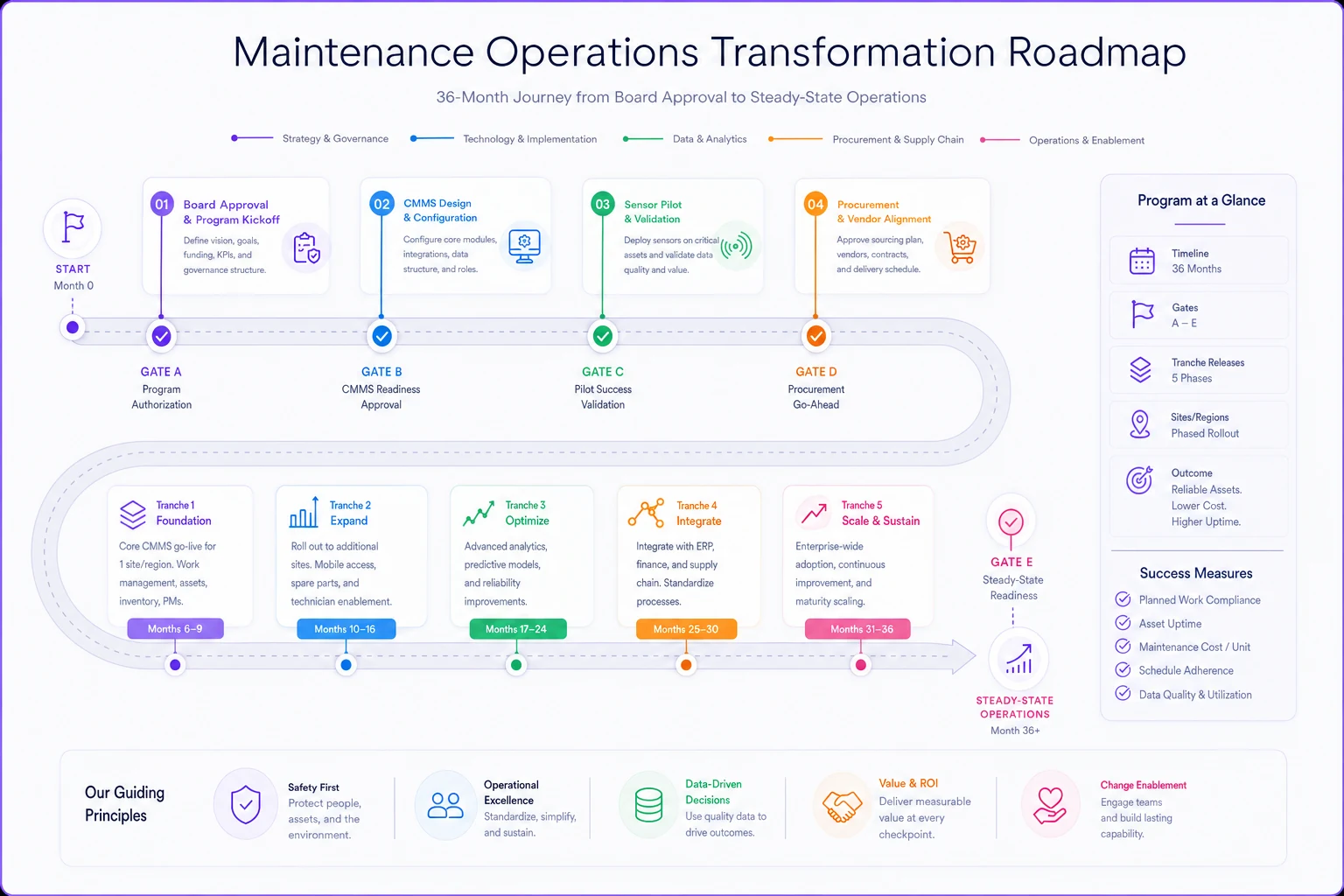
Use this to communicate the sequence to the board and align procurement timing with evidence gates.
How a single alert moves through the whole system
Following one event end to end makes the dependencies stop feeling abstract.
A vibration sensor on a supply fan at a pilot site crosses its warning threshold on a Tuesday afternoon. The sensor platform sends the event to the CMMS through the integration built in phase 1. The CMMS matches the sensor ID to the asset record, which only works because the asset hierarchy was cleaned up in phase 0. It checks whether an open work order already exists for that asset with the same symptom. If not, it generates a corrective work order at a priority set by the asset's criticality rating, also from phase 0.
The work order routes to the technician assigned to that building. The tech gets it on mobile, sees the trend chart attached, and checks the stocked bearings for that fan before heading out. On site, they confirm early bearing wear, replace it, and close the work order with a failure code, labor time, part used and a note.
That closed work order now does three more things. It feeds the analytics layer as a sensor-detected failure caught before breakdown, which is exactly what Gate C is trying to measure. It decrements parts inventory and may trigger a reorder. And it adds a data point to the asset's lifecycle record, which eventually informs whether the fan gets replaced in the capital plan.
Break any link and the chain fails silently. If the asset ID doesn't match, the alert sits in the sensor portal. If the work order is closed with "done" and no failure code, analytics can't count it. If the part wasn't in CMMS inventory, the tech makes a second trip. Nobody logs these as failures. They just see a pilot that "didn't show much."
That's the strongest argument for treating the four workstreams as one budget. Each link belongs to a different workstream, and funding three of four links gets you zero working chains.
Building the single budget request
Now the part that actually goes in front of the board.
The structure that tends to work is one program, one total envelope, released in tranches at gates. The board approves the full 36-month envelope as an authorization but releases only phase 0 and phase 1 funding up front. Each later tranche releases when a gate passes, after a defined review.
That does a few things at once. It shows the board you've thought about dependencies. It caps their downside, since a failed Gate C means they've spent maybe 40% of the envelope instead of all of it. And it removes the annual re-justification fight, because the gates are the justification.
A typical example
-
Tranche 1 (months 0–12) CMMS licensing with phased billing, implementation services, data cleanup labor (often a contract data specialist for 4–6 months), pilot sensor hardware for maybe 30–50 assets, integration work, training time. Roughly 40–45% of the total.
-
Tranche 2 (months 12–24) remaining CMMS cutover waves, legacy decommissioning, analytics capability (internal time or a part-time analyst), sensor expansion if Gate C passes. Around 35%.
-
Tranche 3 (months 24–36) fleet-level sensor rollout on proven asset classes, automation configuration, finance and procurement integrations. The remainder, sometimes less if earlier phases came in under.
Add a contingency, typically 10–15%, held at program level instead of split across workstreams. Splitting it is a common mistake: each workstream spends its own slice independently and nothing is left when integration work runs over (it usually does).
Internal labor is the cost that gets underestimated almost every time. Technician training hours, site lead time in workshops, the planner who spends half their week cleaning asset data for four months. If it's not in the request, it gets absorbed as overtime or just doesn't happen. Include it, even if finance treats it as a soft cost.
Running a gate review
Gates only work if they're run the same way every time. A workable process looks like this:
-
Two weeks before the gate, the program lead circulates the evidence pack: outcome metrics, data completeness figures, pilot results, budget spent versus planned, and open risks.
-
Site leads from the pilot sites review it first and flag anything that doesn't match ground reality. This step catches a lot of optimistic reporting.
-
The gate meeting itself runs no more than an hour. Present evidence against the pre-agreed exit criteria, not against new criteria invented the week before.
-
The decision is one of four proceed, proceed with conditions, extend the current phase with a fixed end date, or stop/pivot that workstream.
-
Procurement actions tied to the decision get triggered the same week, whether that's releasing an RFP, extending pilot terms, or giving notice.
-
The decision and its reasoning get written down in a short memo that goes back to the board and down to the sites. Same document, both directions.
That last step is where board-to-ground actually happens. If sites only hear "we're moving to phase 3" without the why, you're back to the translation problem.
What breaks as you scale from 3 sites to 15
Things that work at pilot scale tend to fall apart when the program spreads.
Gate criteria drift. At three sites the program lead knows every number personally. At fifteen, the evidence is aggregated, and averages hide a lot. A program can pass Gate D on good average numbers while four sites barely use the system. Site-level evidence has to stay visible even when the board summary rolls up.
Vendor dashboards become the de facto system of record. Once sensors are on hundreds of assets, the vendor's interface is genuinely useful, and site teams start working out of it instead of the CMMS. Within a year, half your condition-related work is undocumented in the CMMS. This needs an explicit rule: if it's work, it's a work order.
Procurement terms written for the pilot don't fit the fleet. Pricing, support levels and data-retention terms that were fine for 40 sensors become a problem at 600. The fix is negotiating the scale contract from real data in phase 3, but plenty of teams just roll the pilot contract forward because it's easier.
The program team runs out of capacity. Two people can drive three sites. They can't drive fifteen while also running analytics and managing vendors. Most roadmaps don't budget for the program team growing in phases 2–3, and the result is gates that slip because nobody had time to build the evidence pack.
Local workarounds multiply. Each site finds its own small way around the standard process. Individually harmless. Together they wreck the cross-site comparability that justified standardizing in the first place.
None of this shows up in year one. All of it shows up in year two.
Real scenario: a regional senior living operator
A senior living operator with 11 communities across two states had a pattern that probably sounds familiar. Over two budget cycles, the facilities director submitted a CMMS replacement, a temperature and HVAC monitoring proposal, and a reporting tool request as three separate items totaling a bit over $1.3M. The CFO funded the monitoring hardware and deferred the rest.
Sensors went onto walk-in freezers and rooftop units at most communities. Alerts went to email. Within about five months, the regional maintenance lead estimated that well under a third of alerts were being acted on, mostly because nobody could tell which ones mattered and there was no work order trail. Two freezer failures still ended in food loss even though alerts had fired hours earlier. The board started asking why they'd paid for monitoring at all.
The restructured request bundled everything into one 36-month program of roughly $1.8M–$1.9M, released in three tranches, with the existing sensors folded into the plan rather than written off. Phase 0 focused on asset cleanup at three communities and signing the CMMS with phased billing. In phase 1, the existing sensors at those three communities were integrated so alerts created work orders with criticality-based priority. Everywhere else, alerts were throttled to critical-only until those sites cut over.
By around month 14, the three pilot communities had gone from something like 55–60% of work orders closed with complete data to the high 80s. Unplanned HVAC calls at those sites dropped roughly 20–25% against their own baseline, and there were no refrigeration losses in that period, versus two or three a year before. Gate C passed on those numbers and the board released tranche 2 without the usual budget fight. The remaining communities cut over in two waves through month 22.
The sensor results weren't even the most interesting part. The CFO stopped treating maintenance tech requests as discretionary, because the gate memos gave finance a predictable way to see what was working.
When this approach makes sense (and when it doesn't)
When it makes sense
A gated, single-envelope roadmap fits best when you have multiple sites (roughly four or more), a CMMS that's either missing or end-of-life, and at least some appetite for condition monitoring on critical equipment. It also fits when leadership has been burned by tech projects that ran over, since the tranche structure answers that fear directly.
It works especially well if finance already does capital planning on multi-year horizons. They'll recognize the tranche logic immediately.
When it's a bad idea
If your CMMS is fine and adopted, and the real gap is one targeted sensor pilot, a 36-month program is overkill. Run the pilot on its own with a clear go/no-go and move on.
It's also a bad idea in the middle of a merger, a major restructuring, or a leadership change at the VP level. Multi-year programs need a stable sponsor. If the person who championed it at month 0 might be gone by month 9, shorten the horizon and make the first phase deliver something standalone.
And if your basic maintenance practices are shaky (PMs regularly missed, no consistent work order discipline), fix that first. Sensors on top of a reactive operation mostly produce more reactive work, just with better timestamps.
Who should NOT do this
Single-site operations, usually. The overhead of gates, tranches and cross-workstream sequencing pays off when there's scale to coordinate. One facility can sequence these things informally.
Teams without anyone who can own the program as a real part of their job. If the plan is for the facilities director to run this on top of everything else, it'll slip. Budget a program lead, even part-time, or don't start.
Organizations expecting predictive maintenance results in year one. If the board wants a big ROI number at month 12, this roadmap will disappoint them, because month 12 is when you're just starting to measure. Reset expectations first or pick a different approach.
Pre-submission checklist for the budget request
Before the request goes anywhere near the board, run it against this list.
-
Every workstream (CMMS, sensors, analytics, procurement) appears in the same document, with dependencies drawn explicitly
-
Total envelope stated, with tranche amounts and the gate that releases each one
-
Gate exit criteria written in measurable terms, agreed by the site leads who'll be measured
-
No sensor hardware purchase before asset data at pilot sites meets a stated threshold
-
CMMS contract terms include phased billing or site-based ramp
-
Sensor pilot terms are short or pilot-specific, with no scale commitment
-
Internal labor (training, data cleanup, site lead time) costed and included
-
Contingency held at program level, not split by workstream
-
Two or three outcome metrics defined, with a baseline or a plan to establish one in phase 0
-
Named program owner with real time allocated
-
A stated "stop" condition for at least one workstream, so the board can see you'd actually kill something
-
Legacy system decommissioning date included, not left open-ended
The "stop" condition is the item skipped most often, and it builds the most trust with finance. A board that sees you've written down what would make you quit is a lot more willing to believe you'll spend their money carefully.
The one-page executive brief template
This is the document that goes to the board or executive committee. One page, every gate. Same template from month 0 through month 36, so leadership learns to read it fast and can compare progress over time.
-
DECISION REQUESTED [One sentence. e.g., "Release Tranche 2 ($___) to proceed to Phase 2."]
-
OUTCOME METRICS (same 2–3 every brief) Metric Baseline Current Target at next gate Unplanned labor % of total [ ] [ ] [ ] WO close-out completeness [ ] [ ] [ ] Critical asset response time [ ] [ ] [ ]
-
GATE EXIT CRITERIA - STATUS [Criterion 1] Met / Partially met / Not met [one-line evidence] [Criterion 2] ... [Criterion 3] ...
-
WORKSTREAM STATUS (one line each) CMMS
[sites live / in cutover / remaining] Sensors: [assets instrumented, alerts → WO conversion rate] Analytics: [what we can now reliably measure that we couldn't before] Procurement: [contracts active, next commitment point]
-
BUDGET Authorized total
[ ] Released to date: [ ] Spent: [ ] Contingency remaining: [ ] Variance explanation (if >10%): [ ]
-
TOP 3 RISKS [Risk] → [Mitigation] → [Owner]
-
WHAT CHANGED ON THE GROUND [2–3 sentences in plain language from site level. What technicians/site leads are doing differently, and one concrete example.]
-
IF WE STOP HERE [What the organization keeps if the program halts at this gate. Protects against sunk-cost arguments in both directions.]
Section 7 is the one executives remember. A plain sentence like "technicians at the three pilot sites now get freezer alerts as work orders with temperature history attached, and the last two freezer issues were fixed before product was lost" lands better than any chart.
Section 8 is the blunt one. It forces the program to show that each phase leaves something durable behind, whether that's a clean asset register, a working CMMS or a validated pilot, even if the rest never gets funded. Boards approve multi-year programs more readily when they can see the exit value at each step.
Where operational software fits into all this
The coordination load in a program like this is mostly unglamorous: tracking which sites have passed data thresholds, compiling gate evidence from three or four systems, making sure sensor alerts actually become work orders, keeping procurement milestones tied to gate decisions. That's what eats a program lead's week.
This is where AI-assisted operational platforms earn their place, and not by doing anything magical. They take the repetitive assembly work off people. Flagging work orders closed without failure codes before they pollute the analytics. Pulling outcome metrics per site into the same format every month so the gate brief mostly builds itself. Catching duplicate alerts before they become duplicate work orders. Surfacing which sites are drifting from the standard process before it shows up in a bad gate result. When the workflow, the asset data and the evidence live in one place, the program team spends its time on decisions instead of spreadsheets.
It doesn't replace the sequencing logic. A platform can't tell you to delay sensor purchases until your asset data is clean. Once you've made that call, though, it makes it much easier to see when the threshold's been met.
Closing thoughts
Thirty-six months sounds long until you notice the first six are mostly data cleanup and the last twelve are mostly turning a project into a normal part of operations. The stretch that's actually transformative, where the CMMS goes live everywhere, sensors prove themselves or don't, and analytics start informing real decisions, is about eighteen months in the middle. Everything around it is what makes that middle work.
If you take one thing into your next budget conversation, make it this: the four pieces have to be asked for together, with the dependencies visible and the board holding the release lever at each gate. That's less exciting than a big upfront ROI pitch. It's also far more likely to still be funded in year two.
Start with the table. If you can fill in every cell honestly for your own operation, gate criteria included, you've got most of a roadmap already, and the brief template and budget structure mostly follow from it.
Thirty-six months sounds long until you notice the first six are mostly data cleanup and the last twelve are mostly turning a project into a normal part of operations. The stretch that's actually transformative, where the CMMS goes live everywhere, sensors prove themselves or don't, and analytics start informing real decisions, is about eighteen months in the middle. Everything around it is what makes that middle work.
Ready to optimize your maintenance operations?
Join 2,000+ facilities using Openfixit to reduce unplanned outages, extend asset life, and improve operational efficiency.