


Most multi-site maintenance orgs weren't designed. They accumulated. You opened a second location, hired a jack-of-all-trades to cover it, then a third site got a contractor because hiring took too long, and by the time you're at eight sites you've got a mess — one region has three techs and a supervisor while another runs on a single overworked lead and a rotating cast of vendors. Nobody drew this on purpose. It just grew.
That accidental structure works fine until it doesn't. The cracks show up as inconsistent response times between regions, wildly different labor costs per square foot, and the slow realization that you have no idea who's actually qualified to do what. When a key person quits, an entire site's institutional knowledge walks out with them.
This is about designing the org on purpose — the roles, the ladders people climb, the math behind how many bodies you actually need, and a decision framework for insource versus outsource that doesn't just default to whatever was cheapest last quarter.
The real problem isn't headcount — it's undefined roles
When people say "we're understaffed," they usually mean something more specific they haven't named yet. The pain is rarely a raw shortage of hands. It's that the hands you have are doing work that doesn't match their skill level, their pay, or the actual demand at their site.
A typical example: a Level 3 tech making around $34/hr spends half his week resetting tripped breakers and replacing air filters — work a Level 1 could handle. Meanwhile the Level 1 you hired to do exactly that is stuck escalating everything because nobody defined what he's cleared to touch. You're paying a premium for basic work and getting bottlenecked on the cheap stuff. That's not a headcount problem. That's a role-definition problem.
-
Skill mismatch — expensive people doing cheap work, or the reverse (which is worse, because it produces callbacks)
-
Accountability gaps — when everyone can do a little of everything, no one truly owns anything
-
Impossible planning — you can't calculate headcount if you can't define what a "unit of work" requires
Before you touch a headcount calculator, you need a taxonomy. What roles exist, what each one is responsible for, and where the boundaries sit.
A role taxonomy that actually holds up across sites
The trap is over-engineering. Some operators build a 14-role matrix that looks impressive in a slide deck and gets ignored on the floor because nobody can remember which title does what. Keep it tight. Most multi-site facility orgs run cleanly on five to seven role families.
Eliminate downtime with proactive maintenance.
Openfixit helps you plan, track, and complete maintenance efficiently—maximizing asset reliability.
- Centralized asset management
- Automated maintenance scheduling
- Inventory and parts tracking
No credit card required
Here's a taxonomy that holds up across a range of portfolio sizes:
| Role family | Core responsibility | Typical span | Sits where |
|---|---|---|---|
| Technician I (Generalist) | Routine PMs, filter changes, resets, minor repairs | Task-level | Single site |
| Technician II (Skilled trade) | HVAC, electrical, plumbing diagnostics and repair | Asset-level | Single site or shared |
| Technician III (Specialist/Lead) | Complex diagnostics, RCA, mentoring, vendor QA | Multi-asset / mentoring | Site or regional float |
| Site Supervisor | Daily scheduling, backlog triage, on-site accountability | One site | On site |
| Regional Manager | Standards, budgets, hiring, cross-site coordination | 4–10 sites | Regional |
| Reliability / Planner | PM optimization, capacity planning, spares strategy | Portfolio | Central |
| Program / Compliance | Calibration, inspections, audit readiness | Portfolio | Central |
Two things people consistently get wrong here.
First, they collapse the Planner role into the Regional Manager because "we're not big enough for a dedicated planner." The problem is that planning is proactive work and management is reactive work, and reactive work always wins when they live in the same head. The planner's job gets abandoned during the next crisis, which guarantees there will be another one. Even at six or seven sites, a part-time planning function that's protected from firefighting pays for itself.
Second, they forget to define the regional float — the Level 3 who covers gaps across sites. This role is the pressure valve for the whole system. Without it, every vacation, sick day, or demand spike gets patched with overtime or an emergency contractor call. More on why the float role changes your headcount math below.
Competency ladders: what separates each level
A role taxonomy tells you what exists. A competency ladder tells people how to move up — and just as importantly, it gives you an objective basis for scheduling and pay decisions.
The mistake most operators make is defining levels by years of experience. "Level 2 requires 3 years." That's lazy, and it produces techs who've been mediocre for a long time. Define levels by demonstrated competencies, not tenure.
A competency ladder is really three things stacked together:
-
Technical competencies — what asset classes and repair types they're cleared to work on unsupervised
-
Autonomy level — what they can decide and execute without escalating
-
Coordination scope — whether they only do work, plan work, or direct others' work
Here's what a practical ladder looks like written in terms of demonstrated capability:
-
Level I → II Can independently diagnose and repair at least two trade areas (e.g., basic HVAC + electrical) to a defined quality standard, verified by a lead's sign-off on roughly 15–20 completed work orders with no callback within 30 days.
-
Level II → III Can lead a root-cause investigation, produce a corrective action, and mentor a Level I through a repair. Demonstrates clean documentation on mobile — which, in practice, is where a lot of promotions stall, because the tech is great with a wrench and terrible at recording what he did.
-
Level III → Supervisor Can build and balance a weekly schedule across a backlog, run a daily triage, and manage vendor quality on site.
That documentation gap deserves real attention, because it quietly wrecks the whole ladder. If your promotion criteria include clean data capture but your field workflow makes logging a pain, you'll never promote anyone honestly. A solid mobile technician adoption plan with role-based workflows matters here — the ladder assumes the field data is trustworthy, and it won't be unless the tools make capturing it faster than not capturing it.
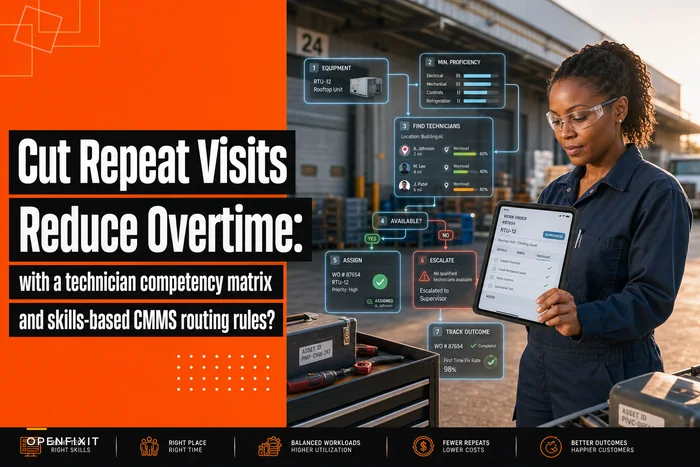
The competency ladder also feeds directly into how work gets routed. Once levels are defined by real capability, you can stop guessing who gets which job. A well-built technician competency matrix with skills-based routing rules turns the ladder from an HR document into a live operational tool — the system knows a given work order needs a Level II with HVAC clearance and routes accordingly, instead of dumping it on whoever's closest.
The headcount calculator — and why gut-feel staffing fails at scale
Staffing by feel works at one or two sites because the manager can see everything. It falls apart around the fourth site, because no single person has visibility into the total load anymore, and "I feel like we're slammed" stops being a plannable input.
The fix is a demand-based calculation, not a ratio pulled from an industry benchmark. Benchmarks like "one tech per 100,000 sq ft" ignore asset density, age, and PM intensity — a 100,000 sq ft warehouse and a 100,000 sq ft hospital are not remotely the same maintenance load.
-
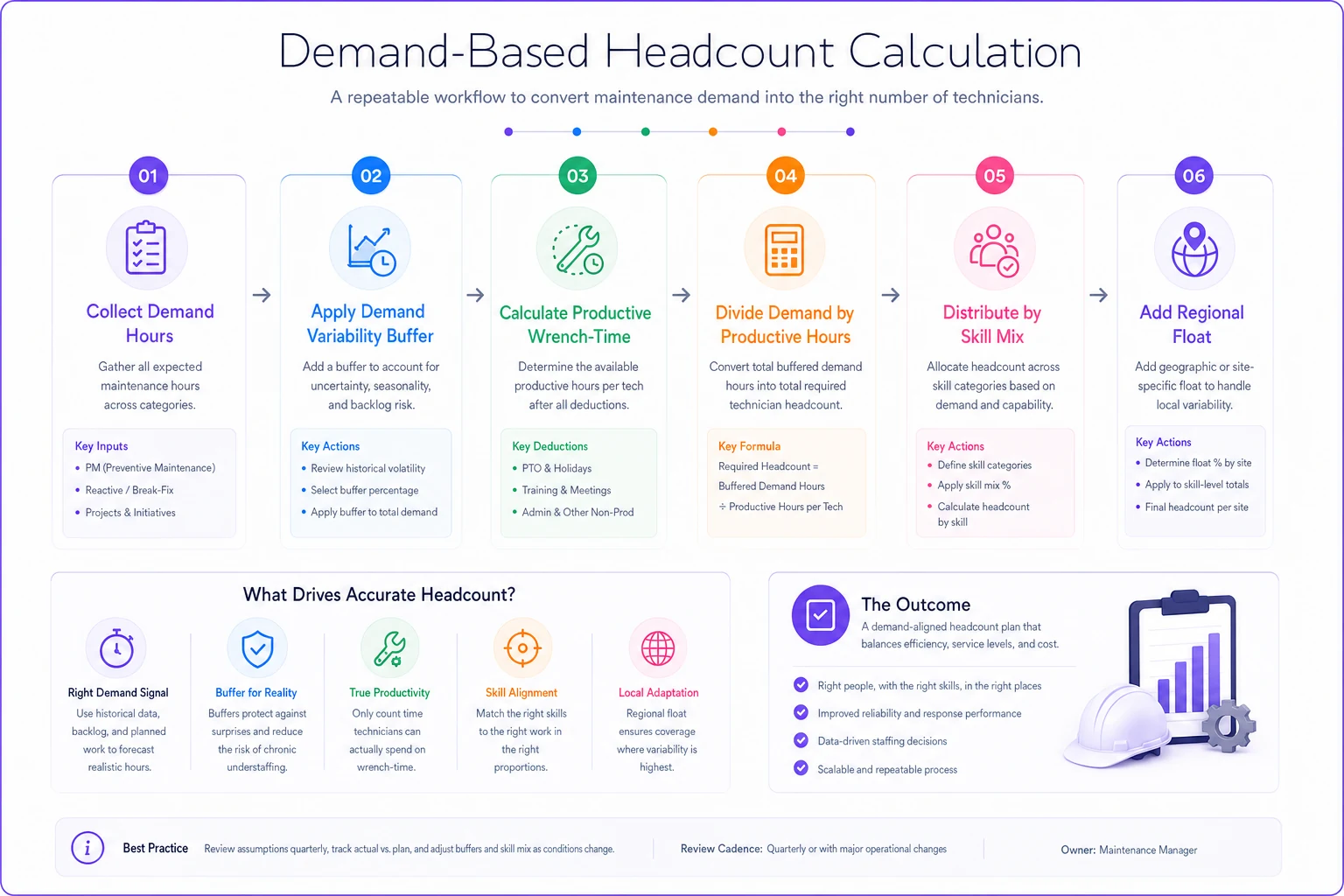
Total the annual labor hours of demand. Add up PM hours (from your PM schedules), average corrective/reactive hours (from work order history), and project/improvement hours. Pull this from real completed-work data, not estimates.
-
Add a demand variability buffer. Reactive work isn't smooth. If your monthly reactive hours swing ±25%, you can't staff to the average or you'll be underwater half the year. Staff closer to the 70th–75th percentile of demand and use the float role plus contractors for peaks.
-
Convert to available productive hours per tech. A full-time tech does not give you 2,080 productive hours. Subtract PTO, training, travel between sites, admin, and unproductive gaps. Realistically you're looking at somewhere around 1,400–1,600 productive wrench-time hours per year per tech. Using 2,080 is the single most common reason orgs come out chronically understaffed on paper.
-
Divide and distribute. Total demand hours ÷ productive hours per tech = raw headcount. Then distribute by skill mix, not just total number — you might need 6 heads but the split matters enormously.
-
Layer in the float. Add regional float capacity sized to your absence and spike rate, typically one float per 4–6 sites depending on geography.
The workflow below shows the demand-based headcount calculation process.
For the deeper version of this modeling with the variability math worked out, the demand-driven capacity planning model for multi-site teams goes through it in detail. The org-design point here is simpler: your role taxonomy and your headcount math have to be the same conversation. You can't calculate how many people you need until you've defined what a "person" is at each level.
A quick worked example
Take a five-site retail portfolio. Pulling a year of completed work orders, total demand comes out to roughly 11,800 hours — about 4,200 PM, 6,100 reactive, and the rest projects. At the 75th percentile to absorb variability, call it around 12,900 planning hours.
At 1,500 productive hours per tech, that's roughly 8.6 techs of raw demand. Round to 9, but the skill split reveals the real story: most of the reactive volume is HVAC and electrical, so you need at least three or four Level II/III bodies, not nine generalists. Add one regional float across the five sites. The org that "felt" like it needed a couple more generalists actually needed to upskill two existing techs and add one specialist — a very different and often cheaper answer than blanket hiring.
Insource vs. outsource: a decision matrix, not a reflex
The default failure here is deciding by inertia. Whatever got outsourced when you were small stays outsourced forever, even after the volume justifies bringing it in-house. And vice versa. Nobody re-examines it.
Outsourcing decisions should be driven by four variables: workload volume/predictability, skill rarity, risk/compliance sensitivity, and geographic density.
| Factor | Lean insource when… | Lean outsource when… |
|---|---|---|
| Volume & predictability | Steady, high-frequency work | Spiky, seasonal, or one-off |
| Skill rarity | Skill is core and used constantly | Highly specialized, used rarely |
| Risk / compliance | Errors carry high liability or IP | Standardized, low-differentiation work |
| Geographic density | Sites clustered, easy to cover | Sites remote or isolated |
| Cost at volume | Utilization would run high | Utilization would be low |
The insight most operators miss: utilization is the hinge. A specialized skill used 5 hours a month should never be a full-time hire — that person is idle most of the time and you'll invent make-work to justify the salary. But a "specialized" skill that turns out to be needed 25 hours a week across the region is quietly costing you a fortune in contractor markups, and bringing it in-house pays back fast.
Run the actual utilization number before deciding. If a contractor is billing 90+ hours a month of the same recurring work at a marked-up rate, you're often past the break-even point where an in-house hire is both cheaper and more accountable.
When insourcing is a bad idea
Don't insource specialized, low-frequency, high-liability work just to feel in control. Elevator maintenance, fire suppression certification, refrigerant recovery on large systems — these need certifications, specialized tooling, and carry real regulatory exposure. Keeping a rarely-used specialist on payroll to cover them almost never pencils out, and you inherit the compliance risk instead of transferring it. Outsource these and manage them through strong vendor governance.
Who should NOT restructure right now
If you're mid-crisis — backlog exploding, key people leaving, a major site failure in progress — this is not the moment to redraw the org chart. Stabilize first. Org redesign requires clean work-order data to calculate demand, and if your data is a mess (missing labor hours, uncoded work orders, no asset hierarchy), your headcount math will be garbage in, garbage out. Fix the data foundation before you build the org on top of it.
Regional enablement: the layer everyone forgets
Here's what breaks specifically at scale, past the point of one region: standards drift. Each region quietly evolves its own way of doing things — different PM procedures, different vendors, different definitions of what "Level II" even means. Within a couple of years you have five orgs wearing one company's name, and cross-site benchmarking becomes impossible because you're not measuring the same things.
-
A shared competency ladder that means the same thing in every region (a Level II in the Northeast is a Level II in the Southwest)
-
Standardized PM libraries and procedures so a float tech can walk into any site and get to work
-
Central planning and compliance functions that set the standard, with regional managers executing it
-
Consistent onboarding and training milestones so promotions are earned the same way everywhere
The organizations that scale cleanly treat their central team as enablers of consistency, not as a headquarters that issues edicts. Regional managers own execution; central functions own the standard. Blur that and you get either chaos or paralysis.
Training milestones tied to the ladder
A competency ladder without a training pathway is just a wish. If you tell someone "get to Level II" but there's no structured way to build those competencies, you're relying on osmosis — and osmosis produces uneven, slow, unpredictable development.
-
First 30 days (new Level I) site orientation, safety clearances, asset familiarization, shadow roughly 10 work orders, demonstrate clean documentation on 5 solo jobs
-
90 days cleared to work assigned asset classes unsupervised, first coverage of an absence, baseline productivity established
-
6–12 months (I → II track) second trade competency demonstrated, callback rate under threshold, ready for skills-based routing on those assets
-
Ongoing (II → III) lead first RCA, mentor a new hire through a full repair, own vendor QA for one asset class
The pattern worth noting: training milestones and headcount planning are the same system viewed from different angles. Your float and upskilling strategy depends on people actually moving up the ladder on a predictable timeline. If nobody's progressing, your headcount model stalls — you can't upskill your way out of a specialist shortage if there's no pipeline. The milestones aren't an HR nicety. They're a supply mechanism for the skill mix your capacity math says you need.
A short real scenario
A regional operator running seven light-industrial sites had grown to 14 maintenance staff, almost entirely generalists, plus heavy contractor spend on HVAC. Labor costs looked reasonable per head, but overtime was running hot — somewhere in the $8k–$11k range per month across the portfolio — and HVAC callback rates were embarrassing because the generalists were out of their depth and the good contractors were booked out.
They ran the demand math and found two things. First, HVAC reactive hours were high and steady enough to justify two dedicated in-house Level II HVAC techs — the contractor billing had quietly crept past the break-even point without anyone noticing. Second, they had no float, so every absence turned into overtime.
The redesign: convert two generalists into HVAC-focused Level IIs through a structured training pathway, hire one regional float, and pull recurring HVAC work in-house while keeping contractors for peaks and specialized refrigerant work. Over the next two quarters, overtime dropped by roughly half, HVAC callbacks fell noticeably, and total labor-plus-contractor spend came down even with the added float — because they stopped paying markup on predictable recurring work. Same rough headcount, completely different structure.
Pulling it together
Maintenance organization design isn't an org chart exercise you do once and frame on the wall. It's a system where four pieces have to move together: the role taxonomy defines what work each person owns, the competency ladders define how people grow into those roles, the headcount math tells you how many of each you need based on real demand, and the insource/outsource matrix decides what lives inside the org versus outside it.
Regional enablement keeps all of that consistent across sites, and training milestones keep the pipeline flowing. Change any one piece and the others shift — add sites and your float ratio changes, upskill your techs and your contractor mix changes, tighten your role definitions and suddenly your headcount answer looks different.
The operators who scale well aren't the ones with the most people. They're the ones whose structure was designed to change on purpose as they grew, instead of accumulating by accident until something broke.
The operators who scale well aren't the ones with the most people. They're the ones whose structure was designed to change on purpose as they grew, instead of accumulating by accident until something broke.
Ready to optimize your maintenance operations?
Join 2,000+ facilities using Openfixit to reduce unplanned outages, extend asset life, and improve operational efficiency.